
TestHub Team
Why PYQs Are the Most Underrated Tool in Your JEE 2027 Preparation
Everyone tells you to take mock tests. Almost no one tells you to build your entire strategy around previous year questions first. Here's what changes when you flip that order.
Over 15.38 lakh students appeared for JEE Main 2026 across both sessions. Almost all of them solved mock tests. Very few of them treated previous year questions as their primary study tool instead of an afterthought squeezed in during the last month. If you're preparing for JEE Main or Advanced 2027 or 2028, this one shift in approach is worth more than another coaching module or another 50-hour week.
Table of content:
Why PYQs Get Ignored?
Quality Over Quantity: Why Fewer Questions Teach You More
How to Actually Use PYQs (Not Just Solve Them)
PYQs vs Mock Tests: They're Not the Same Tool
JEE Advanced Needs a Separate PYQ Strategy
Conclusion
Why PYQs Get Ignored?
Most students follow the same sequence: finish NCERT, complete coaching modules, then start Jee main and advanced mock tests 2027 somewhere in the final few months. PYQs show up on this list too, but usually as revision material, not as a teaching tool. That's backwards. A mock test is written by faculty trying to guess what JEE might ask.
A PYQ is a question JEE actually asked. It has already been vetted for difficulty, calibrated against a real exam, and proven to represent what students genuinely face on exam day. There are over 14,000 JEE Main PYQs available from 2002 onward, and most individual chapters have somewhere between 30 and 80 of these questions from the last decade.
That's a small, high-signal dataset. Fifty real exam questions from one chapter teach you more about how that chapter is actually tested than 200 generic practice problems ever will.
Quality Over Quantity: Why Fewer Questions Teach You More
Most chapters only have 30 to 80 PYQs from the last decade, a much smaller number than the hundreds of practice problems in a typical coaching module. That's not a weakness, it's the whole point. Every one of those 30 to 80 questions is something JEE has actually asked, which means zero wasted effort.
Fifty PYQs from a chapter will teach you more about how that chapter gets tested than 200 generic textbook problems, simply because they've already proven themselves on the real exam. There are over 14,000 JEE Main PYQs available from 2002 onward, so this isn't a shortage of material, it's a smarter allocation of the material that exists.
This advantage compounds when you apply it consistently. A student who solves PYQs for every chapter right after finishing it builds something a last-minute PYQ sprint can't replicate: by the time mock test season starts, they're not discovering the exam pattern for the first time.
They already know it, chapter by chapter, because they anchored each topic to real questions as they went. Students who wait until the final two months to touch PYQs are essentially trying to learn the pattern and build speed at the same time, a much harder combination than doing them separately, early.
How to Actually Use PYQs (Not Just Solve Them)?
The mistake isn't skipping PYQs entirely. It's solving them at the wrong time and without a system. Here's a simple table to fix that:
When to Solve PYQs | What to Do | Why It Works |
Right after finishing a chapter's theory | Solve all available PYQs for that chapter, year by year | Understands the real exam pattern before incorrect habits form |
During revision cycles | Re-solve only the PYQs you got wrong earlier | Strengthens weak areas and improves retention |
Final 60 days before the exam | Attempt timed, mixed-chapter PYQ sets | Builds exam-day speed, accuracy, and subject-switching ability |
Solving PYQs chapter-wise, right after you finish that chapter's theory, is far more useful than saving them for a "revision phase" three months later. You catch pattern gaps while the concept is still fresh, and you correct your understanding before it hardens into a wrong habit. This is also where TestHub's PYQ practice tool becomes useful, it's organized by chapter and year, so you can solve a chapter's full PYQ history the moment you're done with theory, instead of hunting through scattered PDFs.
PYQs vs Mock Tests: They're Not the Same Tool
This is where a lot of aspirants get confused. Mock tests and PYQs solve different problems, and treat them as interchangeable wastes both.
Tools | Best used for | Limitation |
PYQs (JEE Main) | Learning the exact pattern, difficulty level, and recurring concepts of a chapter | Finite in number; won't build raw exam-day stamina alone |
PYQs (JEE Advanced) | Building tolerance for multi-step reasoning and multi-correct answer formats | Fewer papers overall since Advanced has a shorter history than Main |
Mock Tests | Simulating full exam conditions, timing, stamina, subject-switching | Written by faculty, so difficulty and style can drift from the real exam |
A reasonable target across a full preparation cycle looks like this: complete chapter-wise PYQs for every topic as you finish it, then layer in 25 to 40 full mock tests once your base is solid. TestHub's mock test series, built on 1000+ exam-pattern tests with detailed solutions, works well specifically because it's meant to follow PYQ-based concept clarity, not replace it.
JEE Advanced Needs a Separate PYQ Strategy?
Students preparing for both exams often study using one approach, and this is where most Advanced attempts fall short.
JEE Advanced PYQs are structurally different from JEE Main PYQs.
Advanced questions introduce multi-correct MCQs, partial marking, and multi-step problems that require you to reason through something you've never seen before, not just apply a formula you recognize. If you only solve Main PYQs, you'll walk into Advanced underprepared for that format shift.
The fix is to treat Advanced PYQs as a separate, additional layer: once your Main-level PYQ practice for a chapter is solid, go back and solve that same chapter's Advanced-level PYQs specifically for depth. Calculus, Coordinate Geometry, and Electrostatics deserve this treatment first, since they carry disproportionate weight in both exams.
This is also why TestHub separates PYQ practice by exam level at testhub.in/pyq, so you're not accidentally treating a Main-level question bank as Advanced preparation.
Conclusion
PYQs aren't a shortcut and they aren't optional revision material, they're the most direct evidence of what JEE actually tests. Students preparing for 2027 and 2028 who build their chapter-wise study around PYQs first, then layer in mock tests, consistently walk into the exam with a clearer sense of what to expect. Start that sequence now, one chapter at a time, and let the real exam data do the guiding instead of guesswork.
Start Solving PYQs the Right Way
Practice 50,000+ previous year questions, sorted by chapter and year, right after you finish each topic.
Frequently Asked Questions
Common questions readers ask about this topic.
Why are PYQs more important than mock tests for JEE preparation?
PYQs are actual questions that appeared in JEE, already vetted for difficulty and calibrated to the real exam pattern. Mock tests are written by coaching faculty attempting to simulate that difficulty, which means they can sometimes drift toward unrealistic difficulty levels. PYQs teach you the real pattern; mock tests build exam-day stamina on top of that pattern.
When should I start solving JEE PYQs?
Start right after finishing a chapter's theory, not during a separate "revision phase" later. Solving PYQs immediately shows you how that chapter is actually tested and helps correct misunderstandings before they become fixed habits.
How many JEE Main PYQs are available to practice from?
There are over 14,000 JEE Main PYQs available from 2002 to 2025, with most individual chapters having between 30 and 80 questions from the last decade alone.
Do I need to solve JEE Advanced PYQs separately from JEE Main PYQs?
Yes. JEE Advanced PYQs test multi-correct answer formats, partial marking, and multi-step reasoning that JEE Main PYQs don't cover. Solving only Main-level PYQs leaves a real gap if you're also targeting Advanced, so treat Advanced PYQs as a separate, additional practice layer once your Main-level pattern recognition is solid.
More on the blog
2 Sept 2026 · TestHub Team
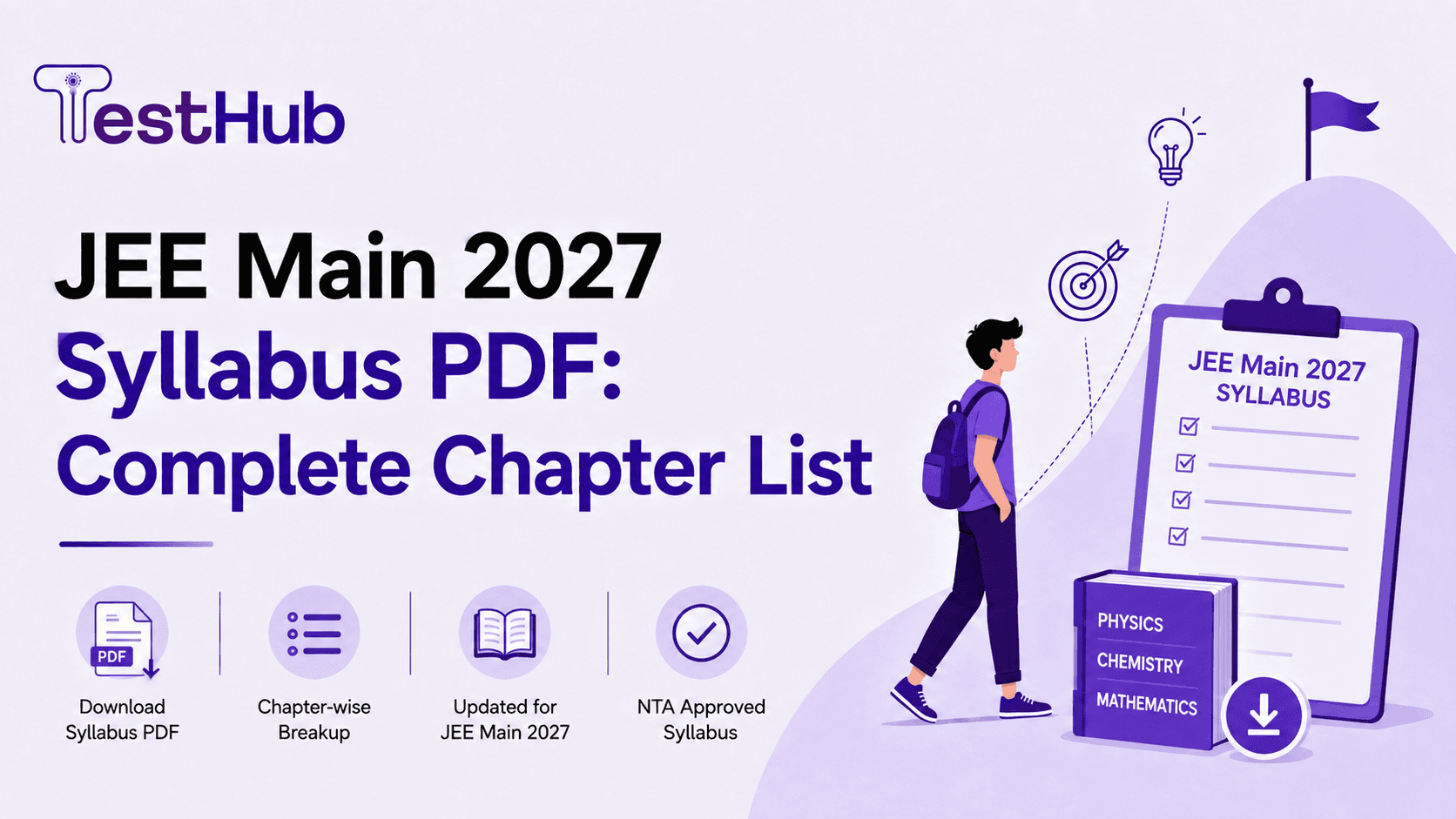
JEE Main 2027 Syllabus PDF: Complete Chapter List
Get the complete JEE Main 2027 syllabus chapter-wise for Physics, Chemistry, and Mathematics, along with the exam pattern, removed topics, and practical preparation tips to plan your JEE Main 2027 preparation effectively.
29 Aug 2026 · TestHub Team
TestHub AI Analysis: How Smart Analytics Fix Your Mistakes Faster
TestHub’s AI-powered mock test analysis goes beyond your score to identify chapter-wise weaknesses, time-management issues, conceptual and calculation errors, and performance trends—helping you turn every mock test into a clear, actionable plan for improvement.
26 Aug 2026 · TestHub Team
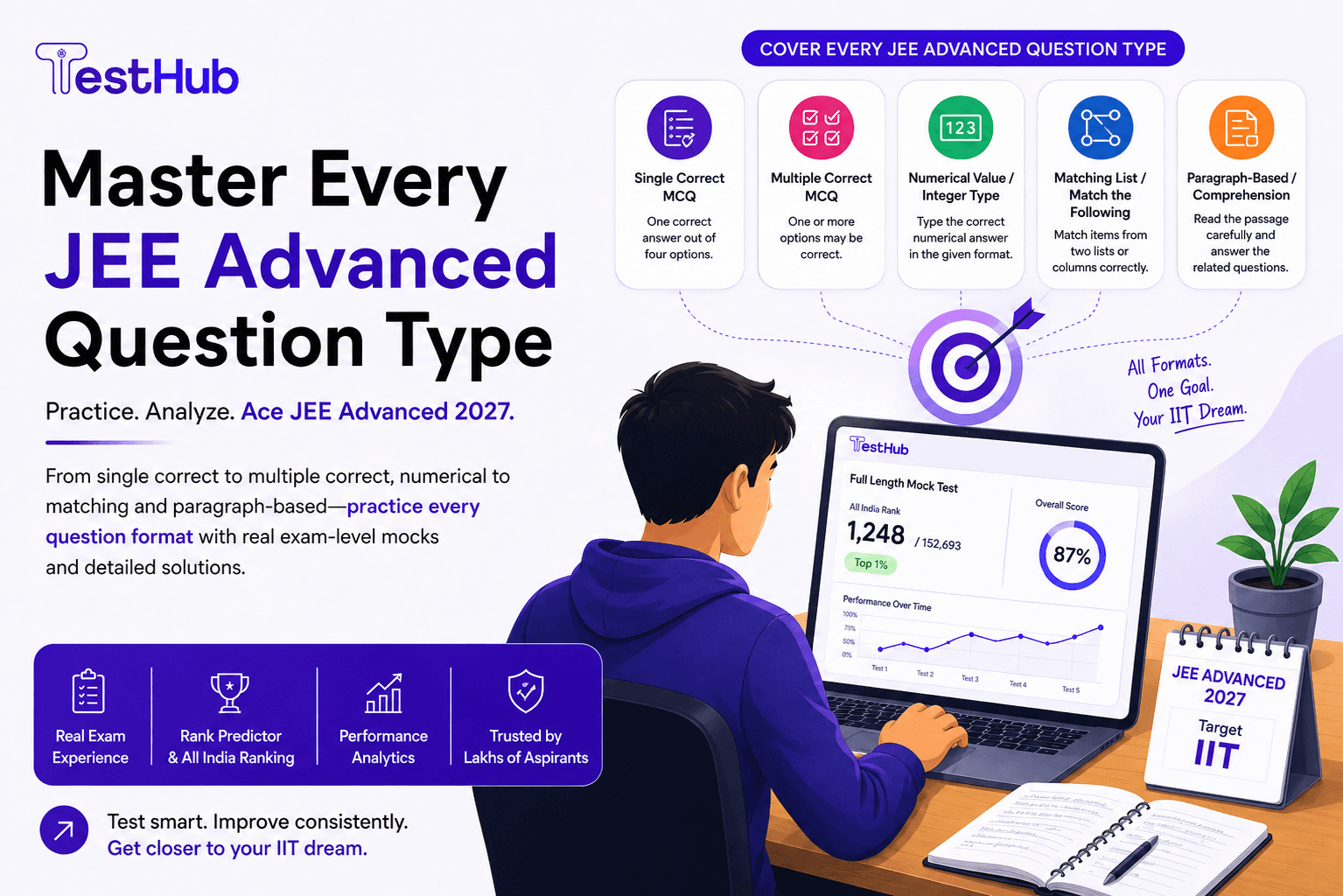
Types of Questions in JEE Advanced: A Complete Breakdown (2027 Guide)
JEE Advanced tests more than subject knowledge - it tests how well you handle different question formats, marking schemes, and strategic risks. This guide covers every major JEE Advanced question type, including single-correct, multiple-correct, numerical, matching, and paragraph-based questions, with practical strategies for approaching each.
26 Aug 2026 · TestHub Team
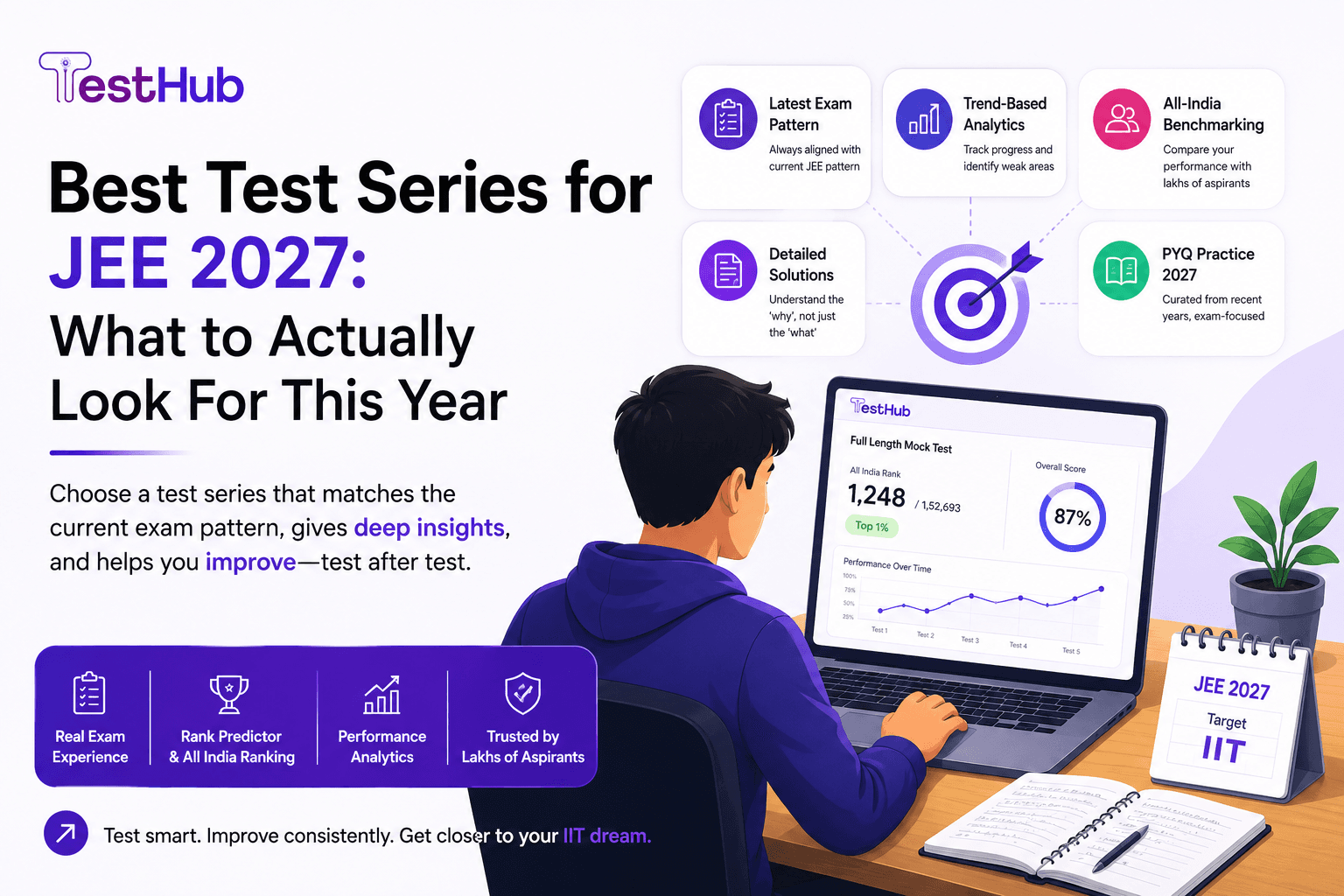
Best Test Series for JEE Main 2027
Choose the right JEE 2027 test series by focusing on current exam patterns, detailed solutions, trend-based analytics, All-India benchmarking, and relevant PYQ practice - not just the number of tests offered.
17 Aug 2026 · TestHub Team
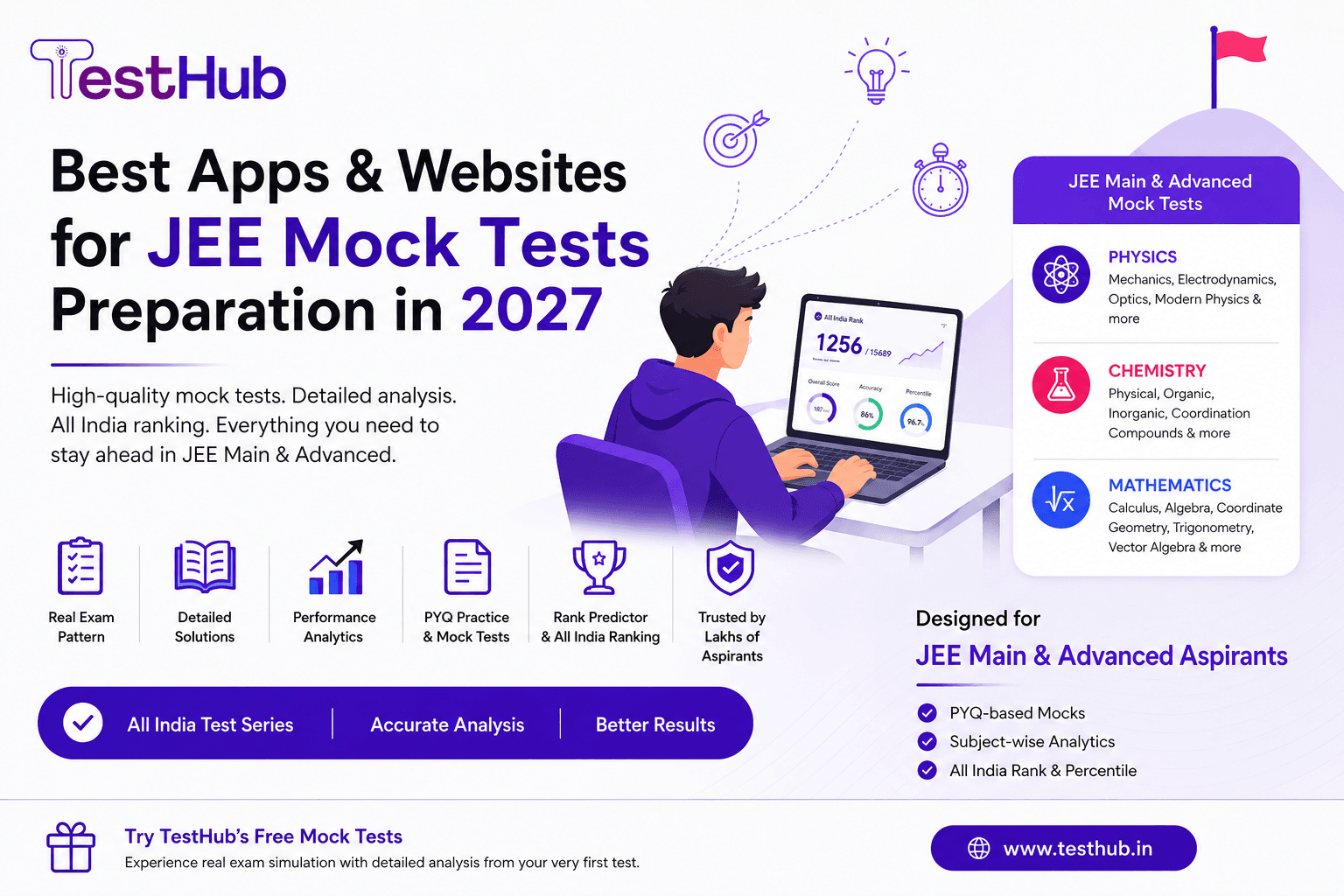
Best Apps and Websites for JEE Mock Tests Preparation (2027 Guide)
Choosing the best JEE mock test app depends on your preparation stage and what you actually need from a testing platform. This guide compares the major categories—from coaching apps and free PYQ platforms to dedicated mock test websites—and explains how to choose the right option for JEE Main and Advanced preparation.
12 Aug 2026 · TestHub Team
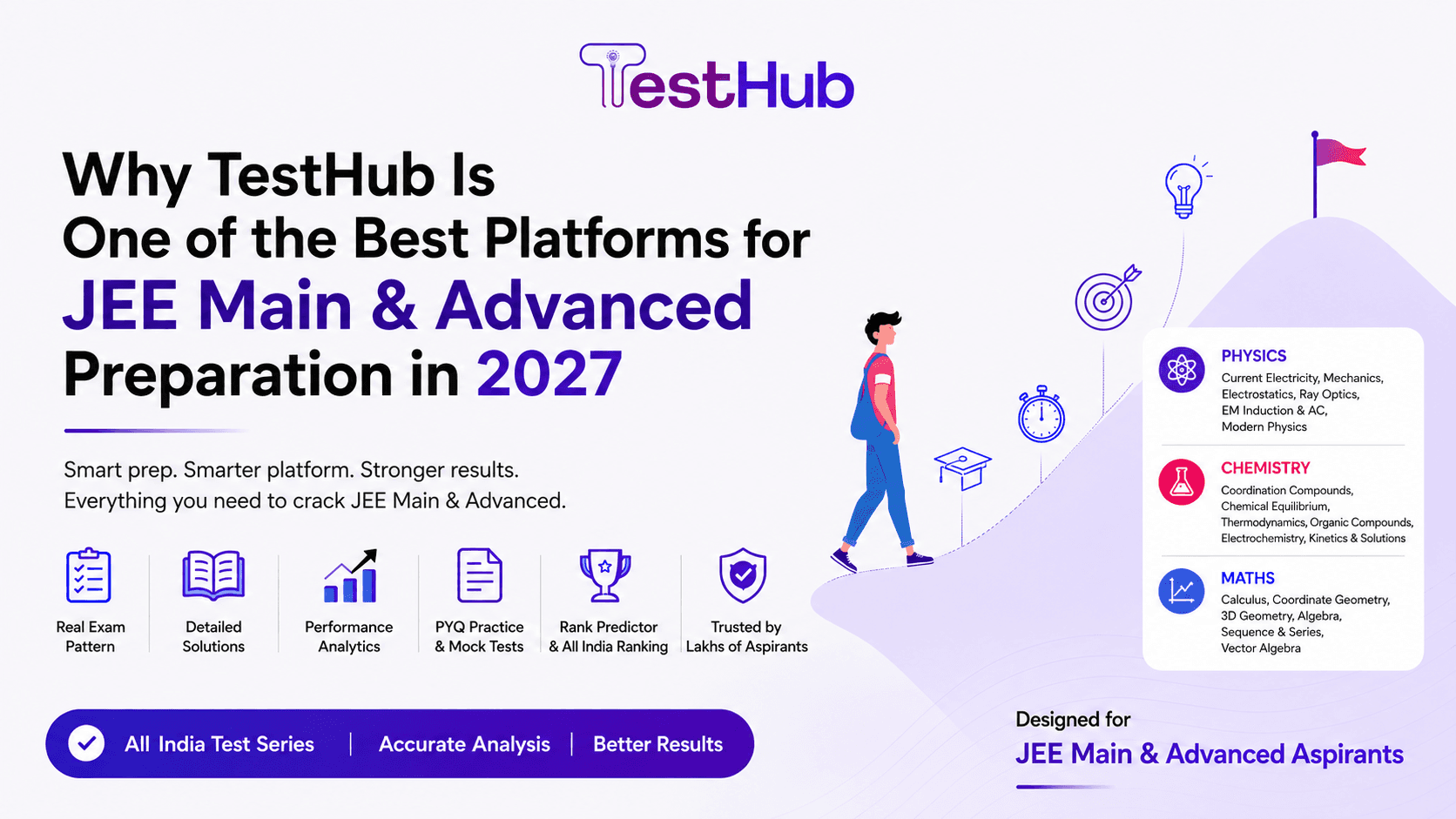
Why TestHub Is One of the Best Platforms for JEE Main & Advanced Preparation in 2027
TestHub is a JEE-focused preparation platform offering All-India test series, detailed solutions, performance analytics, PYQs, a 50,000+ question bank, and rank prediction to help JEE Main and Advanced aspirants prepare smarter and improve their performance