

TestHub Team
JEE 2027 Dropper Strategy: The Only Guide You'll Ever Need
A complete TESTHUB JEE 2027 dropper strategy covering attempt analysis, subject-wise prep, PYQs, and a month-by-month plan to help droppers fix past mistakes and improve their rank.
Dropping a year for JEE takes courage. But here's the hard truth: most droppers don't improve their score not because they lack intelligence but because they repeat the same mistakes with a fresh timetable. This guide covers everything you need: strategy, a subject-by-subject plan, a daily schedule, a PYQ approach, and the real reasons droppers fail.
Table of Contents:
Before anything else: audit your last attempt
JEE 2027 Dropper Strategy: What the Toppers Actually Do
Subject-wise preparation tips for JEE 2027
The Importance of PYQs in JEE 2027 Preparation
Month-by-month study plan for JEE 2027 droppers
Why do droppers often fail to improve their score?
Before anything else: audit your last attempt
Before jumping into books and lectures, spend the first few days analysing your previous JEE attempt honestly. Go through your scorecard and question papers chapter by chapter to identify exactly where you lost marks. Was it due to weak concepts, poor time management, calculation mistakes, lack of revision, or chapters you never prepared properly?
List your weakest three chapters in each subject. These get the most time in Phase 1.
Break the syllabus into monthly chapter targets rather than vague goals like "finish Physics."
Start each day by doing a 20-minute revision of yesterday's work before touching anything new.
Switch subjects every 90 minutes to stay sharp and avoid mental fatigue mid-session.
Never go to bed without quickly reviewing what you covered that day; even 10 minutes helps retention dramatically.
Keep one day a week, ideally Sunday, for revision and self-assessment only. No new topics that day.
JEE 2027 Dropper Strategy: What the Toppers Actually Do
This is not about studying 14 hours a day. It is about studying the right things, in the right order, and actually retaining them. Here is what works:
Before anything else, go through the complete JEE 2027 syllabus and mark the chapters that carry real weight in the exam.
Strengthen your fundamentals before moving to advanced-level questions, as strong basics make problem-solving much easier.
Get your basics right before jumping into JEE-level problems. A shaky foundation means every hard question will feel harder than it actually is.
Make a short formula sheet for each chapter as you finish it and revise it every morning. Ten minutes of daily revision beats one hour of last-minute cramming.
Write down every mistake from your practice sessions, TESTHUB mocks test, and PYQs. Not to feel bad about them but to make sure you never repeat them.
Solve questions from all three subjects every single day. Skipping even one subject for a few days breaks the rhythm, and it takes time to rebuild it.
Focus on understanding concepts and applying them rather than memorising solutions.
Track your progress regularly and adjust your study plan whenever required.
Complete chapter-wise PYQs after every topic to understand the actual exam pattern and important concepts.
Stick to a limited number of trusted resources instead of constantly switching between different books and materials.
Take regular mock tests through a reliable test series like TestHub to track progress, improve speed, and identify weak areas early.
Subject-wise preparation tips for JEE 2027
Physics
Physics in JEE tests your conceptual depth more than your calculation speed. Most students try to memorise formulas without understanding derivations, and that is exactly why they fail on questions that combine two concepts.
How to study physics the right way:
Master fundamental concepts before jumping into advanced questions. Clarify the basic concepts from NCERT and HC Verma.
Give extra attention to high-weightage topics like mechanics, electrodynamics, modern physics, optics, and thermodynamics.
Solve numerical problems daily to improve accuracy and calculation speed. Use DC Pandey for JEE-level multi-concept problems
Maintain a separate notebook for formulas, shortcuts, and frequently made mistakes.
Do all PYQs chapter-wise so that it will help you understand question patterns.
Revise important formulas and graphs every week to avoid forgetting them.
Chemistry
Chemistry can significantly improve your overall rank if prepared strategically. Since many questions are direct, regular revision is more important than repeatedly studying new content.
Physical Chemistry: Practice numericals daily. Chapters such as Electrochemistry, Chemical Kinetics, and Thermodynamics require consistent revision throughout the year.
Organic Chemistry: Focus on reaction mechanisms, not individual reactions. If you understand why a reaction happens, you can predict answers to questions you've never seen before.
Inorganic Chemistry: This is pure NCERT territory. Read it, revise it, and make short notes. There is no shortcut here, but it's one of the most rewarding areas if you're consistent.
Revise completed chapters every week to improve long-term retention.
Keep a formula and reaction sheet for quick daily revision.
Solve chapter-wise and topic-wise questions to identify weak areas.
Mathematics
Mathematics is either your biggest strength or your biggest liability. Priority areas by weightage:
Strengthen Algebra, Calculus, Coordinate Geometry, and Trigonometry first.
Learn the application of formulas instead of memorising them mechanically.
Solve questions with different difficulty levels from each chapter.
Maintain a notebook of important concepts, tricks, and frequently repeated question patterns.
Work on calculation speed and accuracy through regular timed practice.
Identify weak chapters early and allocate extra practice sessions to them.
The Importance of PYQs in JEE 2027 Preparation
Previous Year Questions (PYQs) are one of the most valuable resources for JEE preparation, yet many droppers don't use them enough. JEE Main and Advanced follow a specific pattern of testing concepts and problem-solving skills. While mock tests are important, nothing reflects the actual exam better than previous years' papers. PYQs help you understand the level of questions, important topics, and the way concepts are applied in the exam.
They also help you identify recurring patterns. JEE may not repeat the same questions, but it often tests similar concepts in different ways. The more PYQs you solve, the easier it becomes to recognise these patterns on exam day.
01 Chapter-wise PYQs right after finishing each chapter (from 2010 onwards) | 02 Full-length PYQ papers in 3-hour timed sessions from December onward | 03 Maintain an error journal: concept tested, why you failed, correct approach | 04 Frequency analysis: identify high-weightage chapters from PYQ patterns |
Month-by-month study plan for JEE 2027 droppers
Phase 1: Foundation & Concept Rebuilding (June - Aug)
Month | Physics | Chemistry | Maths |
June | Units & Dimensions, Kinematics, NLM, Friction | Mole Concept, Atomic Structure, Chemical Bonding | Sets, Relations, Quadratic Equations, Complex Numbers |
July | WEP, COM, Rotational Motion, Gravitation | GOC, Hydrocarbons, Haloalkanes, Chemical Equilibrium | Limits, Continuity, Differentiation, Application of Derivatives |
August | Electrostatics, Capacitors, Current Electricity | Inorganic (p-block), Chemical Kinetics, Electrochemistry | Integral Calculus (Indefinite + /Definite), Area under Curves |
Phase 2: Advanced Problem-Solving & Mocks Begin (Sept - Nov)
September | Magnetism, EMI, Alternating Current | Thermodynamics, Solutions, Coordination Compounds | Straight Lines, Circles, Parabola, Ellipse |
October | Optics (Ray + Wave), SHM, Waves | Aldehydes, Ketones, Carboxylic Acids, Amines | Vectors, 3D Geometry, Probability, P&C |
November | Modern Physics, Semiconductor, Communication | Biomolecules, Polymers, d&f block, Qualitative Analysis | Matrices, Binomial, Sequences & Series, Differential Equations |
Cover all remaining chapters across all three subjects.
Begin full-length mock tests every week.
Phase 3: Revision & Mock Mastery (Dec – Jan)
Complete at least 15 full-length mock tests in timed conditions.
Revise your personal formula/reaction notes every single day (at least 30 minutes).
Solve the last 10 years of JEE Main and Advanced papers in full 3-hour sessions.
No new topics after December 15, only revision from this point.
Phase 4: Final Sprint (Feb – April)
Attempt JEE Main Session 1.
Use the gap between Session 1 and Session 2 to fix specific errors identified.
After JEE Main, shift focus entirely to JEE Advanced topics: mechanics, calculus, and organic.
Revise high-yield chapters and PYQs daily in the final two weeks.
Weekly schedule:
Mon-Thu: Give 2-3 hours to each subject and cover chapter-wise.
Friday: Revision of weak areas.
Saturday: Full 3-hour mock test.
Sunday: Mock analysis and relax.
Why do droppers often fail to improve their score?
Below are some reasons why students fail to improve their scores:
1. They focus more on study hours than on the quality of their preparation.
2. They keep postponing mock tests until it's too late to learn from them.
3. They spend too much time on strong subjects and ignore their weak ones.
4. They keep completing new chapters but do not revise old topics regularly.
5. They depend too much on coaching and do not spend enough time on self-study.
6. They repeat the same mistakes from their previous attempt instead of fixing them.
7. They jump into difficult questions without building a strong foundation first.
8. They underestimate NCERT, especially in chemistry and theory-based topics.
9. They keep collecting new books and resources instead of mastering a few good ones.
10. They ignore Previous Year Questions (PYQs), even though they reveal the real exam pattern and important topics.
As you move through your preparation, make sure you are not relying only on syllabus completion. Regular testing is equally important because it helps you understand where you stand and what needs improvement. A structured test series, such as TestHub, can be a useful way to track your progress, build exam temperament, and identify weak areas well before the actual exam.
Make Your Drop Year Count
Practice with full-length mock tests, identify weak areas, improve accuracy, and build exam confidence for JEE 2027.
Frequently Asked Questions
Common questions readers ask about this topic.
Is taking a drop for JEE 2027 worth it?
A drop year can be worth it if you use it to fix the mistakes from your previous attempt. Many students improve their rank significantly by focusing on revision, mock tests, and consistent practice.
How many hours should a JEE 2027 dropper study daily?
Most successful droppers study for 8–10 focused hours a day. Consistency, revision, and problem-solving matter far more than simply studying for long hours.
When should JEE 2027 droppers start taking mock tests?
Droppers should ideally start taking mock tests from September onwards. Early mock tests help identify weak areas and improve exam temperament.
How important are PYQs for JEE 2027 preparation?
PYQs are among the best resources for understanding question patterns, important topics, and the exam's actual difficulty level. Every dropper should solve them regularly.
Can I crack JEE 2027 with self-study during my drop year?
Yes, many students crack JEE through self-study. The key is to follow a structured plan, solve enough questions, revise regularly, and take mock tests consistently.
Which subject should JEE droppers focus on the most?
There is no single answer. The best approach is to give extra attention to the subject that most affected your score on your previous attempt while maintaining balance across Physics, Chemistry, and Mathematics.
More on the blog
2 Sept 2026 · TestHub Team
JEE Main 2027 Syllabus PDF: Complete Chapter List
Get the complete JEE Main 2027 syllabus chapter-wise for Physics, Chemistry, and Mathematics, along with the exam pattern, removed topics, and practical preparation tips to plan your JEE Main 2027 preparation effectively.

29 Aug 2026 · TestHub Team
TestHub AI Analysis: How Smart Analytics Fix Your Mistakes Faster
TestHub’s AI-powered mock test analysis goes beyond your score to identify chapter-wise weaknesses, time-management issues, conceptual and calculation errors, and performance trends—helping you turn every mock test into a clear, actionable plan for improvement.
26 Aug 2026 · TestHub Team
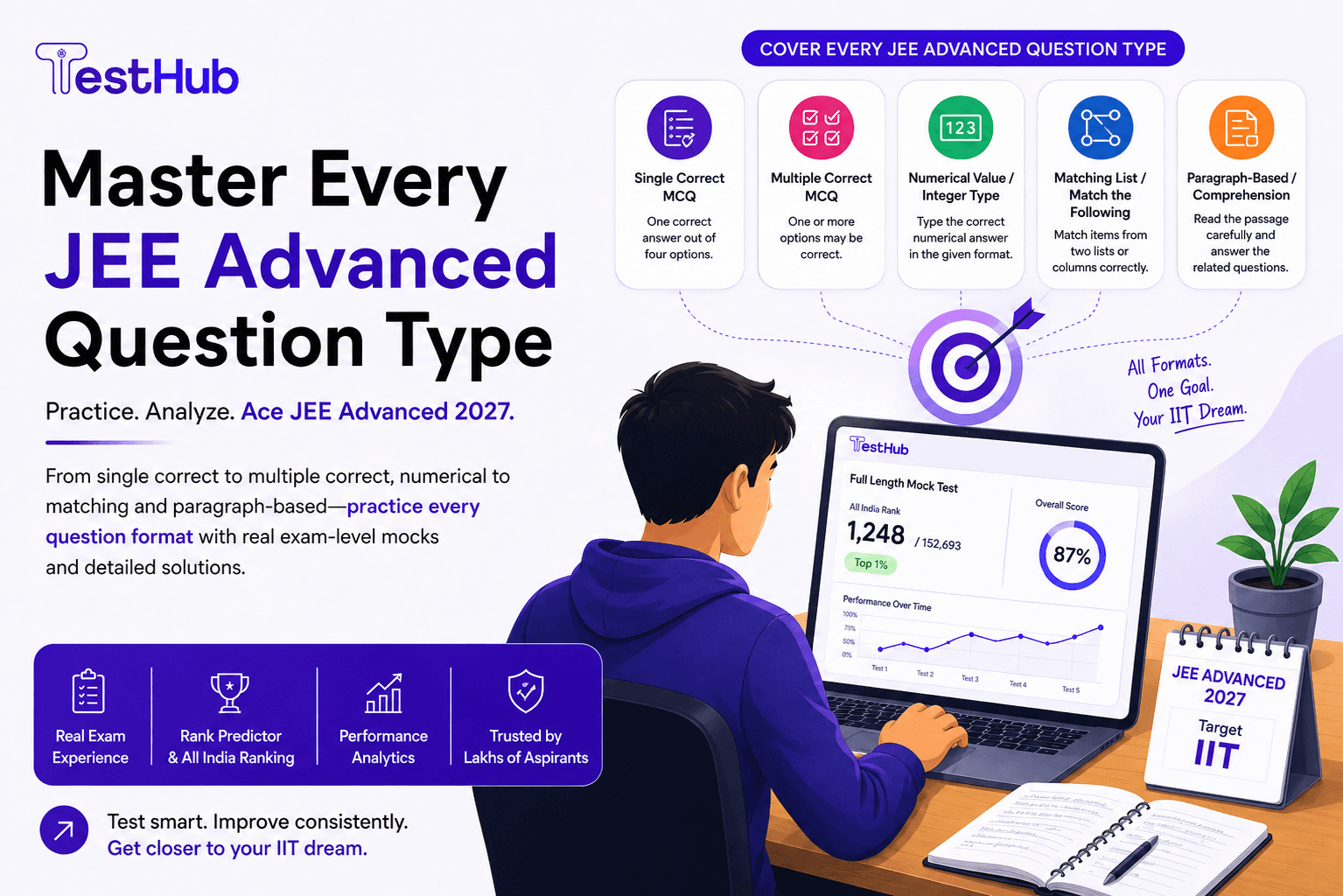
Types of Questions in JEE Advanced: A Complete Breakdown (2027 Guide)
JEE Advanced tests more than subject knowledge - it tests how well you handle different question formats, marking schemes, and strategic risks. This guide covers every major JEE Advanced question type, including single-correct, multiple-correct, numerical, matching, and paragraph-based questions, with practical strategies for approaching each.

26 Aug 2026 · TestHub Team
Best Test Series for JEE Main 2027
Choose the right JEE 2027 test series by focusing on current exam patterns, detailed solutions, trend-based analytics, All-India benchmarking, and relevant PYQ practice - not just the number of tests offered.

17 Aug 2026 · TestHub Team
Best Apps and Websites for JEE Mock Tests Preparation (2027 Guide)
Choosing the best JEE mock test app depends on your preparation stage and what you actually need from a testing platform. This guide compares the major categories—from coaching apps and free PYQ platforms to dedicated mock test websites—and explains how to choose the right option for JEE Main and Advanced preparation.

12 Aug 2026 · TestHub Team
Why TestHub Is One of the Best Platforms for JEE Main & Advanced Preparation in 2027
TestHub is a JEE-focused preparation platform offering All-India test series, detailed solutions, performance analytics, PYQs, a 50,000+ question bank, and rank prediction to help JEE Main and Advanced aspirants prepare smarter and improve their performance