

TestHub Team
How to Analyse JEE Advanced Mock Tests: The Complete Guide Every Aspirant Needs
Most JEE aspirants give mock tests, but very few know how to analyse them properly. This complete guide explains a step-by-step system to review JEE Advanced mocks, identify weak patterns, improve accuracy, manage time pressure, and turn every test into a rank-improving opportunity.
Every year, lakhs of students appear for JEE Advanced, but only a few thousand make it to the IITs. The difference is rarely raw intelligence—it is strategy, self-awareness, and the ability to learn from mistakes. Mock test analysis is where that learning happens. Done right, it tells you exactly where your rank is going to land before the actual exam even begins.
This guide walks you through a systematic, step-by-step approach to analysing JEE Advanced mock tests, covering error classification, time management review, subject-wise performance tracking, and revision cycles so that every practice test actually moves the needle on your score.
Table of Contents:
Why are Mock Tests Important?
Why Do Most Students Analyse Mock Tests the Wrong Way?
How to Analyse the JEE Advanced Test Series?
Why Is the Testhub JEE Advanced Test Series Worth Your Time?
Final Thoughts
Why are Mock Tests Important?
A JEE Advanced mock test is not a morale check. It's not there to tell you if you're good enough. The JEE Advanced exam is known for its complexity, multi-concept questions, and negative marking. A single mock test exposes the following:
Which topics do you understand, versus which ones do you only think you understand
How you perform under timed pressure
Whether your question-selection strategy is costing you marks
Where is your time going during the exam
Why Do Most Students Analyse Mock Tests the Wrong Way?
The most common mistake JEE aspirants make is checking only their final score and moving on. "I got 112 today, better than last time"—and the test paper goes into a drawer.
Mock test series analysis is not about the score you got. It is about understanding why you got that score and what specifically needs to change. A student who scored 90 but analysed the test in depth will outperform a student who scored 120 but never looked back at their mistakes.
68% | 2–3 hrs | 3x |
JEE marks are lost due to avoidable errors, not a lack of knowledge | Minimum time that should be spent analysing each full-length mock | Faster improvement is seen in students who maintain error logs vs those who don't |
How to Analyse the JEE Advanced Test Series?
Taking a JEE Advanced mock test series is easy. What separates top rankers from the rest is what happens in the 2–3 hours after the test is over. If you are not analysing your mock tests, you are wasting your most powerful preparation tool.
Step 1: Attempt the Mock in Real Exam Conditions
Analysis begins before the test even starts. Sit for the mock in a quiet room, at the same time slot as the actual JEE Advanced exam (9 AM–12 PM and 2:30 PM–5:30 PM), with no breaks, no phones, and no disturbances. This is non-negotiable.
If you attempt a mock casually, pausing to eat and checking your phone between sections, the data you collect from the analysis is wasted. It will not reflect how you actually perform under real pressure and fatigue. Treat every mock as the real thing.
Pro Tip:
Keep a rough sheet next to you during the mock and mark every question where you felt unsure, guessed, or ran short on time. Circle questions you skipped and put a star on ones where you changed your answer. This raw data becomes your most valuable input during analysis.
Step 2: Calculate Your Score
Check your score. A score of 90 might still have serious problems hiding in it. A score of 55 might actually show real improvement over your last attempt.
Look at:
Raw marks in each subject: Physics, Chemistry, Mathematics
Marks lost to negative marking: This is critical in JEE Advanced
Questions attempted vs. questions correct: Your accuracy rate
Questions you skipped: Were they genuinely hard, or did you panic?
Step 3: Classify Every Wrong Answer by Error Type
Once the mock is over, go through every incorrect answer, but do not just look at the solution and move on. You need to classify the error. This is most important for the effective JEE Advanced mock test analysis.
Error Type | What It Means | Action Required |
Conceptual Error | You did not know or misunderstood the concept | Revisit the topic. Do 20+ similar questions. |
Silly / Calculation Error | You knew the concept, but made a computational mistake | Practice writing steps cleanly. Do not skip intermediate steps under time pressure. |
Reading Error | You misread the question and missed "NOT," "incorrect," etc. | Slow down. Underline keywords while reading the question. |
Time Pressure Error | You knew the method, but ran out of time or rushed | Revisit your question selection strategy and your time allocation for each section. |
Overconfidence / Wrong Guess | You marked without full confidence and lost negative marks | Be more disciplined with the skip-or-attempt decision. Revise the marking strategy. |
Maintain an Error Log: a simple notebook or spreadsheet where you record each wrong question, the topic, and the error type. Over 10–15 mocks, this log will show you clear patterns.
Step 4: Analyse Time Management Question by Question
JEE Advanced is as much a time management exam as it is a knowledge exam. Paper 1 and Paper 2 each have three sections with different marking schemes—single correct, multiple correct, integer type, and match-the-list. Each type demands a different time budget.
After each mock, go back and honestly estimate how much time you spent on each question. Ask yourself: Did you spend 12 minutes on an integer-type chemistry question that was worth only 4 marks? Could those 12 minutes have earned you 3 correct answers elsewhere?
Ideal Time Per Question Type
Single Correct: 2–3 minutes.
Multiple Correct (MCQ): 3–5 minutes.
Integer Type: 4–6 minutes.
Match the List: 5–7 minutes for the entire set.
Any question eating more than 8 minutes should typically be skipped and returned to only if time allows
Step 5: Do Subject-Wise and Chapter-Wise Performance Breakdown
After classifying errors, break your performance down by subject: physics, chemistry, and mathematics, and then further by chapter. Do not just look at which subject you scored less in. Look at which specific chapters are consistently bleeding marks.
Create a simple scoring table after each mock. Write the chapter name, the number of questions that appeared, how many you attempted, how many were correct, and the net marks. This chapter-level data, tracked across 8–10 mocks, builds a precise weak-area map that will help more.
Read more: Complete Guide to Crack JEE Advanced
Step 6: Review Questions You Got Right
Most students skip this, but reviewing correct answers is genuinely valuable. Go through the questions you marked correctly and ask, "Did I get this right because I knew it fully, or did I get lucky?" If you got a multiple-choice question right but missed one subpart, that is a partial blind spot you need to address.
Also, look at the questions you skipped entirely. Were they actually beyond your current level, or did you skip them out of fear? Sometimes a skipped question, when reviewed calmly post-test, turns out to be completely doable. That is a strategic error — not a knowledge gap — and it is fixable by better question-selection habits during the exam.
Step 7: Build a Targeted Revision Plan from the Analysis
After every mock, create a small, focused revision plan for the next 3–4 days based purely on what the analysis revealed. Do not revise topics randomly or because a chapter "feels weak."
List the top 3 chapters with the most conceptual errors from this mock
Solve 15–20 targeted questions per week's chapter before the next mock
Revisit the exact questions you got wrong—solve them again 3 days later without looking at the solution
Work on one specific calculation habit to fix (e.g., rewriting units, double-checking signs in integration)
Re-read marking strategy notes before starting the next mock
Step 8: Track Progress Across Multiple Mocks
Maintain a master progress sheet where you record each mock. Overall score, physics/chemistry/math score, number of conceptual errors, number of silly errors, number of questions skipped, and time management. When you look at this sheet after 12 mocks, you will see trends that a single test can never reveal.
Always complete your mock test analysis within 48 hours of taking the test. Memory fades fast. If you delay analysis beyond two days, you lose the psychological context that makes the data meaningful.
How to Create a Mistake Log?
A mistake log is one of the most underrated tools in JEE Advanced preparation. Use a notebook or a digital document. For each question you got wrong or guessed correctly, record:
The topic and subtopic (e.g., Rotational Mechanics — Torque)
Why you got it wrong (conceptual, silly mistake, time pressure, misread)
The correct concept or method — written in your own words
A similar practice problem to reinforce it
Review this log every Sunday. Before each new mock test, go through it once. Over time, this log becomes a personalised revision booklet built entirely from your own weak spots. No standard study material can replicate that.
Why Is the Testhub JEE Advanced Test Series Worth Your Time?
If you're going to invest time in a test series, it should reflect what JEE Advanced actually feels like—in structure, difficulty, and question style. Here's what makes Testhub useful:
Feature | What It Means for You |
Expert-Designed Questions | Built to test multi-concept reasoning — not recycled coaching material. Mirrors how JEE Advanced actually thinks. |
AI-Powered Analytics | After every test, get a breakdown of subject-wise accuracy, time spent per section, and marks lost to negative marking. |
1,000+ Mock Tests & 50,000+ Questions | Enough variety that you're never repeating the same question types. Builds real problem-solving flexibility. |
PYQ Practice & Question Bank | Previous year JEE Advanced papers in a timed environment — integrated into the platform, not an afterthought. |
Structured Test Schedule | Fixed test dates keep you accountable and stop you from postponing—more useful than it sounds during self-study. |
Final Thoughts
JEE Advanced mock test analysis is not a weekend activity — it is a core part of your preparation. The students who reach IITs are not necessarily the ones who solved the most questions but the ones who learned from every mistake they made.
The real exam is just the final mock—make sure all the earlier ones have done their job. And to make sure those earlier ones actually count, you need a test series that reflects what JEE Advanced truly demands. Testhub's JEE Advanced Test Series gives you expert-designed papers, AI-powered post-test analytics, and PYQ practice, all in one structured platform built specifically for serious aspirants.
Turn Your Mock Test Mistakes Into Rank-Boosting Wins
Start practising with our JEE Advanced test series, designed to give you real exam-level questions and the clarity to improve with every attempt.
Frequently Asked Questions
Common questions readers ask about this topic.
How many mock tests should I give before JEE Advanced?
Aim for 15–20 full-length tests, but space them out, one every 5–7 days. The quality of analysis between tests matters far more than the number of tests you attempt.
Why is my mock test score not improving even after regular practice?
Because taking tests without proper analysis in between doesn't work. If you're repeating the same mistakes without fixing them, the score won't move. The problem is rarely the number of tests — it's what you're doing between them.
How do I handle negative marking in JEE Advanced mock tests?
Track negative marks separately after every test. Only attempt a question if you can eliminate at least two options with some reasoning. Completely blind guessing in JEE Advanced is almost always a net loss.
How do I use a mistake log effectively for JEE Advanced preparation?
After every test, log each wrong or guessed question—topic, reason for the mistake, and the correct concept in your own words. Review it every Sunday and skim through it before your next mock. Over time, it becomes your most personalised revision tool.
How do toppers analyse their JEE Advanced mock tests?
Toppers focus on accuracy first. They categorise mistakes, track weak areas, and adjust their strategy instead of just increasing the number of attempts.
Which is the best test series for JEE Advanced 2026?
The best test series is one that matches real exam difficulty and gives clear performance analysis. TestHub’s JEE Advanced Test Series is a strong option, offering quality mocks, detailed solutions, and insights to help you improve after every test.
More on the blog
2 Sept 2026 · TestHub Team
JEE Main 2027 Syllabus PDF: Complete Chapter List
Get the complete JEE Main 2027 syllabus chapter-wise for Physics, Chemistry, and Mathematics, along with the exam pattern, removed topics, and practical preparation tips to plan your JEE Main 2027 preparation effectively.

29 Aug 2026 · TestHub Team
TestHub AI Analysis: How Smart Analytics Fix Your Mistakes Faster
TestHub’s AI-powered mock test analysis goes beyond your score to identify chapter-wise weaknesses, time-management issues, conceptual and calculation errors, and performance trends—helping you turn every mock test into a clear, actionable plan for improvement.
26 Aug 2026 · TestHub Team
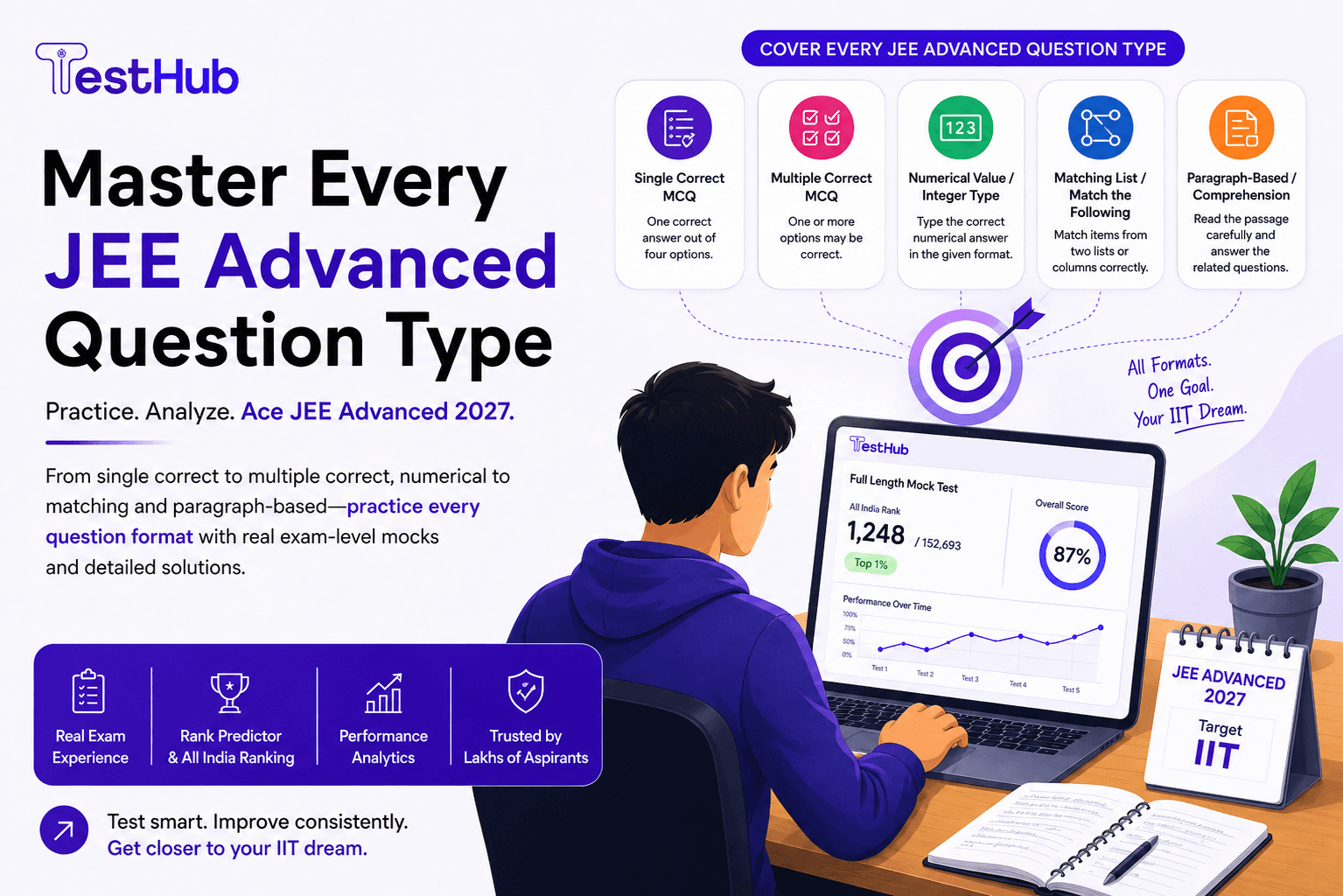
Types of Questions in JEE Advanced: A Complete Breakdown (2027 Guide)
JEE Advanced tests more than subject knowledge - it tests how well you handle different question formats, marking schemes, and strategic risks. This guide covers every major JEE Advanced question type, including single-correct, multiple-correct, numerical, matching, and paragraph-based questions, with practical strategies for approaching each.

26 Aug 2026 · TestHub Team
Best Test Series for JEE Main 2027
Choose the right JEE 2027 test series by focusing on current exam patterns, detailed solutions, trend-based analytics, All-India benchmarking, and relevant PYQ practice - not just the number of tests offered.

17 Aug 2026 · TestHub Team
Best Apps and Websites for JEE Mock Tests Preparation (2027 Guide)
Choosing the best JEE mock test app depends on your preparation stage and what you actually need from a testing platform. This guide compares the major categories—from coaching apps and free PYQ platforms to dedicated mock test websites—and explains how to choose the right option for JEE Main and Advanced preparation.

12 Aug 2026 · TestHub Team
Why TestHub Is One of the Best Platforms for JEE Main & Advanced Preparation in 2027
TestHub is a JEE-focused preparation platform offering All-India test series, detailed solutions, performance analytics, PYQs, a 50,000+ question bank, and rank prediction to help JEE Main and Advanced aspirants prepare smarter and improve their performance