

TestHub Team
Preparation Companion: How TestHub Tracks Your Chapter-Wise Mastery
Most JEE aspirants track how much of the syllabus they've completed, but not how much they've actually mastered. TestHub's Preparation Companion turns real test and practice performance into a measurable readiness score, identifying weak chapters and recommending exactly what to focus on next. Combined with Custom Practice and mock tests, it helps you move from simply completing the syllabus to building genuine exam readiness.
"How much of the JEE syllabus have I actually covered?"
Most students answer this with a guess. You might have read every chapter. You might have sat through every lecture. But "covered" and "actually ready" are not the same thing.
TestHub's Preparation Companion solves this exact problem. It turns vague confidence into a real, measured readiness score.
The Problem With Most Syllabus Trackers
Most JEE prep trackers work the same way. You tick a checkbox once you finish a chapter. That gives you a completion percentage. But it tells you nothing about whether you actually understood the chapter.
Here's the issue. A student who marks 80% of the syllabus "done" and a student who is genuinely strong in 80% of the syllabus can look identical on a simple checklist. Their real exam readiness, however, is nowhere close to the same.
Preparation Companion works differently. It doesn't rely on self-reported completion. Instead, it ties your chapter-wise mastery to how you actually perform in tests and practice. So your readiness score reflects real performance, not just time spent reading.
What Preparation Companion Actually Shows You
Preparation Companion gives you one honest readiness view. This includes:
Your overall mastery percentage
How many chapters have been rated based on real performance
How many chapters are currently flagged as weak
It also tells you exactly what to work on next. Not vague advice like "revise more Chemistry." Instead, it points to something specific, for example, a chapter like GOC (General Organic Chemistry).
This turns a hard-to-measure goal, "Am I ready for JEE Main?" into something trackable. You get a clear percentage to close, plus a ranked list of exactly which chapters are holding that number down.
Why Performance-Based Mastery Matters More
Here's the practical difference this makes.
A completion-based tracker marks a chapter "done" the moment you check the box. It doesn't matter how well you actually performed in questions from that chapter.
Preparation Companion works the opposite way. Your rating is earned through real practice and test performance. As a result, it's far harder to fool and far more useful. It reflects how you'd likely perform on that chapter if it appeared in your next mock.
This distinction matters even more as exam day approaches. Consider two scenarios:
A syllabus that's 100% "covered" on paper, but genuinely weak in five chapters
A syllabus that's 90% covered, but strong everywhere it's been rated
These represent very different risk levels. Preparation Companion is built to surface exactly this kind of gap, something a simple checklist can never show you.
How It Connects to the Rest of Your Preparation
Preparation Companion doesn't work alone. It's part of the same feedback loop as your mock tests and practice sessions.
Once it flags a weak chapter, the natural next step is targeted practice. That's where Custom Practice comes in. You can filter down to a specific subject and chapter, say, Physics → Rotational Motion, and drill it directly. No generic mixed sets required.
One thing worth noting: earning a certified mastery rating through Preparation Companion specifically requires Custom Practice Tests. In other words, these two features are designed to work together, not as separate tools.
This also connects back to your broader All-India test series performance. A full-length mock gives you the raw data. Preparation Companion converts that data into a chapter-by-chapter mastery view. Custom Practice then lets you act on the specific gaps it identifies.
How to Use Preparation Companion Effectively
A few simple habits make this feature genuinely useful:
Check your readiness percentage often, not just once. It's meant to be a running measure.
Prioritize the "Focus next" recommendation before jumping to chapters that simply feel urgent to you. The tool points to your actual gap which isn't always what feels most pressing.
Use Custom Practice right after a chapter gets flagged weak, while the mistake pattern is still fresh.
Track your "Rated" chapter count, not just your overall percentage. A high percentage built on very few rated chapters is less reliable than one built across a broad, well-rated syllabus.
Who Benefits Most From This Feature
First-time aspirants get an honest picture of how far they actually are from exam-ready. No more relying on gut feeling about how much you've "covered."
Droppers benefit even more. A second attempt is really about confirming that last year's weak chapters have actually improved. A performance-based mastery score proves this far more reliably than simply re-reading the same material again.
Final Thoughts
Knowing you've "covered" the syllabus and actually being ready for it are two different things. That gap is exactly what most tracking tools miss.
Preparation Companion measures the second one. It ties your mastery score to real performance, not self-reported completion. So when exam day arrives, your readiness percentage actually means something.
Want to see your real, performance-based mastery score?
Start with TestHub's free mock tests and let the Preparation Companion show you exactly where you stand.
Know Your JEE Preparation Level
Track your chapter-wise mastery, identify weak areas, and improve your preparation with TestHub’s performance-based practice and mock tests.
Frequently Asked Questions
Common questions readers ask about this topic.
Q1. How is Preparation Companion different from a regular syllabus checklist?
A checklist only tracks whether you've studied a chapter. Preparation Companion tracks how well you actually perform in that chapter, using real test and practice data. This gives you a mastery score instead of just a completion percentage.
Q2. Do I need a paid plan to use the Preparation Companion?
It's available across TestHub's plans. However, earning a certified mastery rating requires Custom Practice Tests, which are limited on the free plan. A paid Test Series enrollment unlocks unlimited Custom Practice and the full Preparation Companion experience.
Q3. How does Preparation Companion decide which chapters are "weak"?
It rates chapters based on your actual performance in tests and custom practice attempts. This is different from self-reported completion. Chapters where your real accuracy is lower get flagged as needing more focus.
Q4. Can Preparation Companion tell me exactly what to study next?
Yes. Beyond your overall readiness percentage, it surfaces a specific next focus area such as a particular chapter. This means you're never left guessing which weak area to prioritize first.
Q5. Does Preparation Companion replace AI Analysis and mock tests, or work alongside them?
It works alongside them. Mock tests and AI Analysis show your performance within a single test. Preparation Companion, on the other hand, aggregates that data into a longer-term, chapter-by-chapter mastery view across your entire preparation.
More on the blog

21 Oct 2026 · TestHub Team
JEE Advanced Test Series 2027: Which One to Choose?
Choosing the best JEE Advanced Test Series 2027 depends on your preparation level, budget, and goals. Compare free mocks, JEE Main-focused plans, and combined Main + Advanced test series to find the right fit, with detailed solutions, performance analytics, and realistic rank predictions.

19 Oct 2026 · TestHub Team
JEE Main 2027 Registration: Dates, Fees & Application Form
Learn everything about JEE Main 2027 registration, including expected dates, eligibility criteria, required documents, application fees, and step-by-step form filling instructions. Prepare early and avoid common application mistakes.
7 Oct 2026 · TestHub Team
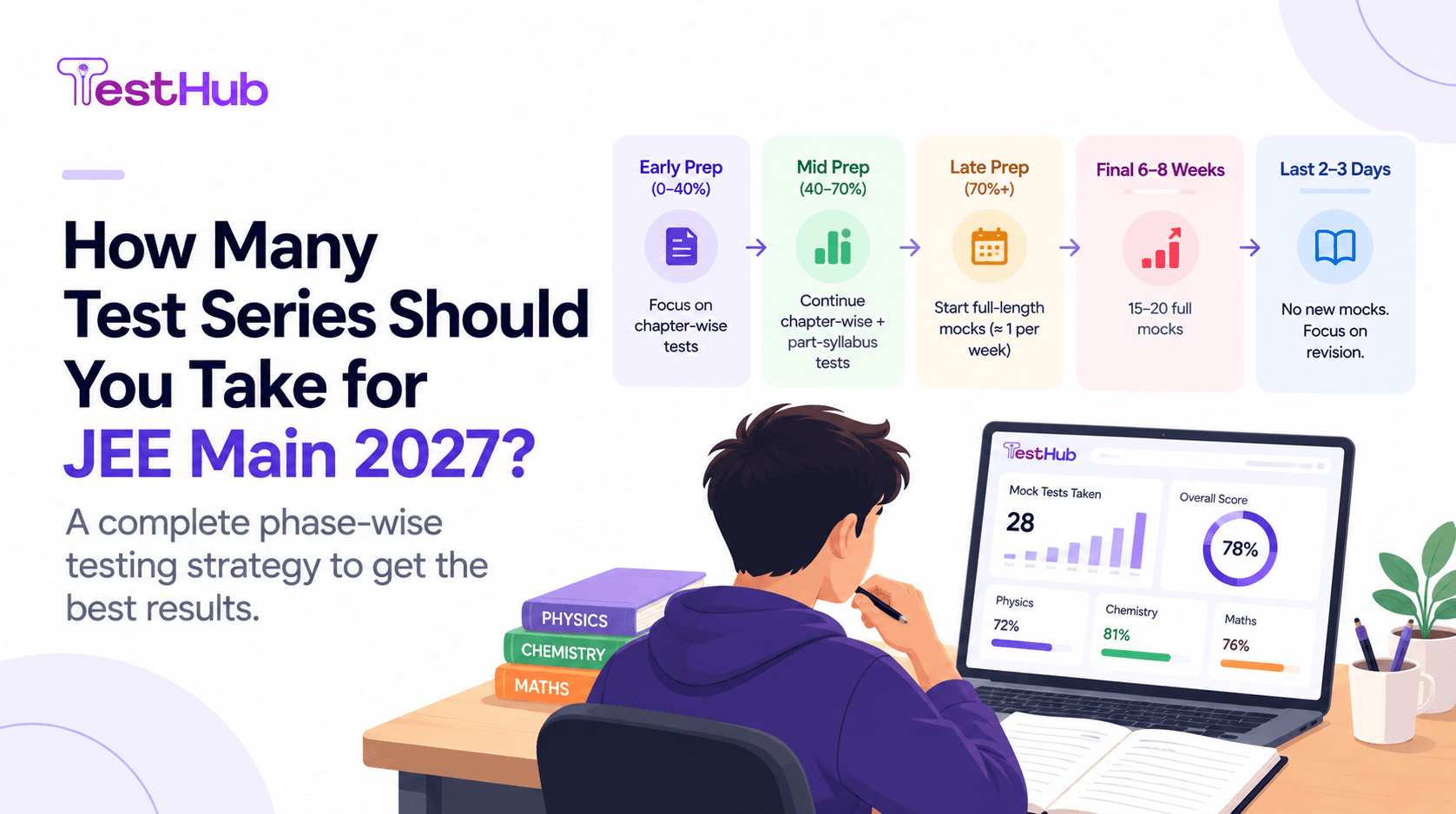
How Many Test Series Should You Take for JEE Main 2027
For most JEE Main 2027 aspirants, 20–40 full-length mock tests are a realistic target, concentrated in the final 3–4 months before the exam. But test count alone isn't enough—consistent analysis, mistake tracking, and a phase-wise testing strategy are what actually turn mock tests into score improvement.
7 Oct 2026 · TestHub Team
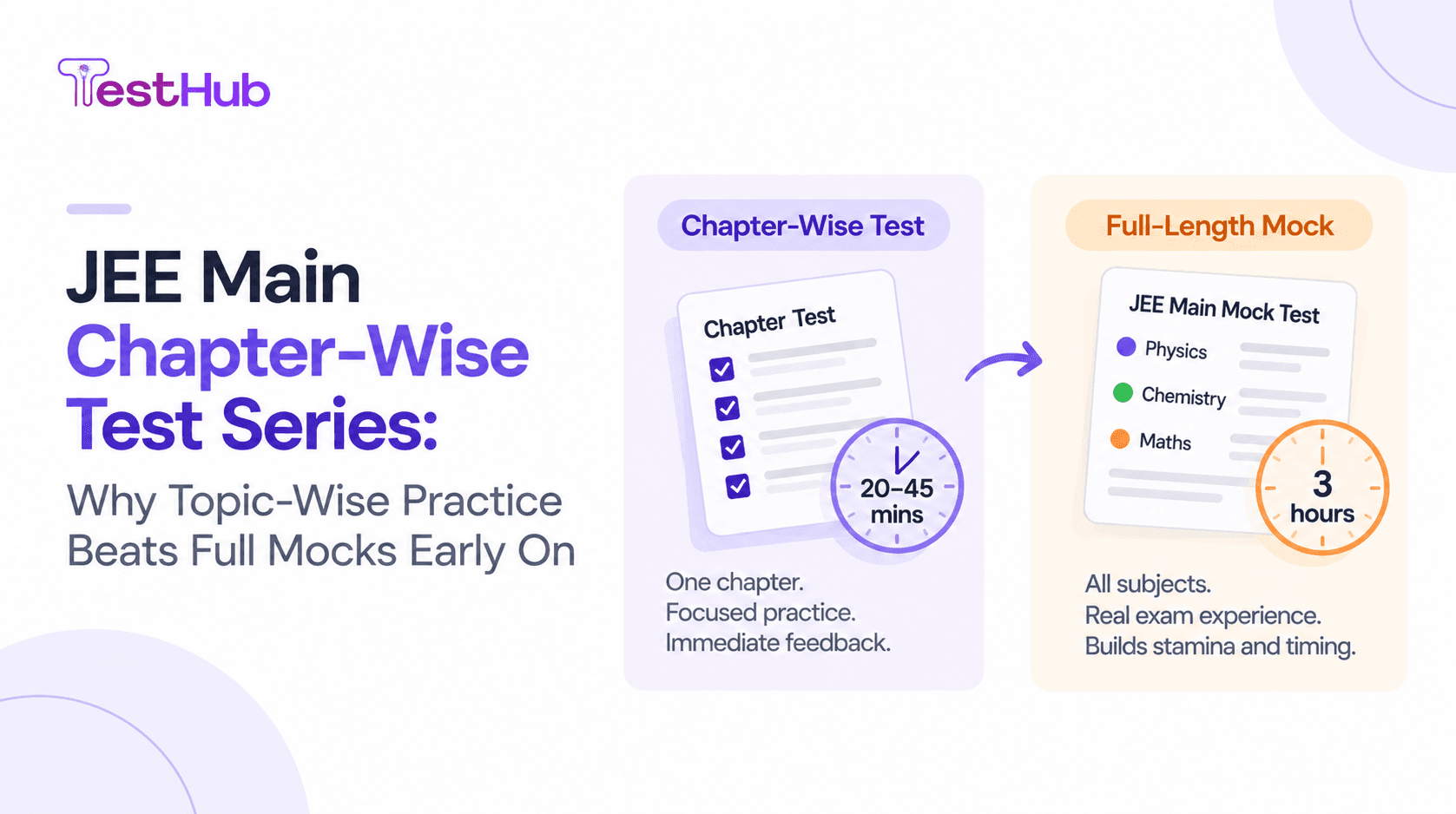
JEE Main Chapter-Wise Test Series: Why Topic-Wise Practice Beats Full Mocks Early On
Chapter-wise JEE Main tests are ideal early in preparation because they provide focused practice and immediate feedback without the pressure of a full-length mock. Learn when to use chapter-wise, subject-wise, and full-length tests to build your preparation progressively and improve your JEE Main performance.

7 Oct 2026 · TestHub Team
Subject-Wise JEE Main Test Series: Why Physics, Chemistry & Maths Need Different Strategies
Physics, Chemistry, and Maths require different strategies in JEE Main. Chemistry rewards speed and recall, Physics demands conceptual accuracy, and Maths requires selective problem-solving and time management. A subject-wise and chapter-wise test series helps students practice according to these differences and identify whether lost marks come from knowledge gaps, conceptual errors, or poor question selection.

28 Sept 2026 · TestHub Team
Best JEE Test Series in Kota vs Online: What Actually Works in 2027
Every JEE 2027 aspirant eventually faces the choice between Kota coaching and online preparation. This guide compares both options across cost, discipline, faculty access, test series quality, flexibility, and pressure to help you choose the approach that fits your preparation style, budget, and goals.
