
TestHub Team
JEE Main Chapter-Wise Test Series: Why Topic-Wise Practice Beats Full Mocks Early On
Chapter-wise JEE Main tests are ideal early in preparation because they provide focused practice and immediate feedback without the pressure of a full-length mock. Learn when to use chapter-wise, subject-wise, and full-length tests to build your preparation progressively and improve your JEE Main performance.
Here's a mistake a lot of Class 11 and early Class 12 students make: they finish maybe 40% of the syllabus, feel a burst of motivation, and jump straight into a full-length, three-hour mock test. It rarely goes well. Not because they're bad at JEE prep but because a full mock at that stage just confirms gaps they already knew existed, without teaching them much new.
Chapter-wise tests solve this problem completely. And knowing when to use each one, not just that both exist, is what actually makes a test series effective early in your preparation.
The Real Difference Between the Two
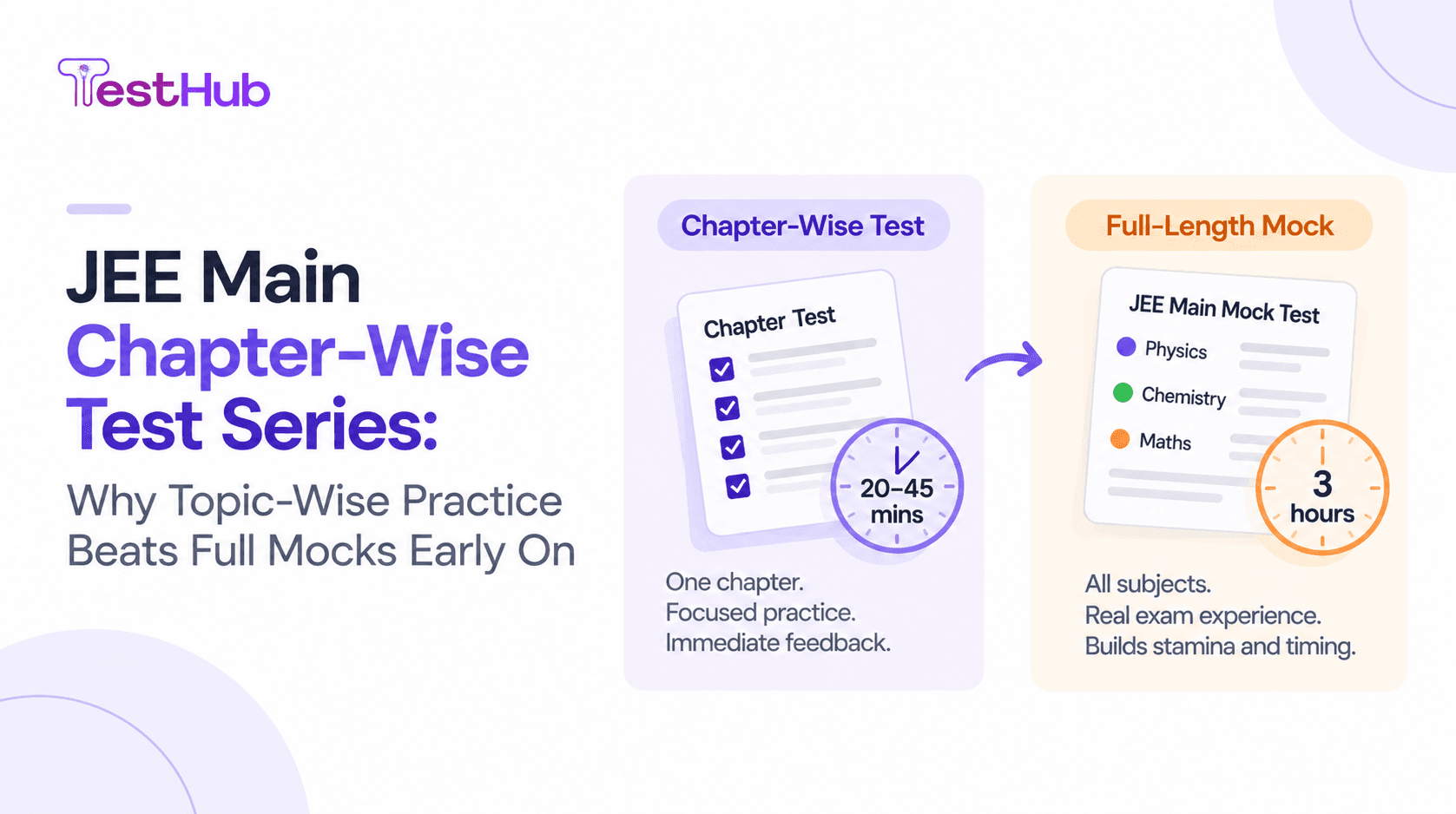
A chapter-wise test covers exactly one chapter. Usually 15 to 25 questions, taking 20 to 45 minutes. It isolates a single topic so you get precise, immediate feedback on that one area.
A full-length mock test covers all three subjects, the entire syllabus tested so far, roughly 75 to 90 questions across three hours. It's designed to build stamina, timing, and real exam temperament.
Both matter. But they matter at completely different stages of your preparation.
Why Full Mocks Fail You Early On
Reflect on the meaning of a full mock. It's an assessment to see if you can transfer all of what you've learned to any chapter, at the last second. If you've only studied 40% of the syllabus, then a full mock isn't really a measure of your ability; it's a measure of what you haven't studied.
That's not useful feedback. You already know which chapters you haven't covered. Taking a 300-mark mock at that stage mostly just dents your confidence for no real diagnostic gain.
Why Chapter-Wise Tests Work So Well Early
Chapter-wise tests solve this by locking in learning at exactly the right moment. Take the test within 48 hours of finishing a chapter, while the concepts are still fresh. This does two things a full mock simply can't at this stage.
First, it provides you with accurate, timely feedback for the exact concept (for example, the exact concept in the chapter of Chemistry that needs work), rather than an overall feeling that "something in Chemistry" needs attention. Second, it establishes a routine for testing from the get-go to get everyone used to testing in a similar format and avoid "full mocks" later on being an out-of-the-ordinary experience.
A Practical Timeline for When to Use Each
The following is a sensible approach to the sequencing for structured JEE preparation:
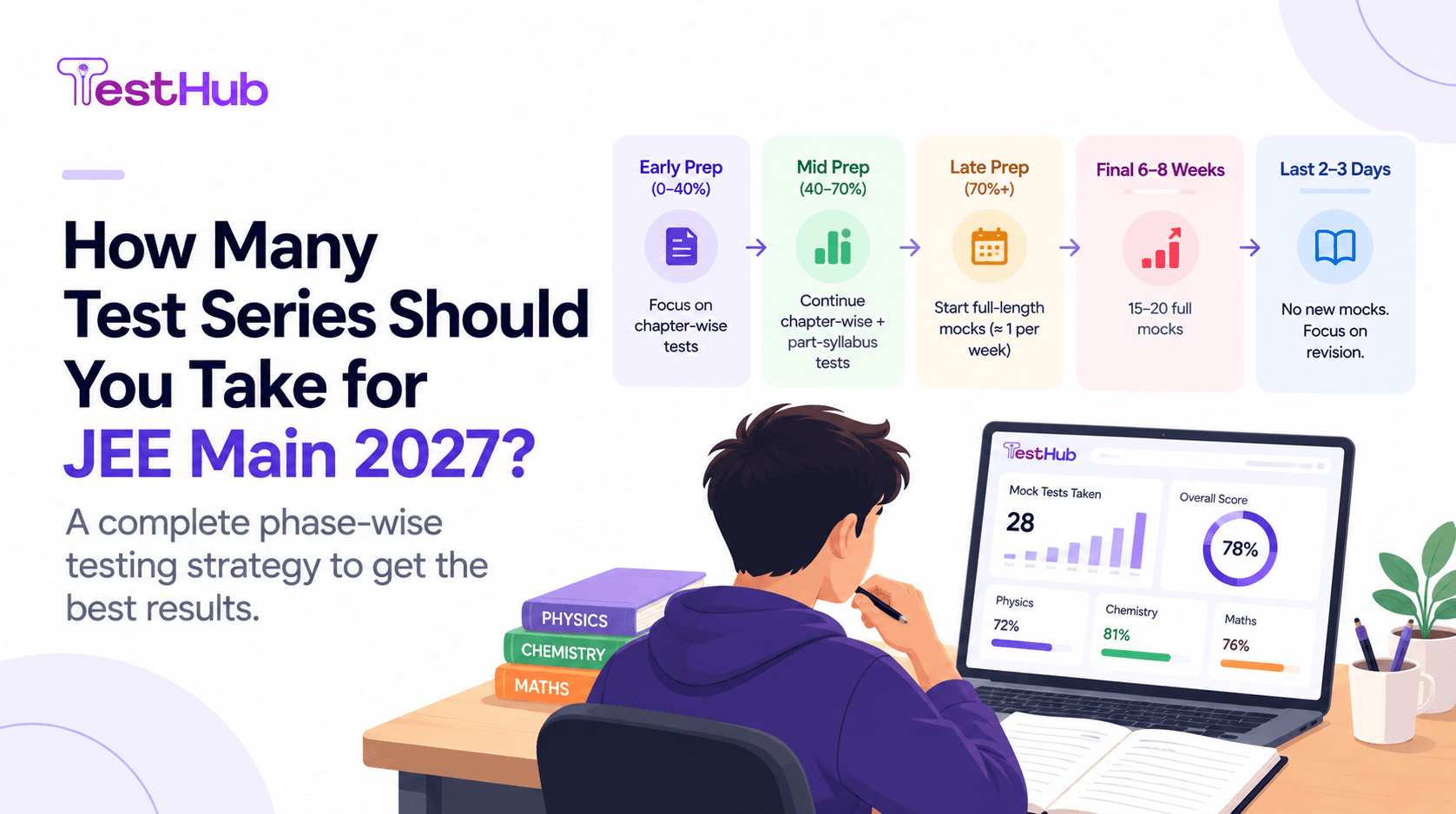
40-50% syllabus coverage: Question-wise tests and chapter-wise tests. Read one every 48 hours after reading each chapter. At this stage, do not attempt full mocks at this time because your syllabus is not ready for them.
40-70% syllabus coverage: Begin to include part-syllabus or subject-wise tests (covering two or more related chapters in one test) occasionally, along with your chapter-wise tests as the main tool.
70% and beyond: This is when full-length mocks should begin not before. Start with roughly one full mock per week, while continuing chapter-wise retests specifically on chapters where you're still weak.
Final 2-3 months: Full mocks become your primary tool, 2-3 per week, alongside targeted chapter-wise drills on whatever full mocks reveal as your weak points.
How Many of Each Do You Actually Need?
There's no single magic number, but a reasonable range that shows up consistently: somewhere around 80-100 chapter-wise tests spread across a full year of preparation (roughly one to two per chapter across all three subjects), and 20-40 full-length mocks concentrated in the final 3-4 months before your exam.
Droppers, with a longer runway and a stronger existing conceptual base, can reasonably aim toward the higher end of the full-mock range.
Using Both Together, the Right Way
The two aren't competing tools; they're sequential ones. Chapter-wise tests build your foundation chapter by chapter. Full mocks later confirm whether that foundation holds up under real exam conditions, across the entire syllabus at once, with genuine time pressure.
Chapter-wise and custom practice tests let you drill a specific weak chapter the moment it's flagged, rather than waiting for your next full mock to reveal the same gap again. Once your syllabus coverage is solid, a proper All-India test series with full-length mocks becomes the right next step, giving you All-India benchmarking on top of the chapter-level work you've already put in.
If you're building your broader test series strategy beyond just timing, our guide on how to choose the best mock test series for JEE Main covers the rest of what to look for.
Final Thoughts
Chapter-wise tests and full-length mocks aren't competing strategies; they're tools for different stages of the same preparation. Use chapter-wise tests to build your foundation chapter by chapter, then bring in full mocks once that foundation is solid enough to actually stress-test under real exam conditions. Getting that sequence right saves you months of feedback that a mistimed full mock simply can't give you.
Ready to build your preparation the right way, stage by stage? Try TestHub's chapter-wise and full-length test series and get detailed feedback matched to exactly where you are in your prep.
Practice Chapter by Chapter. Improve Step by Step.
Strengthen your JEE Main preparation with chapter-wise tests, full-length mocks, detailed analytics, and targeted practice.
Frequently Asked Questions
Common questions readers ask about this topic.
When should I start taking chapter-wise tests for JEE Main?
From the very first chapter you complete, ideally within 48 hours of finishing it. This applies from Class 11 onward; chapter-wise testing should begin immediately, not months into your preparation.
When should I start taking full-length mock tests?
Most experts recommend starting full mocks once you've covered roughly 70-75% of the syllabus. Before that, chapter-wise and part-syllabus tests give you far more useful, targeted feedback.
Is it bad to take a full mock test before finishing most of the syllabus?
It isn't harmful exactly, but it's inefficient. A full mock at that stage mostly confirms gaps you already know about, without teaching you much new. Chapter-wise tests are simply a better tool for that stage.
How many chapter-wise tests should I take per chapter?
One to two tests per chapter is a reasonable starting point, with a retest on any chapter where your first attempt reveals a weak area, before moving on to the next topic.
Should droppers still start with chapter-wise tests, or can they skip straight to full mocks?
Droppers with a strong existing conceptual base can move to full mocks sooner than first-time aspirants, but chapter-wise retests are still valuable for specifically confirming that last year's weak chapters have genuinely improved.
More on the blog

21 Oct 2026 · TestHub Team
Preparation Companion: How TestHub Tracks Your Chapter-Wise Mastery
Choosing the best JEE Advanced Test Series 2027 depends on your preparation level, budget, and goals. Compare free mocks, JEE Main-focused plans, and combined Main + Advanced test series to find the right fit, with detailed solutions, performance analytics, and realistic rank predictions.

19 Oct 2026 · TestHub Team
JEE Main 2027 Registration: Dates, Fees & Application Form
Learn everything about JEE Main 2027 registration, including expected dates, eligibility criteria, required documents, application fees, and step-by-step form filling instructions. Prepare early and avoid common application mistakes.
7 Oct 2026 · TestHub Team
How Many Test Series Should You Take for JEE Main 2027
For most JEE Main 2027 aspirants, 20–40 full-length mock tests are a realistic target, concentrated in the final 3–4 months before the exam. But test count alone isn't enough—consistent analysis, mistake tracking, and a phase-wise testing strategy are what actually turn mock tests into score improvement.

7 Oct 2026 · TestHub Team
Subject-Wise JEE Main Test Series: Why Physics, Chemistry & Maths Need Different Strategies
Physics, Chemistry, and Maths require different strategies in JEE Main. Chemistry rewards speed and recall, Physics demands conceptual accuracy, and Maths requires selective problem-solving and time management. A subject-wise and chapter-wise test series helps students practice according to these differences and identify whether lost marks come from knowledge gaps, conceptual errors, or poor question selection.

28 Sept 2026 · TestHub Team
Best JEE Test Series in Kota vs Online: What Actually Works in 2027
Every JEE 2027 aspirant eventually faces the choice between Kota coaching and online preparation. This guide compares both options across cost, discipline, faculty access, test series quality, flexibility, and pressure to help you choose the approach that fits your preparation style, budget, and goals.
17 Sept 2026 · TestHub Team
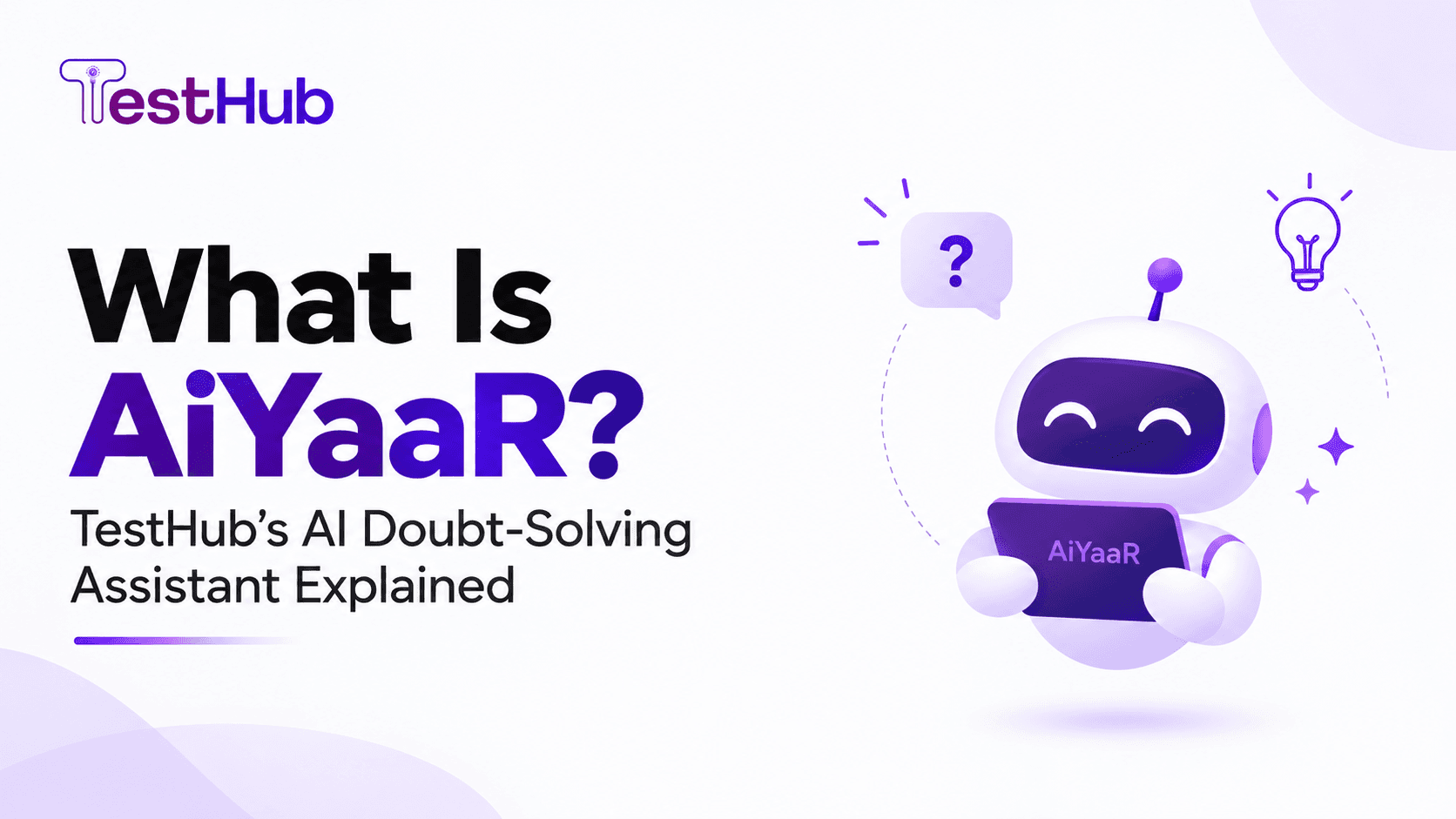
What Is AiYaaR? TestHub's AI Doubt-Solving Assistant Explained
Stuck on a tricky JEE question late at night? AiYaaR, TestHub’s AI study companion, is built to help you solve doubts, understand concepts, analyze mistakes, and plan your next steps. Unlike generic doubt solvers, AiYaaR uses your TestHub preparation history - including test performance, topic-wise progress, mistakes, and study plans—to provide personalized guidance. From “why did I get this wrong?” to “what should I practice next?”, AiYaaR connects every doubt to your larger JEE preparation journey.
