
TestHub Team
JEE Advanced Test Series 2027: Which One to Choose?
Choosing the best JEE Advanced Test Series 2027 depends on your preparation level, budget, and goals. Compare free mocks, JEE Main-focused plans, and combined Main + Advanced test series to find the right fit, with detailed solutions, performance analytics, and realistic rank predictions.
Not every JEE Advanced aspirant needs the same test series. That's worth saying upfront, because most "best test series" content pretends otherwise.
A first-time Class 12 student and a dropper attempting JEE Advanced for the second time are in very different places. Different times are left. Different budget comfort. Different specific gaps to close.
Picking a test series without accounting for that? That's one of the most common, and easily avoidable, mistakes students make.
So let's break down how to actually decide.
A Quick Note on JEE Advanced 2027 First
JEE Advanced 2027 is expected to be conducted by IIT Delhi. This follows the usual rotation among the seven zonal IITs.
The exam structure stays familiar: two compulsory papers, Paper 1 and Paper 2, both on the same day. Physics, Chemistry, and Mathematics. Skip either paper, and you're disqualified. No exceptions.
Here's the thing, though. The exact pattern isn't locked in yet. The conducting IIT can tweak small details year to year. Official confirmation usually comes only a few months before the exam.
So check jeeadv.ac.in for the confirmed pattern as your exam gets closer. Don't just assume last year's structure will repeat exactly.
Why "Which One" Depends Entirely on You
A test series isn't one-size-fits-all. The right amount of practice depends on where you're actually starting from.
Someone who's been doing consistent Advanced-level practice for six months needs something different from someone who just cleared JEE Main and is starting Advanced prep from scratch.
Here's a practical way to think it through.
Option 1: Free Test Series — If You're Still Deciding
Not sure yet whether a full test series is worth it? Start free.
A free plan usually gives you a handful of open mock tests, limited PYQ access, and a capped number of custom practice attempts. That's enough to genuinely judge solution quality and test format before spending anything.
Best for: Students exploring whether they even need a structured test series, or comparing options before committing.
The catch: Free plans typically cap features like Preparation Companion certification and detailed analytics. These need a higher volume of practice to give a reliable reading. Treat free as a trial. Not a full prep strategy.
Option 2: JEE Main-Focused Plan — If You Haven't Cleared Main Yet
Still working toward clearing JEE Main? Then a Main-focused test series makes more sense than diving straight into Advanced-level practice.
This usually includes a large volume of full-length and chapter-wise JEE Main tests. Plus the full practice ecosystem unlimited PYQs, custom practice, mistake practice, and performance analytics.
Best for: Students who haven't cleared JEE Main yet, or who want a strong foundation before shifting focus toward Advanced-specific work.
Why it matters: Advanced-level practice isn't very useful if your Main fundamentals are shaky. You'll end up relearning basics mid-mock instead of actually building Advanced exam temperament.
Option 3: Main + Advanced Combined — If You're Serious About Both
Most JEE aspirants, past a certain stage, are targeting both exams seriously. For them, a combined test series is usually the smarter pick.
A good combined plan generally includes a good quantity of full and chapter-wise tests for both exams, which are approximately 25-30 full JEE Main tests, 15-20 full JEE Advanced tests, along with chapter-wise tests for both exams. Superimpose the entire practice environment: unlimited PYQs, custom practice, mistake practice, Preparation Companion, and AI-powered analysis.
Best for– Students who have appeared and have qualified, or will appear and qualify for JEE Main and require focused Advanced level practice. The two-paper stamina, mixed questions and the partial-marking approach that are so specific to Advanced.
Why it's usually better value: Buying Main and Advanced practice separately, if that were even possible, often ends up costing more. It also fragments your analytics across two disconnected systems instead of one continuous progress view.
A Simple Way to Decide
Ask yourself three questions.
Have I cleared, or am I confident about clearing, JEE Main? If not, prioritize Main-focused practice first.
Am I past the "just exploring" stage? Already tried a few free tests and know you need structured practice? A paid plan is worth it.
Do I need Advanced-specific practice? Think two-paper stamina, multi-correct questions, partial marking strategy. If yes, a combined plan is generally more efficient.
What to Check Before Enrolling in Any Plan
Whichever tier you pick, confirm these first:
Detailed, step-by-step solutions. Not just answer keys.
Subject and chapter-wise analytics. Not just an overall score.
All-India benchmarking against a real student pool.
A rank predictor or similar tool to turn scores into realistic targets.
Want a deeper breakdown of what separates a genuinely useful test series from a shallow one? Our guide on best test series for JEE Main and Advanced covers that in more depth.
Final Thoughts
There's no single "best" JEE Advanced test series plan. There's only the one that matches where you actually are right now.
Be honest with yourself. Is JEE Main settled? Are you still exploring, or ready to commit? Is Advanced-specific practice your immediate priority? That honesty matters more than any single feature comparison.
Not sure which plan fits your stage? Explore TestHub's test series options and start with a free mock test to see exactly where you stand.
Find the Right JEE Advanced Test Series for 2027
Prepare smarter with TestHub’s JEE Main and Advanced mock tests.
Frequently Asked Questions
Common questions readers ask about this topic.
Should droppers pick a different plan than first-time aspirants?
Not necessarily a different tier. But droppers generally benefit most from the combined Main + Advanced plan, since they usually need higher test volume and stronger trend-tracking to confirm last year's mistakes are actually improving.
Is the free plan enough to prepare for JEE Advanced?
It's useful for judging quality before committing. However, the usage limits, fewer custom practice tests, and capped analytics make it better suited as a trial than a full preparation strategy.
When should I upgrade from a JEE Main-only plan to a combined plan?
Once you're confident about clearing JEE Main, or once your Main prep feels solid enough to split focus toward Advanced-specific practice, upgrading is usually the right move.
Does the number of tests matter more than test quality?
No. A smaller set of well-analyzed, accurately patterned tests usually teaches you more than a huge volume of generic ones. Check solution depth and analytics quality before comparing raw test counts.
Will the JEE Advanced 2027 pattern definitely match recent years?
Not guaranteed. The conducting IIT can adjust details year to year. Always confirm the final pattern on the official JEE Advanced website closer to your exam, even if your test series is built on recent historical patterns.
More on the blog
15 Nov 2026 · TestHub Team
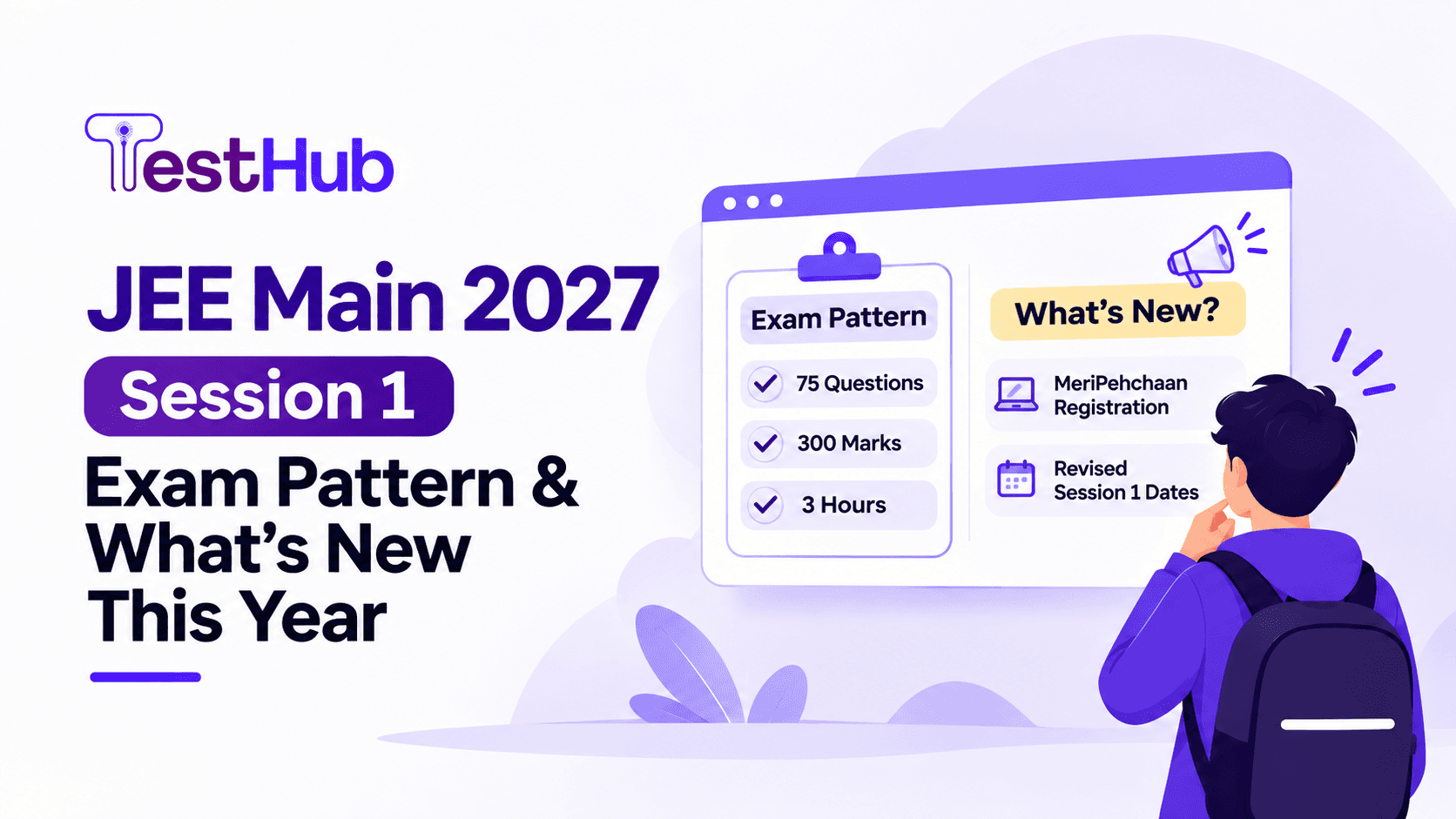
JEE Main 2027 Session 1 Exam Pattern & What's New This Year
JEE Main 2027 follows the same 75-question, 300-mark Paper 1 pattern as 2026, with no major changes to the exam structure. However, new MeriPehchaan-based registration requirements, revised Session 1 exam dates, and key application deadlines make it important for aspirants to stay updated.
1 Nov 2026 · TestHub Team
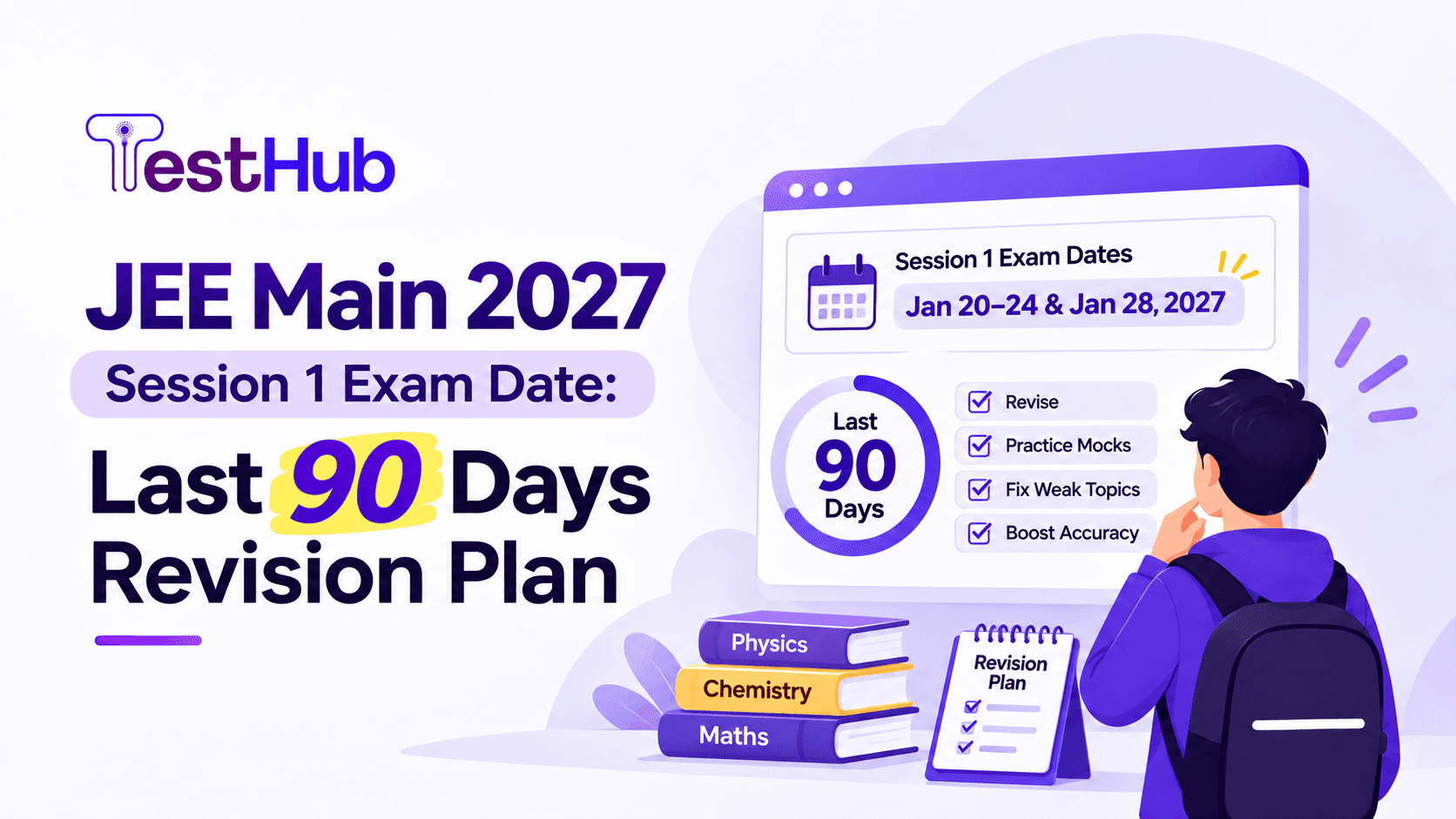
JEE Main 2027 Session 1 Exam Date: Last 90 Days Revision Plan
Prepare for JEE Main 2027 Session 1 with this 84-day study plan, featuring a week-by-week revision timetable, chapter prioritization using PYQs, mock test strategies, subject-wise time allocation, and final-week preparation tips to boost your score.

29 Oct 2026 · TestHub Team
Preparation Companion: How TestHub Tracks Your Chapter-Wise Mastery
Most JEE aspirants track how much of the syllabus they've completed, but not how much they've actually mastered. TestHub's Preparation Companion turns real test and practice performance into a measurable readiness score, identifying weak chapters and recommending exactly what to focus on next. Combined with Custom Practice and mock tests, it helps you move from simply completing the syllabus to building genuine exam readiness.

19 Oct 2026 · TestHub Team
JEE Main 2027 Registration: Dates, Fees & Application Form
Learn everything about JEE Main 2027 registration, including expected dates, eligibility criteria, required documents, application fees, and step-by-step form filling instructions. Prepare early and avoid common application mistakes.
7 Oct 2026 · TestHub Team
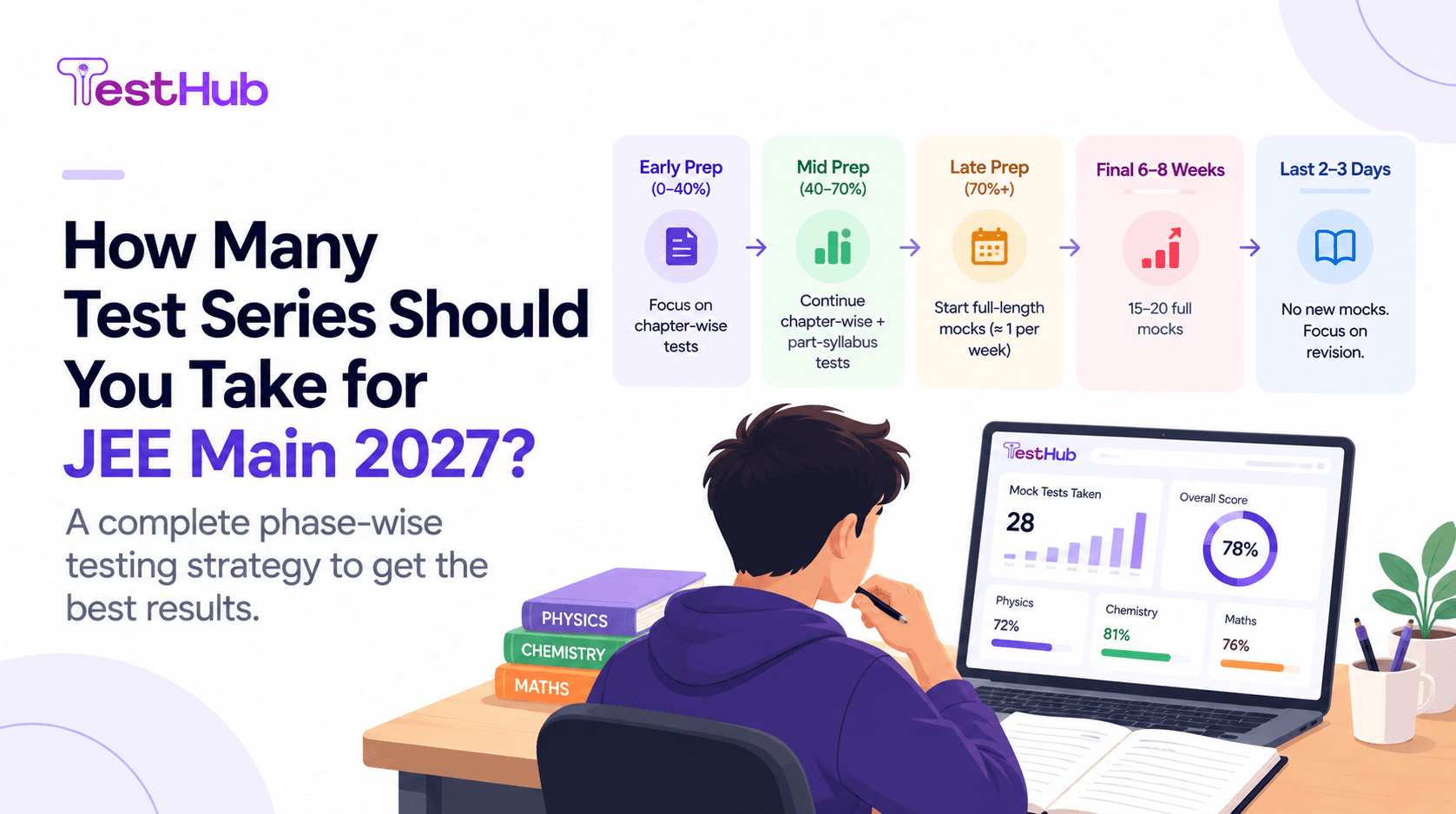
How Many Test Series Should You Take for JEE Main 2027
For most JEE Main 2027 aspirants, 20–40 full-length mock tests are a realistic target, concentrated in the final 3–4 months before the exam. But test count alone isn't enough—consistent analysis, mistake tracking, and a phase-wise testing strategy are what actually turn mock tests into score improvement.
7 Oct 2026 · TestHub Team
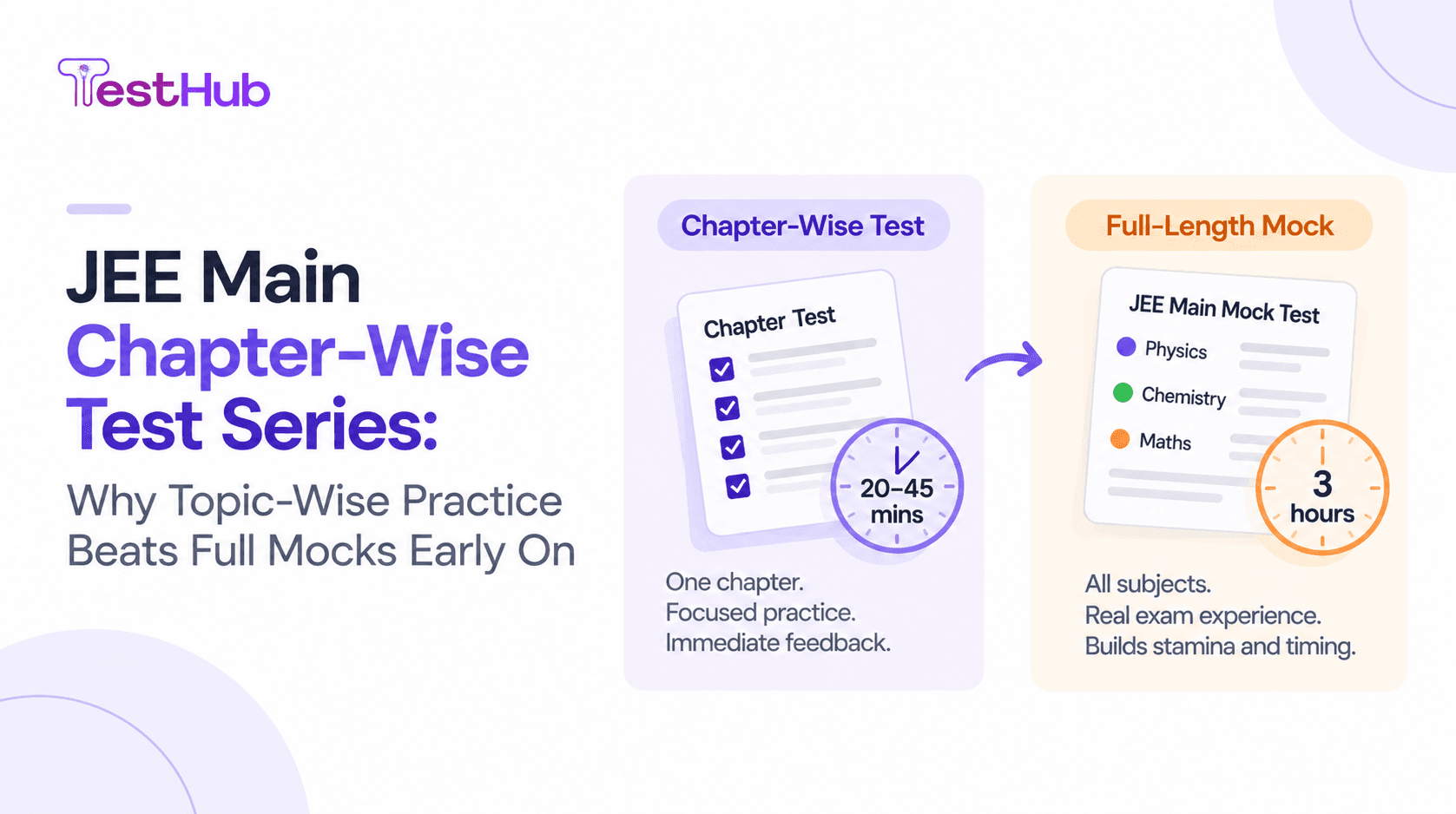
JEE Main Chapter-Wise Test Series: Why Topic-Wise Practice Beats Full Mocks Early On
Chapter-wise JEE Main tests are ideal early in preparation because they provide focused practice and immediate feedback without the pressure of a full-length mock. Learn when to use chapter-wise, subject-wise, and full-length tests to build your preparation progressively and improve your JEE Main performance.