
TestHub Team
Subject-Wise JEE Main Test Series: Why Physics, Chemistry & Maths Need Different Strategies
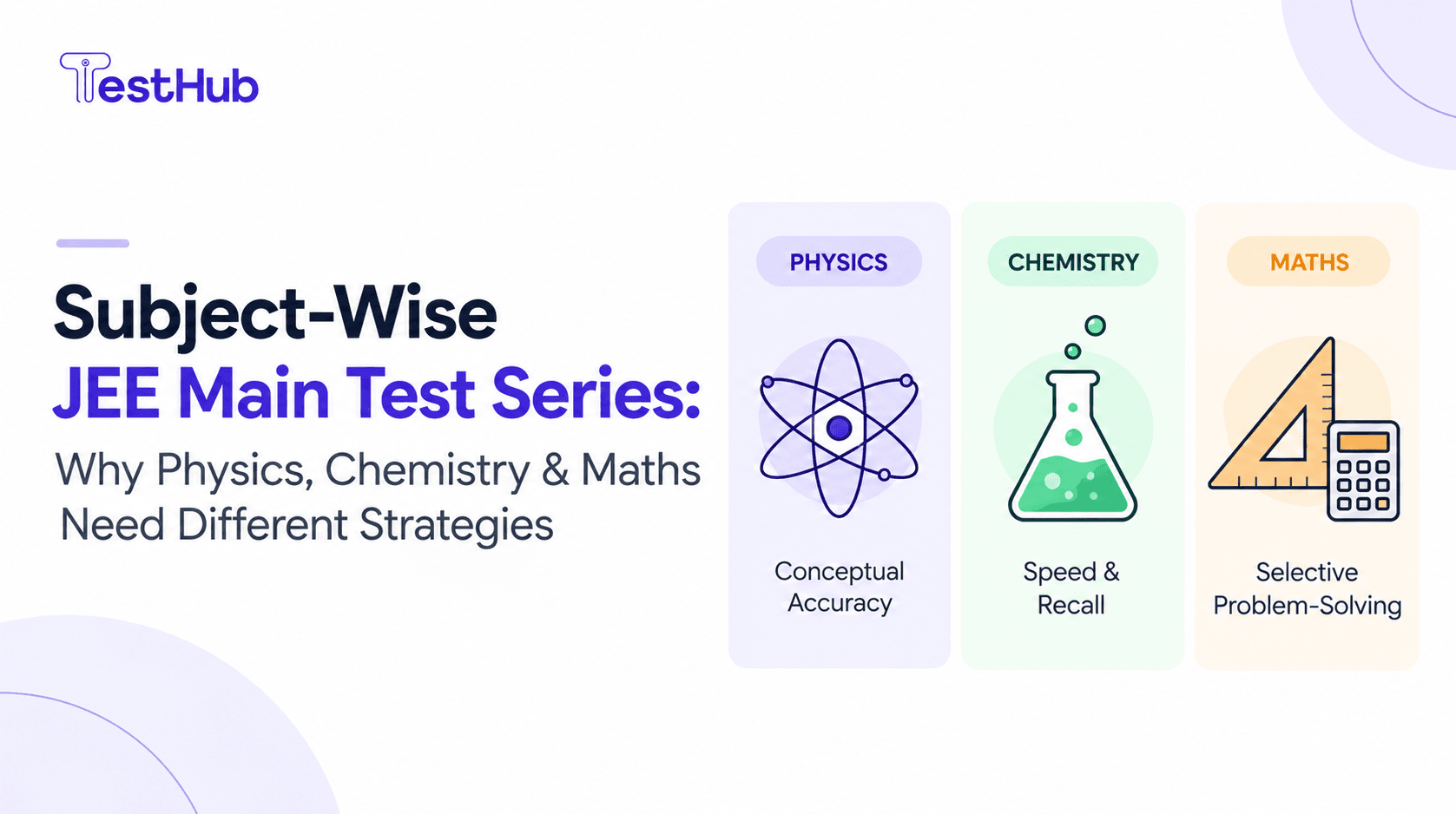
Physics, Chemistry, and Maths require different strategies in JEE Main. Chemistry rewards speed and recall, Physics demands conceptual accuracy, and Maths requires selective problem-solving and time management. A subject-wise and chapter-wise test series helps students practice according to these differences and identify whether lost marks come from knowledge gaps, conceptual errors, or poor question selection.
Here's something most students only realize halfway through their prep: treating Physics, Chemistry, and Maths the same way in a mock test is a mistake. Each subject rewards a completely different approach. Same time pressure. Same negative marking. But three very different games.
If your test series practice doesn't account for that, you're leaving marks on the table not because you don't know the content, but because you're applying the wrong strategy to the wrong subject.
Let's break down what actually works for each one.
Why One Strategy Doesn't Fit All Three Subjects
JEE Main gives you 75 questions across three hours: 25 from each subject, 100 marks each. On paper, that looks balanced. In practice, it isn't.
Chemistry is largely memory- and pattern-based. Physics demands conceptual clarity under pressure. Maths is calculation-heavy and genuinely time-consuming. Treating all three the same way in your test prep means you're probably under-preparing for the subject that actually needs the most tailored approach.
Chemistry: Your Fastest Scoring Opportunity
Educators consistently call Chemistry the most time-efficient, scoring section in JEE Main, provided you approach it with a method, not just broad reading.
Here's why it splits into three genuinely different sub-strategies:
Inorganic Chemistry: is almost entirely memory-based. NCERT is the gold standard here; questions are frequently pulled close to textbook language. This is the section where consistent revision beats clever problem-solving.
Physical Chemistry: is numerical. It rewards the same calculation practice you'd use in Maths, just with chemistry-specific formulas.
Organic Chemistry: is mechanism-based. You need to actually understand reaction pathways, not just memorize outcomes; pattern recognition matters more than raw memory here.
Most time estimates put Chemistry at 40-45 minutes out of your three hours, and many toppers attempt it first specifically to lock in an easy, confidence-building score before tackling tougher sections.
What this means for your test series practice: Don't lump all of Chemistry into one generic practice bucket. Drill Inorganic through pure recall tests, Physical through timed numericals, and Organic through mechanism-focused problem sets.
Physics: Accuracy Over Speed
Physics questions often look longer than they are. They simplify quickly once your concepts are genuinely clear, but they punish shaky understanding hard, since a small conceptual gap early in a solution derails everything after it.
Unlike Chemistry, memorizing formulas isn't enough here. JEE Main rewards students who understand why a formula works, not just what it says. High-scoring areas typically include Mechanics, Electrostatics, and Modern Physics chapters where a clear conceptual foundation pays off repeatedly.
Time estimates generally put Physics at 45-55 minutes. That's meaningfully more than Chemistry, despite the same 25-question count, because Physics questions typically demand more careful reasoning per question.
What this means for your test series practice: Prioritize accuracy over raw speed when practicing Physics. Getting 18 out of 25 right, calmly, usually beats rushing through all 25 and losing marks to careless errors under pressure.
Maths: The Real Time Sink
Here's the subject most students underestimate until exam day actually arrives. Mathematics typically eats up 70-85 minutes of your three hours, noticeably more than either Chemistry or Physics because it's genuinely the most calculation-heavy of the three.
The real skill in Maths isn't knowing more formulas. It's knowing which questions to attempt and which to skip. A common piece of advice among strong scorers: three correctly solved Maths questions beat five half-solved ones. Partial work on a numerical question earns you nothing.
What this means for your test series practice: Practice selective attempt strategy, not just solving problems, but deciding quickly whether a given question is worth your remaining time before you start solving it.
Bringing This Into Your Actual Test Series Practice
Knowing these differences in theory is one thing. Building test practice around them is what actually changes your score.
A subject and chapter-wise breakdown after every mock test tells you specifically where you're losing time versus where you're losing marks a distinction that matters differently for each subject. Losing marks in Chemistry usually points to a memory gap. Losing marks in Physics usually points to a conceptual gap. Losing time in Maths usually points to a selection-strategy problem, not a knowledge problem.
Custom, chapter-specific practice sessions are particularly useful here, since Chemistry, Physics, and Maths each need a different kind of drilling: recall-based for Inorganic, timed-numerical for Physical Chemistry and Maths, and conceptual-application for Physics and Organic Chemistry.
If you're still building your overall test series approach beyond just subject strategy, our guide on how to choose the best mock test series for JEE Main covers the broader criteria worth checking.
Final Thoughts
Physics, Chemistry, and Maths aren't just three sections of the same exam; they're three different tests of ability, wrapped into one paper. Chemistry rewards memory and method. Physics rewards conceptual accuracy. Maths rewards fast, selective calculation. Build your test series practice around these differences, and you'll close gaps a one-size-fits-all approach simply can't reach.
Want practice that's actually built around each subject's real demands? Try TestHub's mock tests and get subject-wise, chapter-wise analytics after every attempt.
Practice Smarter. Improve Subject by Subject.
Prepare for JEE Main with subject-wise and chapter-wise mock tests designed to help you identify mistakes, improve accuracy, manage time, and strengthen weak areas.
Frequently Asked Questions
Common questions readers ask about this topic.
What's the best attempt order for JEE Main Chemistry, Physics, or Maths first?
Most educators and toppers recommend Chemistry first, since it's quick and scoring, followed by Physics, then Maths last, since it typically needs the most uninterrupted time. That said, starting with your personally strongest subject to build early confidence is also a reasonable variation.
How much time should I actually spend on each subject in a mock test?
A commonly recommended split is roughly 40-45 minutes for Chemistry, 45-55 minutes for Physics, and 70-85 minutes for Maths, with a small buffer left at the end for review. Adjust slightly based on your personal strengths.
Q3. Why is Chemistry considered easier to score in than Physics or Maths?
A large share of Chemistry, especially Inorganic, is memory-based and closely tied to NCERT content, making it more predictable to prepare for compared to Physics' conceptual demands or Maths' calculation load.
Should I practice all three subjects equally, or focus more on my weak one?
Both matter, but in different ways. Maintain steady practice across all three to avoid losing your strong subjects' consistency, while directing extra targeted practice specifically at your weak chapters within each subject.
Does a test series really need to treat these three subjects differently, or is a generic mock enough?
A generic full-length mock is still essential for building overall exam temperament, but supplementing it with subject-specific and chapter-specific practice matched to each subject's actual demands closes gaps a generic mock alone won't reveal.
More on the blog

21 Oct 2026 · TestHub Team
Preparation Companion: How TestHub Tracks Your Chapter-Wise Mastery
Choosing the best JEE Advanced Test Series 2027 depends on your preparation level, budget, and goals. Compare free mocks, JEE Main-focused plans, and combined Main + Advanced test series to find the right fit, with detailed solutions, performance analytics, and realistic rank predictions.

19 Oct 2026 · TestHub Team
JEE Main 2027 Registration: Dates, Fees & Application Form
Learn everything about JEE Main 2027 registration, including expected dates, eligibility criteria, required documents, application fees, and step-by-step form filling instructions. Prepare early and avoid common application mistakes.

7 Oct 2026 · TestHub Team
How Many Test Series Should You Take for JEE Main 2027
For most JEE Main 2027 aspirants, 20–40 full-length mock tests are a realistic target, concentrated in the final 3–4 months before the exam. But test count alone isn't enough—consistent analysis, mistake tracking, and a phase-wise testing strategy are what actually turn mock tests into score improvement.
7 Oct 2026 · TestHub Team
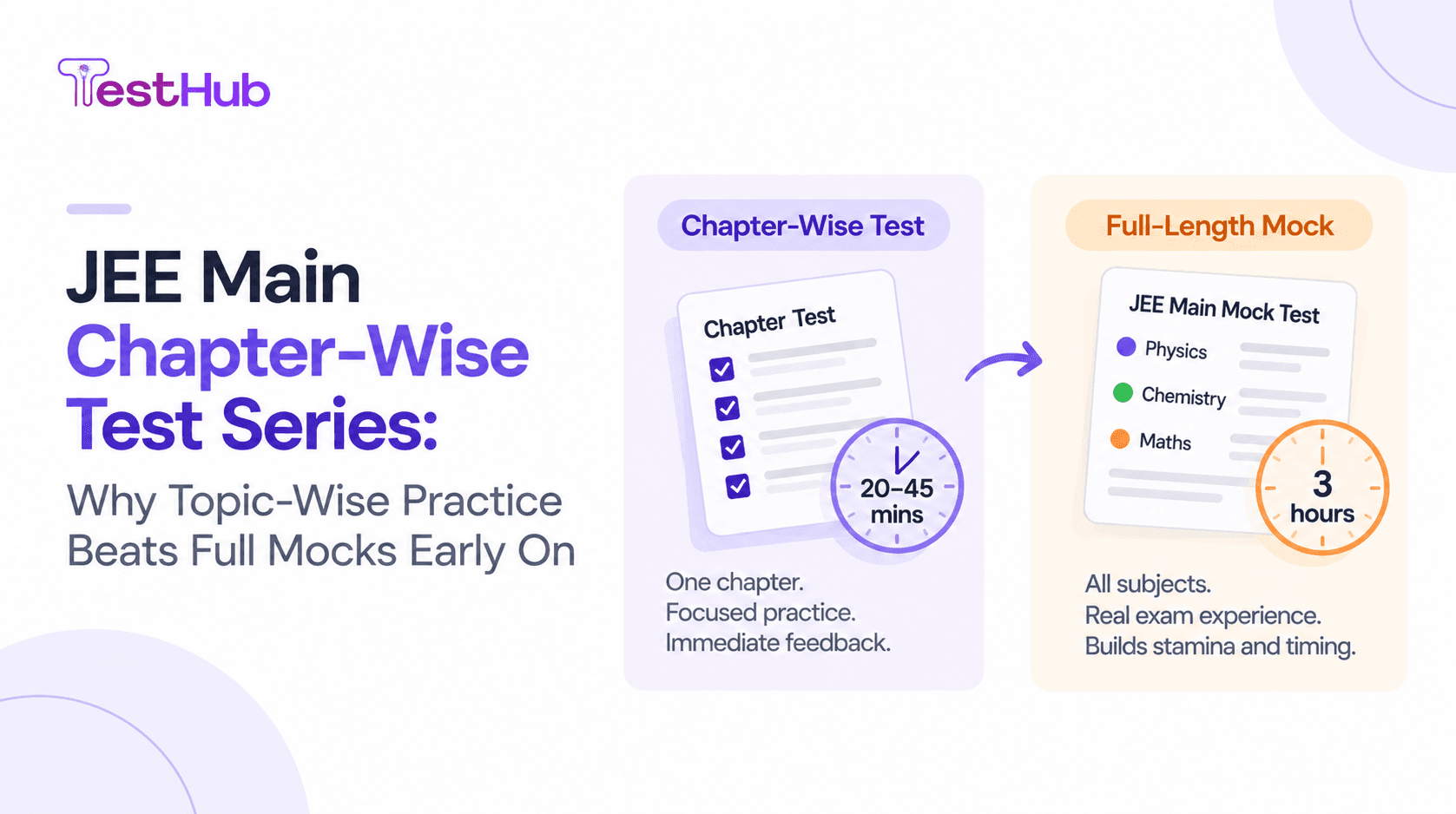
JEE Main Chapter-Wise Test Series: Why Topic-Wise Practice Beats Full Mocks Early On
Chapter-wise JEE Main tests are ideal early in preparation because they provide focused practice and immediate feedback without the pressure of a full-length mock. Learn when to use chapter-wise, subject-wise, and full-length tests to build your preparation progressively and improve your JEE Main performance.

28 Sept 2026 · TestHub Team
Best JEE Test Series in Kota vs Online: What Actually Works in 2027
Every JEE 2027 aspirant eventually faces the choice between Kota coaching and online preparation. This guide compares both options across cost, discipline, faculty access, test series quality, flexibility, and pressure to help you choose the approach that fits your preparation style, budget, and goals.
17 Sept 2026 · TestHub Team
What Is AiYaaR? TestHub's AI Doubt-Solving Assistant Explained
Stuck on a tricky JEE question late at night? AiYaaR, TestHub’s AI study companion, is built to help you solve doubts, understand concepts, analyze mistakes, and plan your next steps. Unlike generic doubt solvers, AiYaaR uses your TestHub preparation history - including test performance, topic-wise progress, mistakes, and study plans—to provide personalized guidance. From “why did I get this wrong?” to “what should I practice next?”, AiYaaR connects every doubt to your larger JEE preparation journey.
