
TestHub Team
How Many Test Series Should You Take for JEE Main 2027
For most JEE Main 2027 aspirants, 20–40 full-length mock tests are a realistic target, concentrated in the final 3–4 months before the exam. But test count alone isn't enough—consistent analysis, mistake tracking, and a phase-wise testing strategy are what actually turn mock tests into score improvement.
Scroll through any JEE prep forum, and you'll find wildly different answers to this question. Some students swear by taking a mock test every single day. Others insist quality matters more than quantity, and two or three well-analyzed tests a week is plenty. Both camps have a point but neither number means much without context.
Let's actually settle this with real numbers, and more importantly, the reasoning behind them.
The Short Answer First
For most JEE Main 2027 aspirants, the realistic target is 20 to 40 full-length mock tests, concentrated in the final 3-4 months before the exam. That's layered on top of chapter-wise and part-syllabus tests taken consistently throughout the year, often somewhere around 80-100 of those across your full preparation.
That's the range. But the more useful question isn't "what's the number" it's "does the number I'm hitting actually mean anything without proper analysis behind it."
Why the Number Alone Doesn't Tell the Full Story
Here's the problem with chasing a specific test count. Two students can both take 30 full mocks and end up in completely different places. One reviews every mistake in detail, tracks patterns across tests, and adjusts their prep accordingly. The other takes the test, glances at the score, and moves on.
The first student is actually improving with every test. The second is mostly just repeating the same exam experience 30 times without extracting much value from it. Quality of analysis, not raw test count, is what separates these two outcomes and it's the single biggest factor most "how many mocks" advice leaves out.
A Realistic Phase-by-Phase Breakdown
Rather than aiming for a flat number from day one, it helps to match your testing volume to your actual preparation stage.
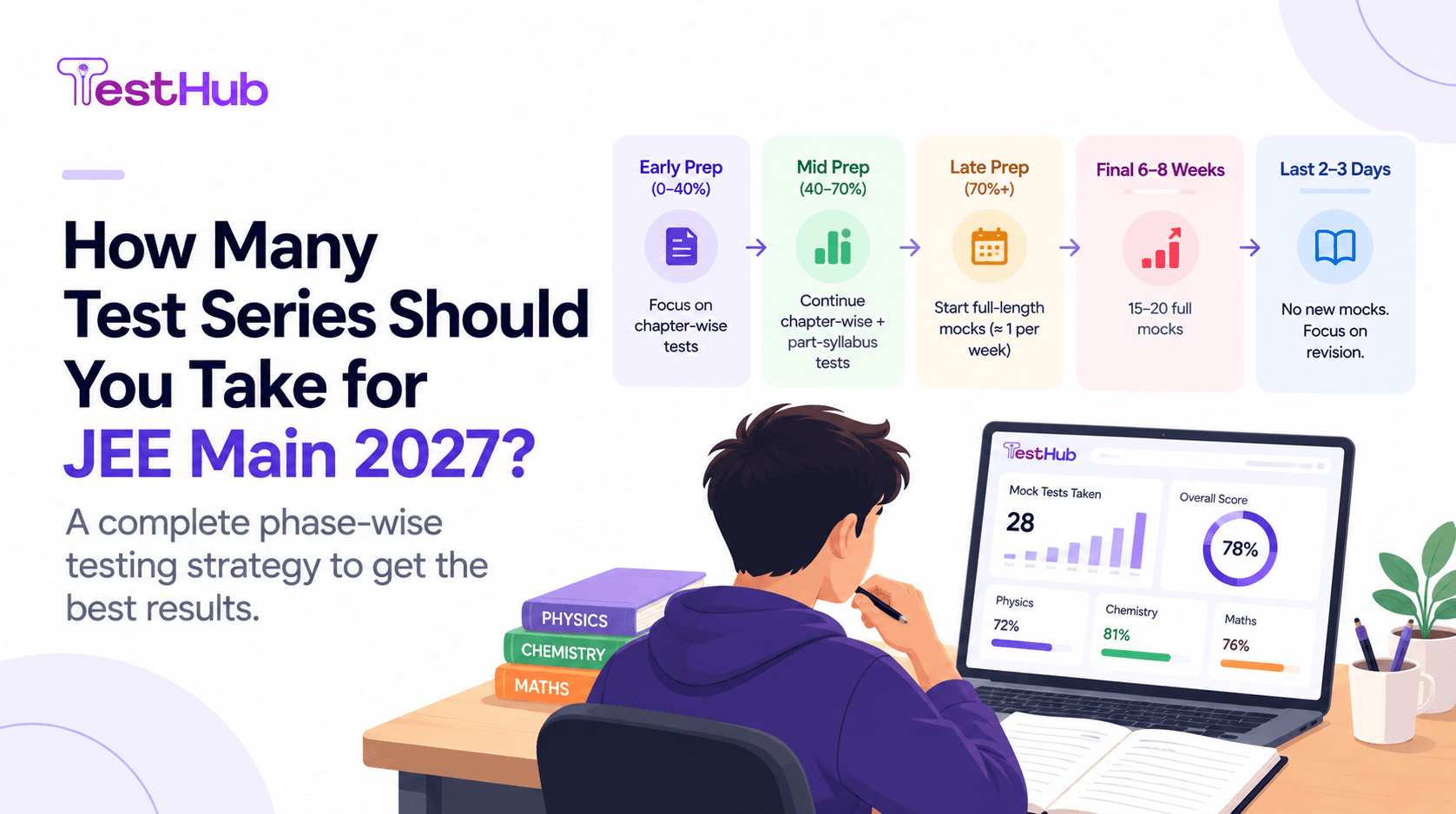
Early preparation (0-40% syllabus covered): Skip full-length mocks entirely here. Focus on chapter-wise tests instead one to two per chapter, taken shortly after finishing each topic. A full mock this early mostly confirms syllabus gaps you already know about.
Mid preparation (40-70% syllabus covered): Continue chapter-wise testing as your main tool, but start introducing occasional part-syllabus tests that combine a few related chapters together.
Late preparation (70%+ syllabus covered): This is when full-length mocks should genuinely begin. Roughly one per week is a reasonable pace here, alongside chapter-wise retests on chapters your mocks reveal as weak.
Final 6-8 weeks before the exam: This is where most of your full-mock volume should concentrate, typically 15-20 full-length mocks in this window alone, spaced with enough gap between each for proper analysis.
Final 2-3 days before the exam: Stop taking new full mocks entirely. Use this window for review and light revision, not fresh testing.
Why More Isn't Automatically Better
It's tempting to think that doubling your mock count would double your improvement. In practice, it doesn't work that way, for a simple reason: your ability to properly analyze a test doesn't scale as fast as your ability to take one.
Cramming five mocks into one week without reviewing any of them properly usually produces less improvement than two mocks that week, each followed by genuinely thorough analysis. If you're taking mocks back-to-back without at least a day or two to review mistakes in between, you're likely accumulating tests faster than you're accumulating actual improvement.
What "Enough" Analysis Actually Looks Like
For each full mock, a reasonable analysis routine includes reviewing every wrong answer's detailed solution, categorizing mistakes by cause conceptual gap, calculation error, or time pressure and comparing this test's subject-wise performance against your last few attempts to spot a real trend.
This is exactly where detailed, subject-wise analytics matter more than the raw test count. A test series that shows you a clear performance trend across your last 5-10 mocks gives you far more actionable insight than simply knowing you've completed 30 tests total.
Droppers: A Slightly Different Number
If you're preparing for a second attempt, you generally have more runway and a stronger existing foundation than a first-time Class 12 student. That means you can reasonably aim toward the higher end of the range, closer to 40-50 full mocks since your time is better spent on high-frequency testing and trend-tracking rather than building foundational concepts from scratch.
For a deeper look at structuring a full drop-year testing plan, our guide on best mock test series for JEE Main droppers covers this in more depth.
Final Thoughts
The "right" number of test series isn't really a fixed number at all; it's a number matched to your preparation stage, backed by consistent, thorough analysis after every attempt. Chasing test count without proper review is how students end up having "taken 40 mocks" without actually improving much from them.
Want a test series that helps you track quality, not just quantity? Try TestHub's mock tests and get detailed, trend-based analytics after every attempt.
Practice Smarter for JEE Main 2027
Try TestHub Mock Tests
Frequently Asked Questions
Common questions readers ask about this topic.
Is there an exact number of test series I need to take before JEE Main?
Not an exact number, but 20-40 full-length mocks in the final 3-4 months, layered on chapter-wise testing throughout the year, is a realistic and commonly recommended range for most aspirants.
Should I take more mocks if I'm scoring poorly, or focus on fewer with deeper analysis?
Generally, fewer mocks with deeper, more consistent analysis produce better results than a high volume of tests taken without proper review. Increase your test frequency only once you're confident you're actually analyzing each one thoroughly.
How many days apart should full-length mocks be?
Spacing mocks 4-5 days apart in earlier phases, and 2-3 times a week during the final 6-8 weeks, generally leaves enough time for proper analysis between attempts without letting momentum drop.
Is it okay to stop taking full mocks a few days before the actual exam?
Yes, this is generally recommended. Stop new full-length mocks in the final 2-3 days before your exam, and use that window for review and light revision instead of fresh testing.
Do droppers need more test series than first-time JEE Main aspirants?
Generally yes. With a longer preparation runway and stronger existing fundamentals, droppers can reasonably aim for a higher full-mock count, closer to 40-50, since their focus should shift more toward volume and trend-tracking.
More on the blog

21 Oct 2026 · TestHub Team
Preparation Companion: How TestHub Tracks Your Chapter-Wise Mastery
Choosing the best JEE Advanced Test Series 2027 depends on your preparation level, budget, and goals. Compare free mocks, JEE Main-focused plans, and combined Main + Advanced test series to find the right fit, with detailed solutions, performance analytics, and realistic rank predictions.

19 Oct 2026 · TestHub Team
JEE Main 2027 Registration: Dates, Fees & Application Form
Learn everything about JEE Main 2027 registration, including expected dates, eligibility criteria, required documents, application fees, and step-by-step form filling instructions. Prepare early and avoid common application mistakes.
7 Oct 2026 · TestHub Team
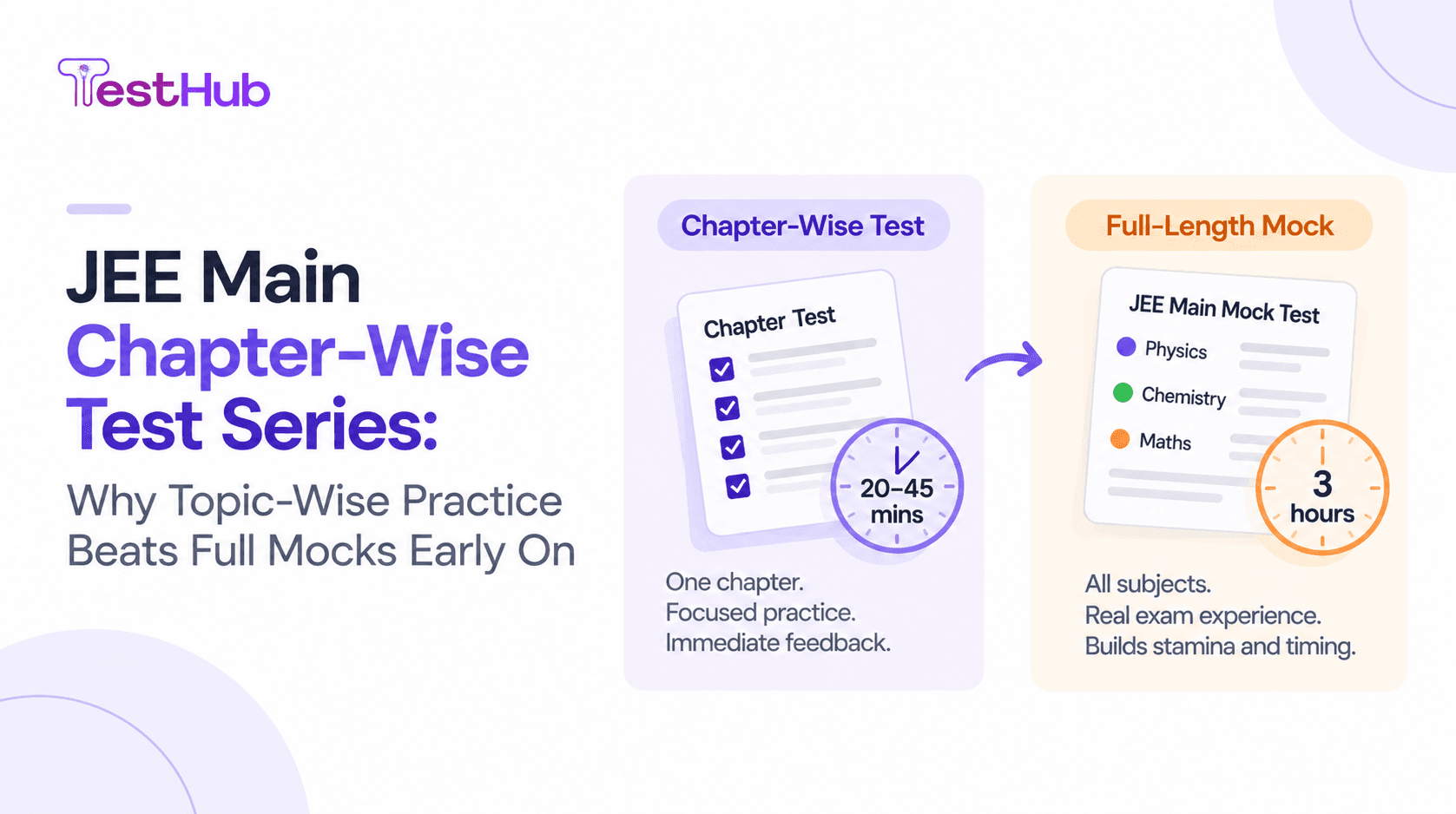
JEE Main Chapter-Wise Test Series: Why Topic-Wise Practice Beats Full Mocks Early On
Chapter-wise JEE Main tests are ideal early in preparation because they provide focused practice and immediate feedback without the pressure of a full-length mock. Learn when to use chapter-wise, subject-wise, and full-length tests to build your preparation progressively and improve your JEE Main performance.

7 Oct 2026 · TestHub Team
Subject-Wise JEE Main Test Series: Why Physics, Chemistry & Maths Need Different Strategies
Physics, Chemistry, and Maths require different strategies in JEE Main. Chemistry rewards speed and recall, Physics demands conceptual accuracy, and Maths requires selective problem-solving and time management. A subject-wise and chapter-wise test series helps students practice according to these differences and identify whether lost marks come from knowledge gaps, conceptual errors, or poor question selection.

28 Sept 2026 · TestHub Team
Best JEE Test Series in Kota vs Online: What Actually Works in 2027
Every JEE 2027 aspirant eventually faces the choice between Kota coaching and online preparation. This guide compares both options across cost, discipline, faculty access, test series quality, flexibility, and pressure to help you choose the approach that fits your preparation style, budget, and goals.
17 Sept 2026 · TestHub Team
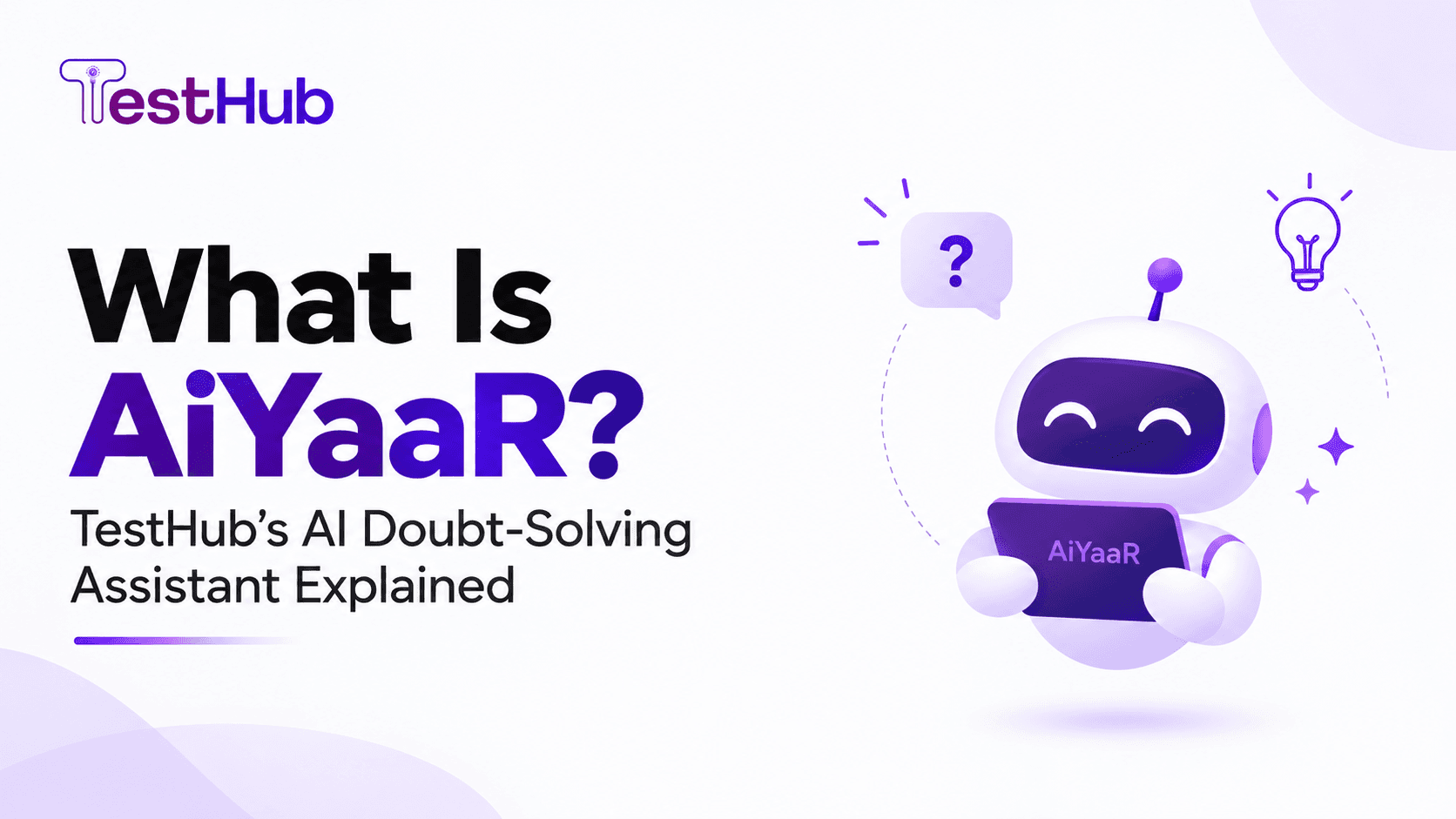
What Is AiYaaR? TestHub's AI Doubt-Solving Assistant Explained
Stuck on a tricky JEE question late at night? AiYaaR, TestHub’s AI study companion, is built to help you solve doubts, understand concepts, analyze mistakes, and plan your next steps. Unlike generic doubt solvers, AiYaaR uses your TestHub preparation history - including test performance, topic-wise progress, mistakes, and study plans—to provide personalized guidance. From “why did I get this wrong?” to “what should I practice next?”, AiYaaR connects every doubt to your larger JEE preparation journey.
