

TestHub Team
TestHub AI Analysis: How Smart Analytics Fix Your Mistakes Faster
TestHub’s AI-powered mock test analysis goes beyond your score to identify chapter-wise weaknesses, time-management issues, conceptual and calculation errors, and performance trends—helping you turn every mock test into a clear, actionable plan for improvement.
You finish a mock test, look at your score, feel a mix of relief and dread, and then... what? Most students close the tab and move on to the next test, because actually digging through 75 questions to figure out why each wrong answer went wrong feels like a whole second exam by itself. That gap — between finishing a test and actually learning from it is where most preparation time quietly gets wasted.
This is exactly the problem TestHub's AI-powered analysis is built to solve. Instead of leaving you to manually reconstruct what went wrong across an entire paper, it does the heavy lifting of pattern-spotting for you, so you walk away from every mock test with a clear, specific answer to "what do I fix next," not just a number.
Why a Score Alone Doesn't Tell You Much
A raw score answers exactly one question: how did you do today? It doesn't tell you whether you're consistently weak in a specific chapter, whether your mistakes are conceptual or careless, or whether you're actually improving compared to your last few attempts. Two students can both score 180 and have completely different underlying problems; one might be strong everywhere but slow, the other might have one badly weak chapter dragging an otherwise strong paper down. A single number can't distinguish between those two situations. Detailed analysis can.
What TestHub's AI Analysis Actually Shows You
The analysis engine isn't a simple pass/fail report; it takes a look at your performance on a multi-layered basis:
One Physics score doesn't mask a poor performance in any of the chapters/sections; instead, there is chapter-wise accuracy.
Time spent and marks received: You spend much more time on some questions than you should. A lot of the marks lost are because students are not allocating their time properly, and this is something they don't realize.
Correct errors are categorized: The wrong answer is classified according to the two most probable causes: conceptual error or computation error or, simply, a question that seems to have been so rushed that you could not possibly have finished. That difference is important, as each will require a totally different fix. If you really have a problem with speeding through numericals, re-reading a chapter won't help.
Trend tracking across tests: It's great to have a single test report, but even more meaningful to see what's happening from test to test: Is a specific weak area steadily declining or has it stayed flat for a month in spite of your efforts? It's the kind of pattern that will be overlooked nearly every time by the person who is reading one test at a time.
How This Is Different From Just Reading an Answer Key
An answer key tells if you have answered a question correctly or incorrectly; that's all. It doesn't remind you of your error, doesn't remind you to compare this test to your last 5 tests, and doesn't indicate where your time went during the exam. In theory, one can undertake this analysis by oneself, test by test, but in practice this is seldom done regularly, just because it is tedious and time-consuming when one becomes tired after a three-hour mock. That analysis becomes something you will do each and every time if you automate it; otherwise, it's a lot of work you're likely to do only when you feel like it.
Why This Matters More for Consistency Than for Any Single Test
The true power of this type of analysis is not in any one report, but in what it will accomplish over the course of weeks and months. If you are confident that your rate of calculation errors is decreasing, but your "bad" chapter remains "bad", you know which chapter or section to focus on when you spend your next study time. The kind of feedback loop that would give you a steady and measurable improvement is the one you don't have when you feel like you're working hard in preparation without gaining anything in return.
This is also part of why a proper All-India test series matters more than isolated practice; the analysis only becomes genuinely useful when you're taking tests consistently enough to build a real trend, not just checking one score in isolation.
Who Benefits Most From This
First-time aspirants get a much clearer picture of where to focus limited revision time, instead of studying every chapter with equal intensity.
Droppers benefit even more, since the whole point of a second attempt is confirming that last year's specific mistakes are actually disappearing, and that's a trend you can only see clearly with analytics that track performance across tests, not just within one.
If you want a broader look at how to choose a test series that supports this kind of consistent feedback, our guide on how to choose the best mock test series for JEE Main covers what else to check beyond analytics specifically.
Getting the Most Out of the Analysis
A few habits make this feature genuinely useful instead of something you glance at once:
Review the chapter-wise breakdown within a day of the test, while the questions are still fresh
Actually read the mistake-category tags, don't just note the score
Check your trend view every 4-5 tests, not after every single one, since single-test fluctuations are normal
Use the rank predictor alongside this to see how your improving accuracy translates into a realistic percentile
Final Thoughts
The gap between students who improve steadily and those who plateau usually isn't effort; it's whether their mistakes are actually being tracked and addressed, or just repeated test after test. TestHub's AI analysis is built to close that gap automatically, so every mock test gives you a specific, actionable answer to what to fix next, not just a score to feel good or bad about for a day.
Want to see this in action? Try a free mock test on TestHub and get a detailed, AI-powered breakdown of exactly where your marks are going.
Ready to Find and Fix Your JEE Mistakes?
Take a TestHub mock test and use AI-powered analysis to identify weak areas, understand your mistakes, and track your performance with every attempt.
Frequently Asked Questions
Common questions readers ask about this topic.
How is TestHub's AI analysis different from a regular performance report?
A regular report usually just shows your score and section-wise marks. TestHub's analysis goes further, categorizing individual mistakes by cause, tracking accuracy trends across multiple tests, and flagging where time was lost, not just where marks were lost.
Do I need to take many tests before this analysis becomes useful?
The single-test breakdown is useful from your very first mock, but the trend-tracking view, which is arguably the most valuable part, becomes meaningful after 4-5 tests, once there's enough data to spot a real pattern rather than a one-off result.
Does this replace reviewing detailed solutions myself?
No, it complements it. The analysis tells you where and what kind of mistakes are happening; the detailed, step-by-step solutions tell you exactly why a specific answer was wrong. Using both together is more effective than either alone.
Is this useful for JEE Advanced preparation too, or only JEE Main?
The same analysis approach applies across both, since the underlying goal of spotting patterns in mistakes and tracking improvement over time matters just as much for JEE Advanced's mixed question formats as it does for JEE Main.
More on the blog
2 Sept 2026 · TestHub Team
JEE Main 2027 Syllabus PDF: Complete Chapter List
Get the complete JEE Main 2027 syllabus chapter-wise for Physics, Chemistry, and Mathematics, along with the exam pattern, removed topics, and practical preparation tips to plan your JEE Main 2027 preparation effectively.
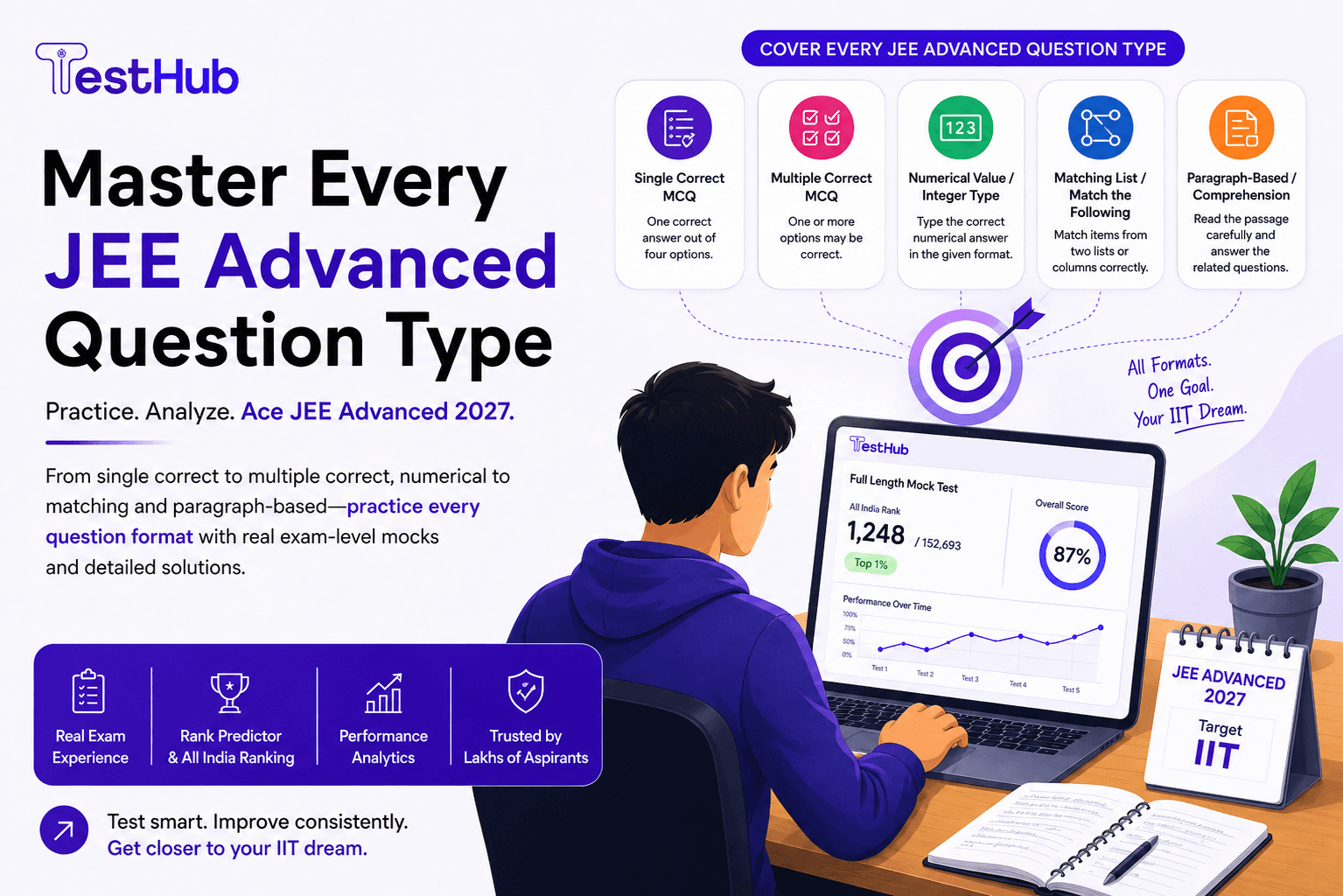
26 Aug 2026 · TestHub Team
Types of Questions in JEE Advanced: A Complete Breakdown (2027 Guide)
JEE Advanced tests more than subject knowledge - it tests how well you handle different question formats, marking schemes, and strategic risks. This guide covers every major JEE Advanced question type, including single-correct, multiple-correct, numerical, matching, and paragraph-based questions, with practical strategies for approaching each.

26 Aug 2026 · TestHub Team
Best Test Series for JEE Main 2027
Choose the right JEE 2027 test series by focusing on current exam patterns, detailed solutions, trend-based analytics, All-India benchmarking, and relevant PYQ practice - not just the number of tests offered.
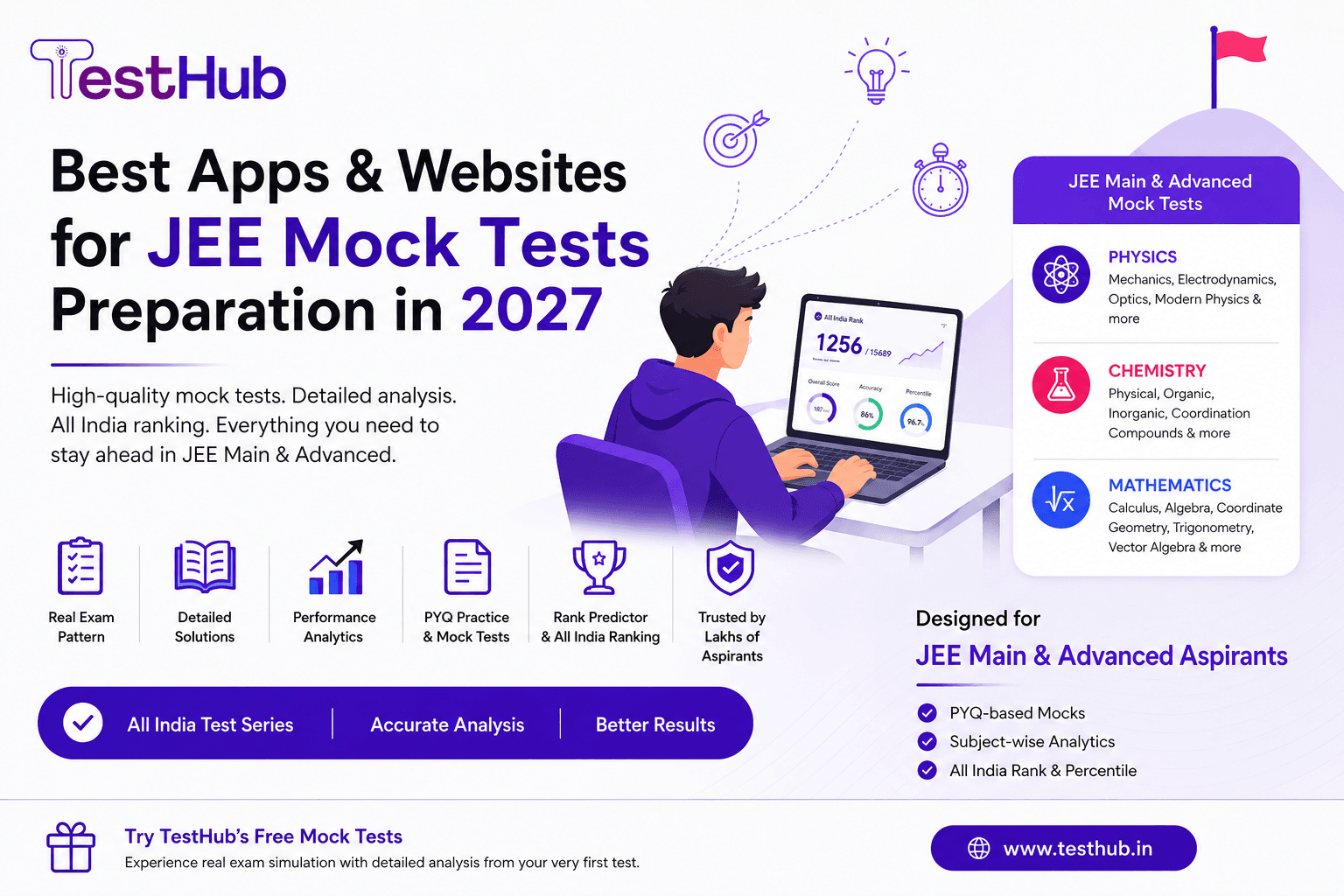
17 Aug 2026 · TestHub Team
Best Apps and Websites for JEE Mock Tests Preparation (2027 Guide)
Choosing the best JEE mock test app depends on your preparation stage and what you actually need from a testing platform. This guide compares the major categories—from coaching apps and free PYQ platforms to dedicated mock test websites—and explains how to choose the right option for JEE Main and Advanced preparation.

12 Aug 2026 · TestHub Team
Why TestHub Is One of the Best Platforms for JEE Main & Advanced Preparation in 2027
TestHub is a JEE-focused preparation platform offering All-India test series, detailed solutions, performance analytics, PYQs, a 50,000+ question bank, and rank prediction to help JEE Main and Advanced aspirants prepare smarter and improve their performance

12 Aug 2026 · TestHub Team
Most Repeated Topics in JEE Main Last 5 Years
Discover the most repeated JEE Main topics from the last five years and learn which Physics, Chemistry, and Maths chapters deserve priority. Use these proven trends to focus your revision, practice PYQs smarter, and maximize your marks without trying to treat every chapter equally.