
TestHub Team
How to Choose the Best Mock Test Series for JEE Main (7 Things to Check)
Choose the best JEE Main mock test series with this 7-point checklist covering exam pattern, analytics, PYQs, solutions, affordability, and All-India ranking.
Whether it's a series of free mock tests or paid ones, every candidate appearing for JEE Main exams will ask the same question in the end, which is, which test series to believe in? There are dozens of sites out there that claim to be "the best," but the truth is that it's not a one-size-fits-all situation; it is simply a place that fits your preparation, budget, and learning gaps. Rather than looking for rankings and reviews, it's better to evaluate each test series based on a set of criteria.
This article guides you through the very same things you need to see before you actually go ahead and buy a mock test series for JEE Main for your exams; in other words, before you make a decision based on marketing rather than substance.
Why Choosing the Right Test Series Actually Matters
In JEE Main, speed and accuracy in the face of pressure are rewarded, not conceptual knowledge. Studying physics, chemistry, and maths well does not guarantee success in the exam on the day if you have never practised exam skills in 75 questions with 180 minutes of time. How you develop that skill is through a mock test series, and only through a well-designed test series. If it is not properly constructed, it can cost you months of preparation time, or worse, it will give you an outdated pattern to train on.
This is why essay writing is as hard as studying itself, since the selection process must be thought through as well.
1. Check If the Pattern Matches the Current Exam Format
NTA has revised the JEE Main pattern more than once in recent years changes to optional questions, section-wise marking, and question count. Before trusting any test series, verify its pattern against the official JEE Main website. If a platform hasn't updated its mock tests to reflect the latest pattern, it's testing you on an exam that no longer exists.
2. Look for Detailed, Step-by-Step Solutions
This is where most test series fall down. An answer key does not help you to determine if your answer was correct or incorrect. A good solution will give reasons for any mistakes made, whether conceptual, calculation or timekeeping. A mock test without solutions is like a scorecard and not a learning tool. Always preview a free sample test before signing up for any paid plan, and read the solutions (not just the answer key).
3. Prioritize Platforms With Real Performance Analytics
The best mock test series don't just tell you your score; they tell you what to fix. Look for a breakdown by subject, chapter, and difficulty level, so you can see exactly where marks are being lost. Bonus points if the platform benchmarks your score against other test-takers, giving you a realistic sense of your all-India standing rather than just a raw number.
4. Check for PYQ (Previous Year Questions) Integration
JEE Main questions frequently echo concepts and sometimes near-exact formats from previous years. A test series that blends genuine PYQ patterns into its mock papers will give you a far more realistic sense of difficulty than one built entirely from freshly written questions. If a platform offers free PYQ practice separately, that's a good sign of how seriously it treats exam-pattern accuracy.
5. Confirm It's an All-India Test Series, Not Just a Practice Tool
There's a real difference between a test you take alone and a test you take alongside thousands of other aspirants. All-India test series benchmark your performance against a large student pool, which gives you a genuine sense of your rank potential, not just whether you improved compared to your own last attempt.
6. Weigh Test Volume Against Quality
More tests generally mean more practice repetitions, but only if each one is well-constructed. A series offering 100 well-designed, well-analyzed tests will do more for your rank than one offering 500 generic papers with shallow feedback. Don't choose based on volume alone; ask how each test is reviewed afterward.
7. Check Affordability Against What You Actually Need
If you're already enrolled in coaching or have a strong self-study routine, you may not need a test series bundled with instructional content; you need testing, analytics, and feedback specifically. Dedicated online test series are usually more affordable for this exact use case, since they're not charging you for classes you don't need.
A Quick Checklist Before You Subscribe
● Does the pattern match the latest JEE Main format?
● Are solutions detailed, not just answer keys?
● Is there subject-wise and chapter-wise performance analytics?
● Does it include PYQ-based questions?
● Is it benchmarked against an All-India student pool?
● Is the number of tests reasonable and well-analyzed?
● Does the price match what you actually need testing, not teaching?
If a platform checks most of these boxes, it's a genuinely strong option regardless of how loudly it markets itself as "the best."
Where to Start
TestHub is built directly around this checklist: an All-India test series for JEE Main and Advanced, detailed solutions on every question, subject-wise performance analytics, and free PYQ practice built into the platform. It also includes a JEE Main rank predictor so you can translate your mock scores into a realistic percentile estimate as you track your progress. Once you've picked a test series, our guide on how to analyse your JEE Advanced mock tests is a good next step to make sure you're extracting maximum value from every attempt.
Whichever platform you choose, run a few free tests first and judge the solution quality and analytics firsthand before paying for a full plan.
Final Thoughts
Choosing the best mock test series for JEE Main isn't about picking the most hyped name; it's about matching a platform against a clear checklist: updated pattern, detailed solutions, real analytics, PYQ integration, and All-India benchmarking. A test series that checks these boxes will teach you far more from every attempt than one that simply gives you a score and moves on.
Ready to put this checklist into practice? Try TestHub's free mock tests and get a detailed, subject-wise breakdown of exactly where to improve next.
Ready to Choose the Best JEE Main Test Series?
Prepare with confidence using TestHub's JEE Main mock test series. Experience exam-level tests, detailed solutions, and performance analytics to improve your score with every attempt.
Frequently Asked Questions
Common questions readers ask about this topic.
How many mock tests should I take before JEE Main?
Most experts recommend attempting at least 25–30 full-length mock tests during the final few months of preparation, along with regular chapter-wise tests. This helps build speed, accuracy, time management, and exam confidence.
Is a free mock test series good enough, or should I pay?
Free mock tests are useful for evaluating question quality, exam pattern, and solution depth before subscribing. Paid test series usually provide more tests, detailed analytics, All-India ranking, and deeper performance insights.
Should I use a test series along with coaching or instead of it?
A mock test series complements coaching or self-study rather than replacing it. Even students enrolled in coaching benefit from regular exam practice, detailed performance analysis, and realistic test-taking experience.
How do I know if a test series isn't working for me?
If your scores, percentile, or rank are not improving after 8–10 well-analyzed mock tests despite consistent preparation, the issue may be the quality of the test series or its feedback. Consider switching to a platform with better analytics and detailed solutions.
More on the blog
2 Sept 2026 · TestHub Team
JEE Main 2027 Syllabus PDF: Complete Chapter List
Get the complete JEE Main 2027 syllabus chapter-wise for Physics, Chemistry, and Mathematics, along with the exam pattern, removed topics, and practical preparation tips to plan your JEE Main 2027 preparation effectively.

29 Aug 2026 · TestHub Team
TestHub AI Analysis: How Smart Analytics Fix Your Mistakes Faster
TestHub’s AI-powered mock test analysis goes beyond your score to identify chapter-wise weaknesses, time-management issues, conceptual and calculation errors, and performance trends—helping you turn every mock test into a clear, actionable plan for improvement.
26 Aug 2026 · TestHub Team
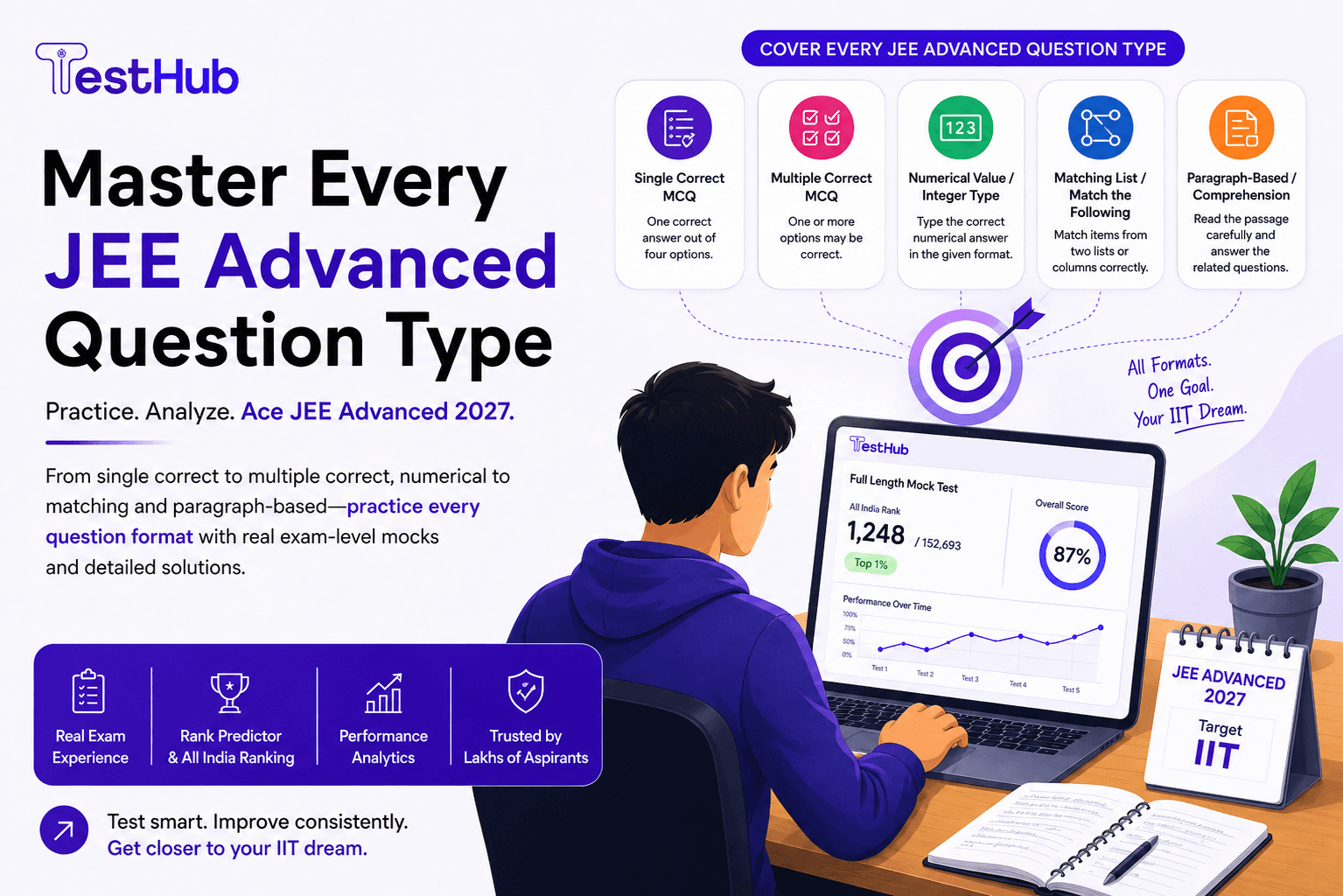
Types of Questions in JEE Advanced: A Complete Breakdown (2027 Guide)
JEE Advanced tests more than subject knowledge - it tests how well you handle different question formats, marking schemes, and strategic risks. This guide covers every major JEE Advanced question type, including single-correct, multiple-correct, numerical, matching, and paragraph-based questions, with practical strategies for approaching each.

26 Aug 2026 · TestHub Team
Best Test Series for JEE Main 2027
Choose the right JEE 2027 test series by focusing on current exam patterns, detailed solutions, trend-based analytics, All-India benchmarking, and relevant PYQ practice - not just the number of tests offered.
17 Aug 2026 · TestHub Team
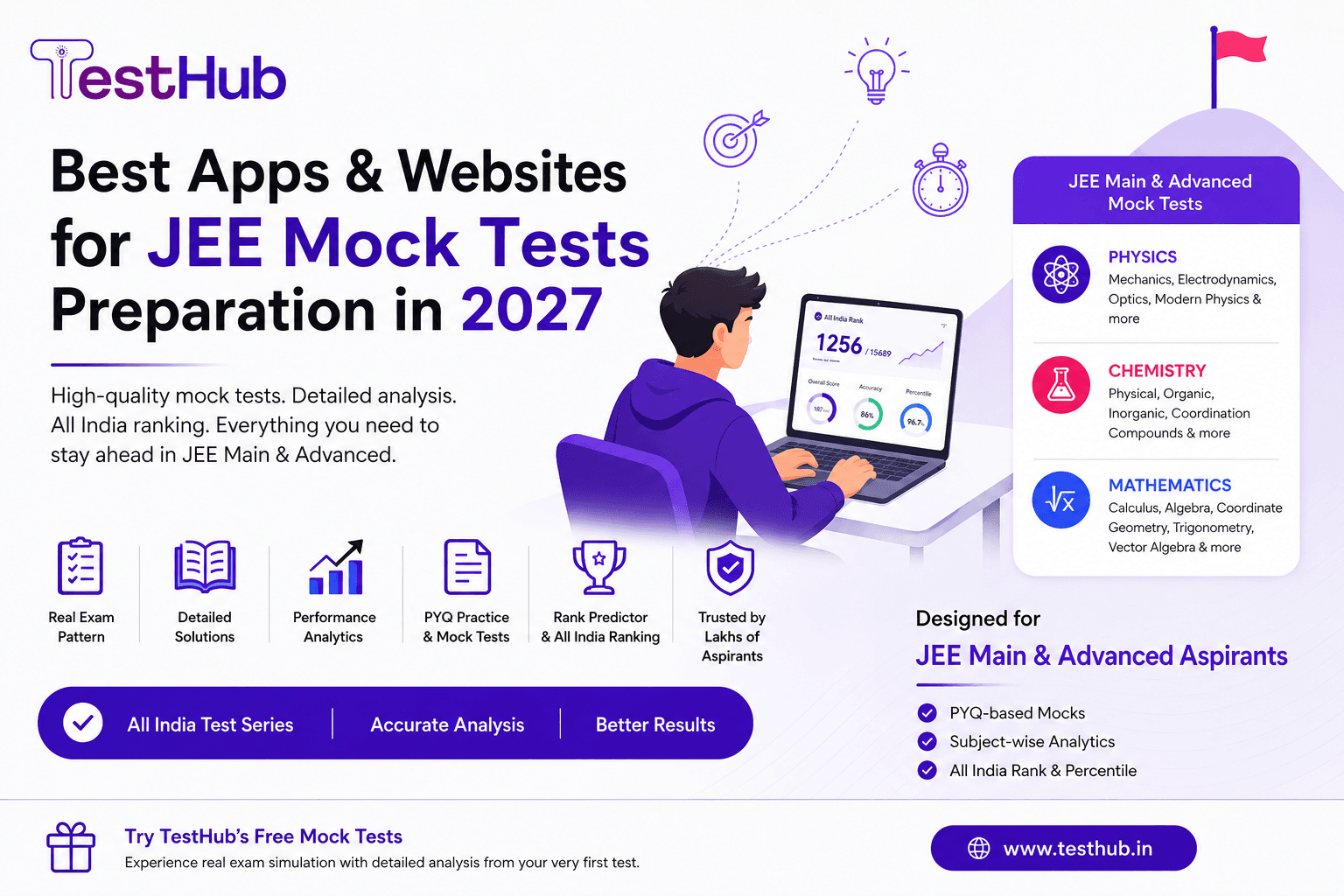
Best Apps and Websites for JEE Mock Tests Preparation (2027 Guide)
Choosing the best JEE mock test app depends on your preparation stage and what you actually need from a testing platform. This guide compares the major categories—from coaching apps and free PYQ platforms to dedicated mock test websites—and explains how to choose the right option for JEE Main and Advanced preparation.

12 Aug 2026 · TestHub Team
Why TestHub Is One of the Best Platforms for JEE Main & Advanced Preparation in 2027
TestHub is a JEE-focused preparation platform offering All-India test series, detailed solutions, performance analytics, PYQs, a 50,000+ question bank, and rank prediction to help JEE Main and Advanced aspirants prepare smarter and improve their performance