
TestHub Team
How Many IIT JEE Main 2027 Mock Tests Should 12th Students Actually Take?
Everyone tells you to "take more mocks" — nobody tells you how many are actually useful. Here's a month-by-month mock test plan for JEE Main 2027, built around real exam dates, not guesswork.
Somewhere between "take one mock a week" and "take one mock a day," most Class 12 students preparing for JEE Main 2027 lose the plot completely. Over 15 lakh candidates appeared for JEE Main across both sessions this year, and the ones who did well weren't the ones who took the most tests, they were the ones who took the right number at the right time.
If you are a class 12 student and you're heading into your board year with January 2027 already on your mind, the question isn't "how many mocks" ,it's "when, and how many, without burning out before the exam even starts."
Table of contents:
Why Does the IIT JEE Mock Test Timing Matters More Than the Count?
Building Your IIT JEE Mock Test Calendar: A Month-Wise Plan
Class 12 Students vs Droppers: Different IIT JEE Mock Test Loads
Mock Tests vs PYQs: Use Both, Not Either For Preparing IIT JEE exams 2027
Subject-Wise Focus During IIT JEE Mock Test Analysis
How to do Percentile Prediction from IIT JEE Main Mock Tests?
Tips to Improve IIT JEE Mock Test Score
Conclusion
Why Does the IIT JEE Mock Test Timing Matters More Than the Count?
Most students treat mock tests like a checklist, take 40, feel prepared. But a mock test taken in June, before you've finished half your syllabus, teaches you almost nothing except how much you don't know yet. NTA conducts JEE Main 2027 in two sessions, January and April 2027, with Paper 1 running 75 questions across Physics, Chemistry and Mathematics for 300 marks. That structure doesn't change, what should change is how your mock tests evolve alongside your syllabus completion.
Early mocks should be diagnostic. Later mocks should be simulation. Treating every mock the same way, regardless of when you take it, is where most preparation time gets wasted.
Building Your IIT JEE Mock Test Calendar: A Month-Wise Plan
Here's a realistic breakdown for a Class 12 student targeting JEE Main 2027, built around the syllabus-completion timeline rather than an arbitrary number:
Phase & Timeline | Focus | Suggested Frequency | Why |
May – Aug 2026 | Chapter-wise practice + concept building | 1–2 topic tests/month | You're still covering the syllabus, so full mocks mainly test topics you haven't learned yet. |
Sep – Nov 2026 | First full-length mocks | 1 full mock every 10–12 days | With 60–70% of the syllabus complete, it's time to build stamina and get used to the 3-hour exam format. |
Dec 2026 | Pre-Session 1 sprint | 1 full mock every 10–12 days | Align mock timing with actual exam conditions during the registration and admit card period. |
Jan 2027 | Final run-up to Session 1 | 2–3 full mocks/week | Peak simulation phase—analyse every mock on the same day to maximize improvement. |
Feb – Mar 2027 | Boards + Session 2 preparation | 1 full mock/week | Prioritise board exams while maintaining JEE momentum with regular practice. |
Apr 2027 | Pre-Session 2 sprint | 2–3 full mocks/week | Match January's intensity and refine your strategy using insights from Session 1. |
This isn't a fixed formula, a student who's ahead on syllabus by August can start full mocks earlier. The point is that frequency should track your readiness, not the calendar alone.
Class 12 Students vs Droppers: Different IIT JEE Mock Test Loads
A dropper who has already been through one IIT JEE Main attempt needs a very different rhythm than a Class 12 student juggling boards. Loading a Class 12 student with a dropper's mock schedule usually backfires, it eats into board prep time without adding much JEE benefit. The table below shows how both kind of students should approach IIT JEE main exams.
Category | Total Full Mocks (Full Year) | Peak Frequency | Board Exam Overlap |
Class 12 (first attempt) | 28–32 full-length mocks | 2–3/week (Jan & Apr) | Mocks scaled down to 1/week during Feb–Mar |
Droppers (second attempt) | 45–55 full-length mocks | Daily or near-daily (Jan & Apr) | No overlap — full intensity maintained year-round |
Note: If you're a Class 12 student, don't compare your mock count to a dropper's Instagram post. Their syllabus is already done; yours isn't. Your job in the first half of the year is concept coverage, not test volume.
Mock Tests vs PYQs: Use Both, Not Either For Preparing IIT JEE exams 2027
A lot of aspirants treat mock tests and previous year questions as competing choices. They're not, they solve different problems. Mock tests simulate exam-day pressure and timing. PYQs tell you exactly what NTA has historically asked and how often certain concepts repeat.
Aspect | Mock Tests | PYQs (Previous Year Questions) |
Purpose | Simulate real exam conditions and timing | Reveal actual NTA question patterns and repetition |
Feedback Type | Speed, stamina, section-wise time allocation | Concept clarity, frequently tested topics |
Ideal Frequency | Weekly, scaling to daily near exam dates | Ongoing, alongside every chapter you finish |
Subject-Wise Focus During IIT JEE Mock Test Analysis
Not every subject needs the same kind of mock test attention, and treating Physics, Chemistry and Maths as one combined score is exactly why most students miss their weak spot for months.
Physics rewards derivation practice alongside numericals, if you're getting numericals wrong, check whether it's a formula gap or a calculation slip, because the fix for each is completely different.
Chemistry splits three ways. Physical Chemistry needs formula recall under time pressure, so speed drills matter more than fresh learning. Organic Chemistry is mechanism logic — memorising named reactions without understanding the electron movement behind them falls apart the moment NTA tweaks a question slightly. Inorganic Chemistry is pure memory and needs the most repeated revision; it's also the section where marks are lost fastest simply because students stop revising it once "done."
Mathematics is largely about calculation speed once concepts are clear, since JEE Main questions are typically more direct than JEE Advanced-level problems — so a slow but conceptually strong student in Maths often loses more marks to time management than to actual misunderstanding.
When you're reviewing a mock, don't just look at your overall score, break it down subject-wise and track which one is silently pulling your percentile down. A common pattern: a student's overall score looks "fine" for months while Inorganic Chemistry quietly drags every attempt down by 15–20 marks. You won't catch that unless you're logging subject-wise splits after every single mock, not just the total.
How to do Percentile Prediction from IIT JEE Main Mock Tests?
Mock test scores are not a direct percentile predictor, most test series use their own difficulty curve and student pool, so a 250/300 on one platform doesn't map cleanly to a real NTA percentile
Track your rank or percentile within the test series consistently over 8–10 mocks rather than trusting a single attempt; one great or one bad mock is noise, not signal
Look at trend direction, not absolute numbers, a student moving from 85th to 90th to 93rd percentile across mocks is on a better trajectory than one stuck at a high 96th with no movement
Compare your mock percentile against the previous year's actual JEE Main percentile-to-rank data (available on NTA's site) for a rough real-world estimate, not the test series' own claimed prediction
Attempt-based normalisation matters, if a mock was taken early in your prep with an incomplete syllabus, don't weight that score the same as one taken in December or January
Session 1 and Session 2 mock performance should be tracked separately, since NTA also normalises scores across shifts and sessions using percentile, not raw marks
Treat any platform's "predicted rank" as directional guidance to plan your JoSAA options, not a guarantee, actual JEE Main cutoffs shift slightly every year based on total attempts and difficulty level
Tips to Improve IIT JEE Mock Test Score
Spend at least 2 hours analysing a mock for every 3 hours spent taking it, skipping analysis is the single biggest reason scores plateau
Separate every wrong answer into one of three buckets: concept gap, silly mistake, or time pressure — each needs a different fix, and lumping them together hides the real problem
Re-attempt only the questions you got wrong, without looking at the solution first, 48 hours after the mock, this tests whether the concept actually stuck or you just memorised the explanation
Track negative marking losses separately from unattempted questions, guessing on unfamiliar questions and losing marks is a different problem than simply running out of time
Keep an error log (a simple notebook or spreadsheet works) noting the chapter, mistake type, and date for every wrong question across mocks: patterns become obvious after 5–6 tests
Don't take back-to-back mocks without analysing the previous one first; two unanalysed mocks in a row is wasted test-taking, not double the practice
Focus revision time on your two lowest-scoring chapters from the last three mocks instead of spreading revision evenly across the whole syllabus
Simulate exact exam-day shift timing (9 AM–12 PM or 3 PM–6 PM) at least 4–5 times in the month before each session, since your alertness genuinely differs by time of day
Conclusion
There's no single magic number of Jee main and advanced mock tests 2027 that guarantees a good JEE Main 2027 percentile, what matters is matching your test frequency to your actual syllabus progress, analysing every attempt properly, and balancing board exam prep without losing JEE momentum. Build your schedule around your own readiness, not someone else's mock test count. Start now, and by January 2027, the exam format will feel familiar instead of foreign.
Stop guessing your mock test count, start tracking it.
Take a free NTA-pattern mock test on TestHub and get your subject-wise breakdown instantly.
Frequently Asked Questions
Common questions readers ask about this topic.
How many mock tests should a Class 12 student take for JEE Main 2027?
Around 28–32 full-length mock tests spread across the year works well for most Class 12 students, alongside regular chapter-wise practice earlier in the year. The exact number matters less than analysing each one properly before moving to the next.
When should I start taking full-length JEE Main mock tests?
Start full-length mocks once you've covered roughly 60–70% of your syllabus, typically around September or October before your January 2027 session. Starting earlier than that mostly tests gaps you already know exist.
Should I take more mocks than a dropper if I'm behind on syllabus?
No, taking a dropper's mock volume while your syllabus is incomplete usually hurts more than it helps. Focus on finishing concepts first; mock frequency should follow syllabus completion, not compete with a dropper's schedule.
What's the difference between mock tests and PYQs for JEE Main 2027?
Mock tests simulate real exam timing and pressure, while PYQs reveal which concepts NTA has actually tested repeatedly over the years. Both are necessary; PYQs from Class 11 onwards, full mocks from the second half of Class 12.
More on the blog
2 Sept 2026 · TestHub Team
JEE Main 2027 Syllabus PDF: Complete Chapter List
Get the complete JEE Main 2027 syllabus chapter-wise for Physics, Chemistry, and Mathematics, along with the exam pattern, removed topics, and practical preparation tips to plan your JEE Main 2027 preparation effectively.

29 Aug 2026 · TestHub Team
TestHub AI Analysis: How Smart Analytics Fix Your Mistakes Faster
TestHub’s AI-powered mock test analysis goes beyond your score to identify chapter-wise weaknesses, time-management issues, conceptual and calculation errors, and performance trends—helping you turn every mock test into a clear, actionable plan for improvement.
26 Aug 2026 · TestHub Team
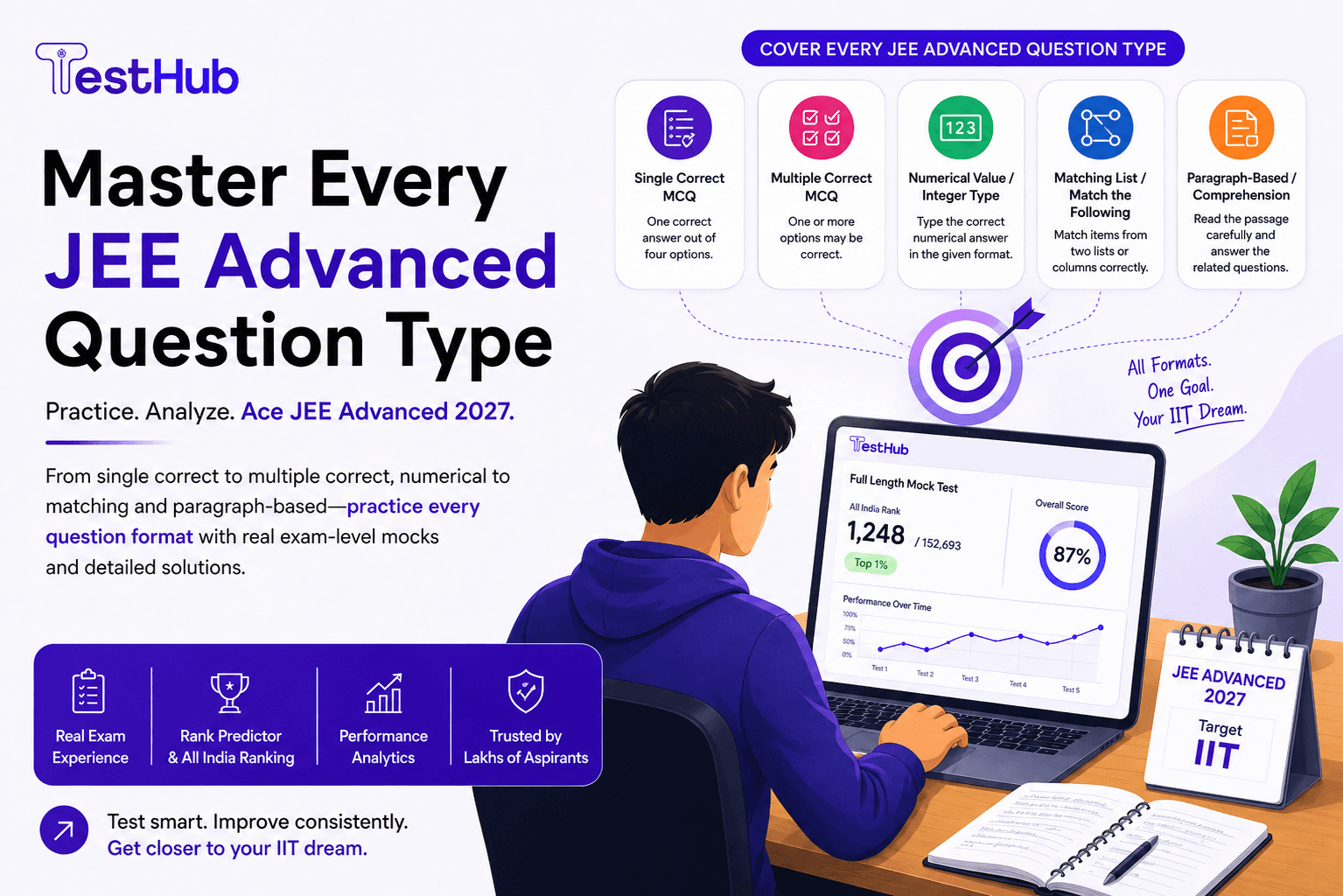
Types of Questions in JEE Advanced: A Complete Breakdown (2027 Guide)
JEE Advanced tests more than subject knowledge - it tests how well you handle different question formats, marking schemes, and strategic risks. This guide covers every major JEE Advanced question type, including single-correct, multiple-correct, numerical, matching, and paragraph-based questions, with practical strategies for approaching each.

26 Aug 2026 · TestHub Team
Best Test Series for JEE Main 2027
Choose the right JEE 2027 test series by focusing on current exam patterns, detailed solutions, trend-based analytics, All-India benchmarking, and relevant PYQ practice - not just the number of tests offered.

17 Aug 2026 · TestHub Team
Best Apps and Websites for JEE Mock Tests Preparation (2027 Guide)
Choosing the best JEE mock test app depends on your preparation stage and what you actually need from a testing platform. This guide compares the major categories—from coaching apps and free PYQ platforms to dedicated mock test websites—and explains how to choose the right option for JEE Main and Advanced preparation.

12 Aug 2026 · TestHub Team
Why TestHub Is One of the Best Platforms for JEE Main & Advanced Preparation in 2027
TestHub is a JEE-focused preparation platform offering All-India test series, detailed solutions, performance analytics, PYQs, a 50,000+ question bank, and rank prediction to help JEE Main and Advanced aspirants prepare smarter and improve their performance