

TestHub Team
JEE Advanced 2026 Exam: Dates, Eligibility, & Exam Pattern — Complete Guide
Get complete details on JEE Advanced 2026 including exam dates, eligibility criteria, exam pattern, and important guidelines to help you plan your preparation effectively for IIT admission.
Every year, over 12 lakh students sit for JEE Main hoping to earn one golden ticket a chance to appear for JEE Advanced. Out of these, only the top 2,50,000 make it to the second stage. And from that pool, only a few thousand secure a coveted seat at an IIT. That is the sheer scale of ambition and competition that JEE Advanced represents.
JEE Advanced 2026 is being conducted by IIT Roorkee on 17 May 2026. If you are a Class 12 student or a 2025 pass-out aiming for B.Tech, B.S., B.Arch, or Dual Degree programs at any of the 23 IITs across India, this exam is your gateway. Unlike JEE Main, which tests what you know, JEE Advanced tests how deeply you understand and how creatively you can apply that knowledge, under real pressure, in real time.
This blog breaks down everything you need to know: official dates, who can appear, what will be asked, how papers are structured, and how you can prepare smarter. Whether you are just starting your preparation or in the final stretch, bookmark this page. Let's get into it.
Table of contents
JEE Advanced 2026 Important Dates (Out)
IIT Roorkee officially announced the JEE Advanced 2026 exam date on 5 December 2025. Staying on top of these dates is non-negotiable and a missed deadline equals a missed year.
Event | Date(2026) |
|---|---|
JEE Main 2026 Result Declaration | 16 February 2026 (Session 1) |
JEE Advanced 2026 Registration (Foreign Nationals) | 6 April 2026 |
JEE Advanced 2026 Registration (Indian Nationals) | 23 April 2026 |
Last Date to Register | To be announced (Expected early May) |
Admit Card Download | ~3 days before exam |
JEE Advanced Exam Date | 17 May 2026 (Sunday) |
Provisional Answer Key | Expected: Late May 2026 |
Result Declaration | Expected: June 2026 |
JoSAA Counselling | Expected: June–July 2026 |
Pro Tip: Bookmark jeeadv.ac.in as your primary source for official date updates. Dates shown above are based on official announcements as of March 2026.
What Is JEE Advanced? Understanding the Exam
JEE Advanced is the second and final stage of the Joint Entrance Examination. Clearing it is the only way to get into an undergraduate engineering, science, or architecture programme at any of the 23 IITs in India, IIT Bombay, IIT Delhi, IIT Madras, IIT Kanpur, IIT Kharagpur, IIT Roorkee, and all others including the newer IITs.
It is conducted by one of the IITs on a rotational basis every year. In 2026, IIT Roorkee is at the helm. The exam is run under the oversight of the Joint Admission Board (JAB), which sets the rules, and the organising IIT handles everything from logistics to the question paper.
What Programs Does JEE Advanced Offer Admission to?
Bachelor of Technology (B.Tech): four-year engineering programs in all fields
Bachelor of Science (B.S.) programs that emphasize research
After passing the JEE Advanced, candidates must pass the Architecture Aptitude Test (AAT) to earn a B.Arch.
Five-year integrated dual degree programs (B.Tech + M.Tech or B.Sc + M.S.)
A significant update for 2026: IISc Bengaluru is now part of the JoSAA counselling process. This means JEE Advanced qualifiers can apply for select B.Tech programmes at IISc through the same seat allocation system. That is an additional reason to aim for a strong rank.
What is the eligibility criteria for JEE Advanced exam 2026
To appear for JEE Advanced 2026, a candidate must satisfy ALL five eligibility conditions simultaneously. Meeting even four out of five is not enough. Read these carefully before registering.
Criterion | Details |
|---|---|
A1 – JEE Main Rank | Must be in top 2,50,000 qualifiers (all categories combined) in JEE Main 2026 B.E./B.Tech. paper |
A2 – Age Limit | Born on or after 1 October 2001 (General/OBC/EWS) | Born on or after 1 October 1996 (SC/ST/PwD) |
A3 – Number of Attempts | Maximum 2 attempts; both must be in consecutive years. You cannot skip a year between attempts. |
A4 – Class 12 Appearance | Should have appeared in Class 12 (or equivalent) for the first time in 2025 OR 2026. Students from 2024 whose results were declared on/after 18 June 2024 are also eligible. |
A5 – Earlier IIT Admission | Must NOT have accepted admission or taken a seat at any IIT (including IIT BHU/ISM) through JEE Advanced in any previous year. |
How the 2,50,000 Slots Are Divided Across Categories
Here is something many students do not realise: your eligibility is not based purely on your overall JEE Main rank. The 2.5 lakh slots are allocated category-wise, and separate rank lists are maintained. That means an SC student ranked 40,000 overall could still qualify if their rank within the SC category list is within the top 35,625 SC candidates.
Category | Share of 2,50,000 Slots | Approx. Candidates Eligible |
|---|---|---|
OPEN (General) | 40.5% | ~1,01,250 |
Open-PwD | 2.25% | ~5,625 |
GEN-EWS | 10% | ~25,000 |
OBC-NCL | 27% | ~67,500 |
SC | 14.25% | ~35,625 |
ST | 7.5% | ~18,750 |
Special case for 2024 pass-outs: If you passed Class 12 in 2024 and your board results were declared on or after 18 June 2024, you are still eligible for JEE Advanced 2026. Similarly, students who had accepted an IIT seat previously but cancelled/withdrew their admission between 5 and 18 November 2025 can also register.
How to register for the JEE Advanced exam 2026?
Registration for JEE Advanced 2026 opens on 23 April 2026 for Indian nationals (and 6 April 2026 for foreign nationals). Here is exactly how to register:
Step-by-Step Registration Process
Visit the official website: jeeadv.ac.in
Log in using your JEE Main 2026 Application Number and Date of Birth
Fill in personal details, academic details, and category information
Choose exam city preferences (you will be given 3 choices)
Upload documents these documents: passport-size photograph, signature, Class 10 certificate, Class 12 certificate (or mark sheet), and category certificates if applicable
Pay the registration fee online (via Credit Card / Debit Card / Net Banking / UPI)
Download and save your confirmation page with registration number
Registration Fee Structure
Category | Registration Fee (Indicative) |
|---|---|
Female Candidates (All Categories) | ₹1,400 |
SC / ST / PwD Candidates | ₹1,400 |
All Other Candidates (Indian Nationals) | ₹2,800 |
SAARC Country Nationals (Foreign) | USD 75 |
Non-SAARC Country Nationals (Foreign) | USD 150 |
What is the marking scheme for JEE Advanced 2026 Marking Scheme
The marking scheme is one of the most critical things to understand. Attempting a question incorrectly in certain sections costs you marks, while leaving it blank does not. Here is the general marking framework based on 2025 Paper 1 as a reference:
Question Type | Correct Answer | Incorrect Answer | Unattempted |
|---|---|---|---|
Single Correct MCQ (Sec I) | +3 | -1 | 0 |
Multiple Correct MCQ (Sec II) | +4 (full); partial credit for partial answers | 0 (no negative) | 0 |
Numerical Answer Type – Sec III (Paper 1) | +4 | 0 (no negative) | 0 |
Numerical Answer Type – Sec IV (Paper 1) | +3 | -1 | 0 |
Smart Exam Strategy: In sections with negative marking, never attempt a question based on a guess. If you can eliminate 2 of 4 options confidently, the probability math may favor attempting but if you are 50/50, skip. In NAT (numerical answer) sections with no negative marking, always fill in your best estimate.
Preparation Strategy for JEE Advanced 2026 — What Actually Works
There is no shortage of advice on the internet about how to prepare for JEE Advanced. Most of it says the same things in different ways. What follows is not generic advice — it is a phased plan built around the reality of the exam: unpredictable pattern, application-based questions, and a compressed timeline.
Phase | Focus Areas | What to Avoid |
|---|---|---|
6+ months out | Build conceptual base from NCERT + standard references. Do chapter-wise tests to find weak spots early. | Jumping into full mocks without conceptual clarity. That's like running a race on a sprained ankle. |
3–6 months out | Shift to JEE Advanced-level problems. Solve PYQs (2010–2025) chapter-wise. Track accuracy per topic. | Covering new topics at this stage. Stick to what's in the syllabus, go deeper on it. |
6–8 weeks out | Full mock tests every 2 days + thorough error analysis. Revise formulas, reactions, and theorems each morning. | Starting new topics. Switching textbooks. Comparing yourself to others on social media. |
Exam week | Light revision, familiar problems, sleep well, travel-plan to exam centre in advance. | All-nighters. Attempting new question sets. Overthinking the paper pattern. |
Mock Tests — The Part Most Students Do Wrong
Attempting mock tests is not preparation. Analysing them is. The split should be roughly 60% attempt, 40% analysis. After every mock test, do the following:
Mark every question you got wrong — was it a conceptual gap, a careless error, or a pattern misjudgement?
Go back to the source material for conceptual gaps. Do not move on until you understand why the right answer is right.
Track your accuracy per section type — are you consistently losing marks on multi-correct MCQs? That is a pattern you need to fix.
Re-attempt the same paper 3–4 days later. If you still get the same ones wrong, the concept has not stuck.
Final Thought and Your Next Step
Here is the honest picture: JEE Advanced 2026 is not an exam you can get through on sheer memorisation or last-minute cramming. It rewards students who have built deep understanding over months, who can stay calm when they see an unfamiliar question type, and who have practised enough to manage their time under real pressure.
The dates are set. The exam is 17 May 2026. Registration opens 23 April 2026 and closes 2 May 2026. The syllabus is unchanged from 2025. Everything you need to know is now in front of you.
What happens next depends entirely on what you do with this information.
Frequently Asked Questions
Common questions readers ask about this topic.
When is JEE Advanced 2026 exam?
JEE Advanced 2026 will be conducted on 17 May 2026 (Sunday) by IIT Roorkee.
Who is eligible for JEE Advanced 2026?
Students must be in the top 2,50,000 of JEE Main 2026, meet age criteria, and have appeared for Class 12 in 2025 or 2026.
How many attempts are allowed for JEE Advanced?
A candidate can attempt JEE Advanced a maximum of two times in consecutive years.
Is there negative marking in JEE Advanced?
Yes, some sections have negative marking, while others like numerical answer type may not.
More on the blog
2 Sept 2026 · TestHub Team
JEE Main 2027 Syllabus PDF: Complete Chapter List
Get the complete JEE Main 2027 syllabus chapter-wise for Physics, Chemistry, and Mathematics, along with the exam pattern, removed topics, and practical preparation tips to plan your JEE Main 2027 preparation effectively.

29 Aug 2026 · TestHub Team
TestHub AI Analysis: How Smart Analytics Fix Your Mistakes Faster
TestHub’s AI-powered mock test analysis goes beyond your score to identify chapter-wise weaknesses, time-management issues, conceptual and calculation errors, and performance trends—helping you turn every mock test into a clear, actionable plan for improvement.
26 Aug 2026 · TestHub Team
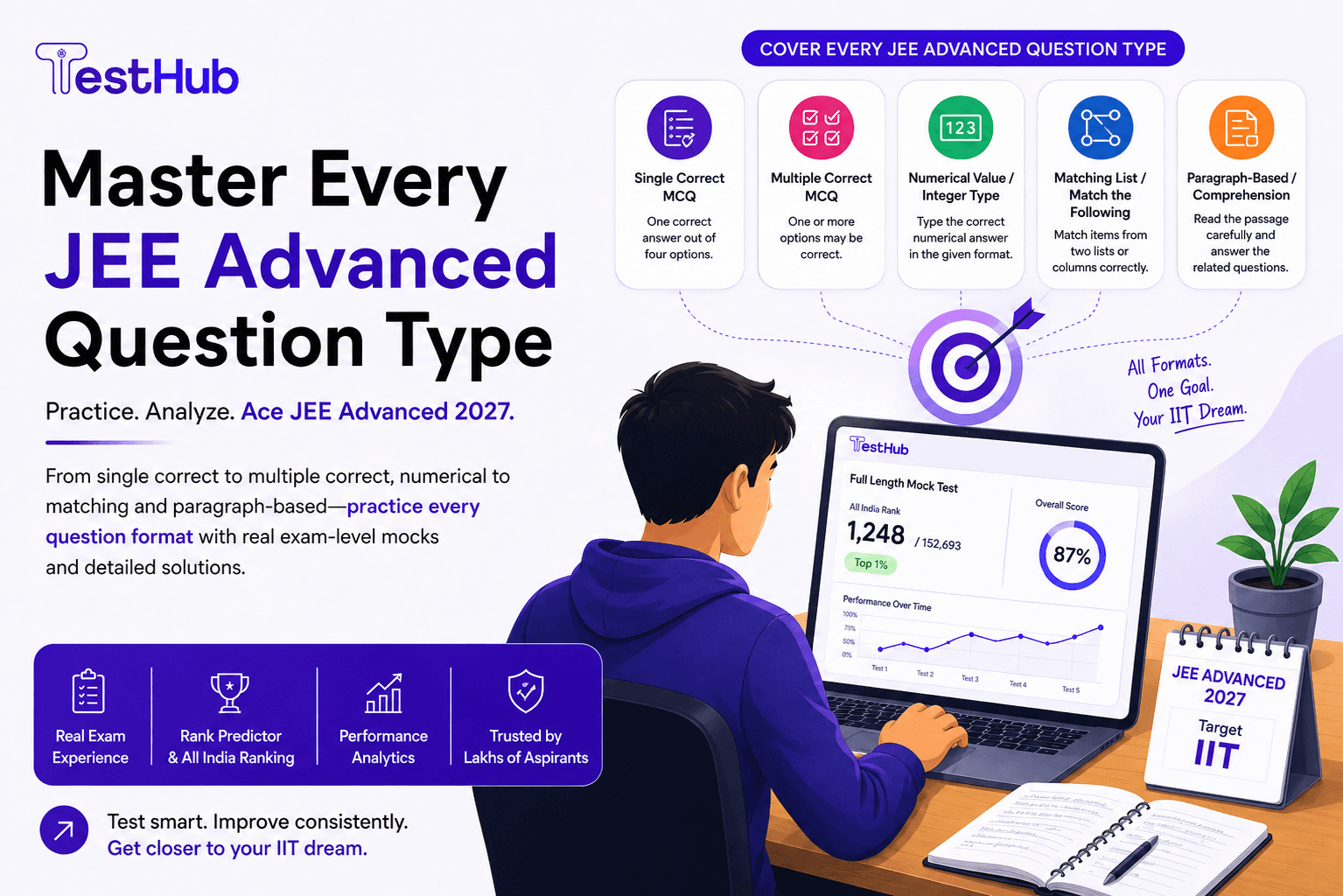
Types of Questions in JEE Advanced: A Complete Breakdown (2027 Guide)
JEE Advanced tests more than subject knowledge - it tests how well you handle different question formats, marking schemes, and strategic risks. This guide covers every major JEE Advanced question type, including single-correct, multiple-correct, numerical, matching, and paragraph-based questions, with practical strategies for approaching each.

26 Aug 2026 · TestHub Team
Best Test Series for JEE Main 2027
Choose the right JEE 2027 test series by focusing on current exam patterns, detailed solutions, trend-based analytics, All-India benchmarking, and relevant PYQ practice - not just the number of tests offered.

17 Aug 2026 · TestHub Team
Best Apps and Websites for JEE Mock Tests Preparation (2027 Guide)
Choosing the best JEE mock test app depends on your preparation stage and what you actually need from a testing platform. This guide compares the major categories—from coaching apps and free PYQ platforms to dedicated mock test websites—and explains how to choose the right option for JEE Main and Advanced preparation.

12 Aug 2026 · TestHub Team
Why TestHub Is One of the Best Platforms for JEE Main & Advanced Preparation in 2027
TestHub is a JEE-focused preparation platform offering All-India test series, detailed solutions, performance analytics, PYQs, a 50,000+ question bank, and rank prediction to help JEE Main and Advanced aspirants prepare smarter and improve their performance