

TestHub Team
How to Crack JEE Main 2027: A Realistic Preparation Roadmap
Every JEE aspirant starts with a plan, but not every plan survives the journey. This honest guide to JEE Main 2027 preparation focuses on what actually works—building strong concepts, using PYQs the right way, analysing mock tests, and staying consistent without burning out. If you're looking for practical advice instead of unrealistic study schedules, this guide is for you.
Every January and April, thousands of students walk into the JEE Main exam hall carrying elaborate study plans copied from a topper's Instagram post or a coaching institute's "ultimate timetable" PDF. Most of these plans collapse within two weeks because they were never built around the student's own pace, strengths, and weak areas in the first place.
Real JEE Main preparation is about building a process that works for you. This guide provides a straightforward strategy for IIT JEE Main 2027, showing exactly where most students go wrong and what to do instead.
Table of contents:
Understanding the JEE Main 2027 Exam Pattern
How to Start Your JEE Main 2027 Preparation?
Subject-Wise Strategy That Works
What are the Mistakes Students Should Avoid Making?
Why are PYQs the Real Syllabus?
Mock Tests: The Step Most Students Get Wrong
The Mental Game Nobody Talks About
Final Word
Understanding the JEE Main 2027 Exam Pattern
Conducted by | NTA |
Sessions | Two — January and April |
Final score | The best of your two attempts is considered |
Subjects | Physics, Chemistry, Mathematics |
Question format | ~25 questions per subject — mix of MCQs and numerical value questions |
Duration | 3 hours |
Difficulty trend | A growing share of shifts lean toward multi-step, conceptually demanding questions, not just direct formula application |
Don't assume | JEE Main stays "easier than Advanced" on every shift—some shifts test at a genuinely high level |
Before finalising anything | Cross-check the official JEE Main 2027 notification closer to the exam rather than relying on last year's pattern |
How to Start Your JEE Main 2027 Preparation?
Most students spend the first week downloading timetables, color-coding notebooks, and watching motivation videos. Here's what actually moves the needle on day one:
Get the syllabus printed and on your wall. Go through it once with a highlighter: strong topics in green, shaky ones in orange, and barely-touched ones in red. That honest map is your real starting point.
Build a timetable around your actual day, not an ideal one. A timetable you follow 80% of the time beats a perfect one you abandon in two weeks.
Pick your study material once and commit to it. NCERT is non-negotiable as the base. One solid reference book per subject alongside it is enough. Chasing every new resource is just procrastination.
Start with your weakest subject, not your favourite. Every student naturally gravitates toward what they're already good at. Flip that habit early; the exam scores all three subjects equally.
Take short notes as you study, in your own words. Copying from a book into a notebook isn't note-taking. Write it the way you'd explain it to a friend, and it'll actually stick.
Don't wait for the "perfect" preparation phase to begin practising. Solve problems from the first week, even if they feel difficult. Struggle early, score better later.
Protect your consistency more than your daily hour count. Six focused days a week for twelve months outperforms three intense weeks followed by burnout, every single time.
Subject-Wise Strategy That Works
Physics
Focus on building strong conceptual clarity rather than memorising formulas.
Try to understand the derivations of important formulas and learn why they work, as this helps solve application-based JEE Main questions.
Based on consistent PYQ trends, prioritise Mechanics, Electrostatics, Current Electricity, and Modern Physics.
Solve that chapter's previous-year questions right after finishing it.
Maintain a separate numerical-mistake log.
Chemistry
Chemistry is honestly the easiest subject to score well in if you approach it the right way.
Start physical chemistry. Once theory is done, solve numericals from equilibrium, electrochemistry, and thermodynamics daily. This is the most scoring part of chemistry, but only if you actually practice it.
For inorganic, read NCERT line by line. A large share of questions are lifted almost directly from the text.
Make short, flashcard-style notes on exceptions, compound colours, and trends.
Get General Organic Chemistry completely solid before starting any reaction chapter. Every reaction builds on this base.
Don't ignore practical and environmental chemistry chapters that consistently hand out easy marks.
Mathematics
Mathematics in JEE Main is more about speed than difficulty. You probably already understand most of the concepts; the real challenge is solving fast enough and avoiding silly mistakes under pressure.
Treat calculus and algebra as your top priority. These two have shown up as high-weightage areas year after year.
Don't skip Vectors. They're calculation-heavy but conceptually simpler; that means easy marks once you've practised the patterns.
After solving a problem the textbook way, try it again in under 3 minutes using a shortcut. If you can't, that's the one to drill, not skip.
Always solve with a timer running. Most math mistakes aren't concept gaps; they're time pressure.
Learn MCQ shortcuts: elimination, plugging in values, and checking answer choices before starting a long method.
Keep a separate silly-mistake log from your concept errors, and review it every weekend.
What are the Mistakes Students Should Avoid Making?
Jumping straight into reference books without finishing NCERT, especially in Chemistry.
Solving PYQs too late, often just a month before the exam, leaving no time to fix the gaps they reveal.
Favoring one subject and neglecting the other two, which hurts overall percentile since JEE Main rewards balance across all three.
Skipping a structured revision plan and forgetting concepts studied months earlier.
Jumping between several teachers, channels, or note sets for the same topic. More sources rarely means more learning; it usually just means more confusion and less actual problem-solving time.
Comparing study hours with friends instead of tracking actual syllabus completion and accuracy.
Why are PYQs the Real Syllabus?
IIf there's one thing every JEE aspirant should be doing from day one, it's solving previous-year questions. They show you exactly how the exam thinks:
which chapters carry real weight
which concepts keep coming back
how questions are framed
what level of difficulty you're actually preparing for
But most students treat PYQs as a last-minute revision tool. That's where the opportunity is lost.
The right way to use JEE Main previous year questions online is chapter by chapter:
Finish the theory for a chapter.
Solve your standard practice questions.
Solve JEE Main PYQs from the last 5–10 years for that chapter.
Sit with your mistakes and understand exactly why each one happened.
This approach to chapter-wise JEE PYQ practice is what separates consistent performers from students who cram everything at the end. You'll start noticing patterns certain question types that repeat, specific concepts that show up in different forms, and gaps in your understanding that wouldn't have surfaced any other way.
If you're looking for a more structured way to practise, finding the best platform for JEE PYQs matters more than most students realise. Instead of hunting for questions across scattered sources, platforms like Test Hub let you practise organised PYQs chapter by chapter in one place — for both JEE Main and Advanced. You can track your performance and quickly identify the topics where you're losing marks.
Once your PYQ practice is consistent, the natural next step is pairing it with the best JEE test series you can access. A good JEE Main mock test series should mirror the actual exam pattern, give you detailed analysis of your attempts, and help you benchmark where you stand. Look for a most relevant JEE Main test series one that's updated to reflect the latest NTA patterns, not recycled questions from five years ago.
For Advanced aspirants specifically, a JEE Advanced test series with detailed analysis is non-negotiable in the final four months. The analysis is where the real learning happens — not in the score, but in understanding why you lost marks and how to fix it before exam day.
The Mental Game Nobody Talks About
JEE Main 2027 will have approximately 12–14 lakh registrations. The competition is real. But here's what the data shows: most students don't fail JEE Main because they don't know enough — they fail because they lose confidence in the last 3 months.
Build a routine that protects your mental health:
7–8 hours of sleep is non-negotiable (sleep consolidates memory)
Physical activity 3–4 times a week, even a 20-minute walk resets focus
Weekly review sessions every Sunday to adjust your strategy, not panic about it
Final Word
There is no secret formula. But there is a difference between students who study for JEE and students who prepare for JEE. The former consume content endlessly. The latter build systems of revision, error correction, mock analysis, and mental resilience.
Start now. Stay consistent. Trust the process but also audit it regularly.
JEE Main 2027 is 18 months away. That's enough time for a complete transformation, if you use it right.
Preparing for JEE Main 2027?
Take your preparation to the next level with a high-quality JEE Main test series.
Frequently Asked Questions
Common questions readers ask about this topic.
How many times should I revise the syllabus before JEE Main 2027?
At least twice, ideally three times. First revision after finishing each chapter, second after completing the full syllabus, and a final quick revision in the last few weeks using short notes and formula sheets. Most students underestimate how much revision it actually takes for things to stay sharp.
What is the ideal timetable for JEE Main 2027 preparation?
One that you can actually follow, not one that looks impressive on paper. Two focused study sessions a day, rotating subjects across the week, daily practice questions, and a weekly mock test once your syllabus is largely covered, that's a realistic and effective structure for most students.
How should I use AI tools for JEE Main 2027 preparation?
AI is genuinely useful for breaking down difficult solutions, explaining concepts in simpler language, and generating similar practice questions. Use it as a learning aid when you're stuck, not as a way to get answers without attempting the problem yourself first.
How do I stay motivated during JEE Main 2027 preparation?
Motivation will come and go; that's normal, and it happens to every student. What keeps you going isn't motivation; it's habit and routine. Set small daily targets, track your progress honestly, take one half-day off every week, and remind yourself that showing up on the bad days is what actually separates consistent performers from everyone else.
More on the blog
2 Sept 2026 · TestHub Team
JEE Main 2027 Syllabus PDF: Complete Chapter List
Get the complete JEE Main 2027 syllabus chapter-wise for Physics, Chemistry, and Mathematics, along with the exam pattern, removed topics, and practical preparation tips to plan your JEE Main 2027 preparation effectively.

29 Aug 2026 · TestHub Team
TestHub AI Analysis: How Smart Analytics Fix Your Mistakes Faster
TestHub’s AI-powered mock test analysis goes beyond your score to identify chapter-wise weaknesses, time-management issues, conceptual and calculation errors, and performance trends—helping you turn every mock test into a clear, actionable plan for improvement.
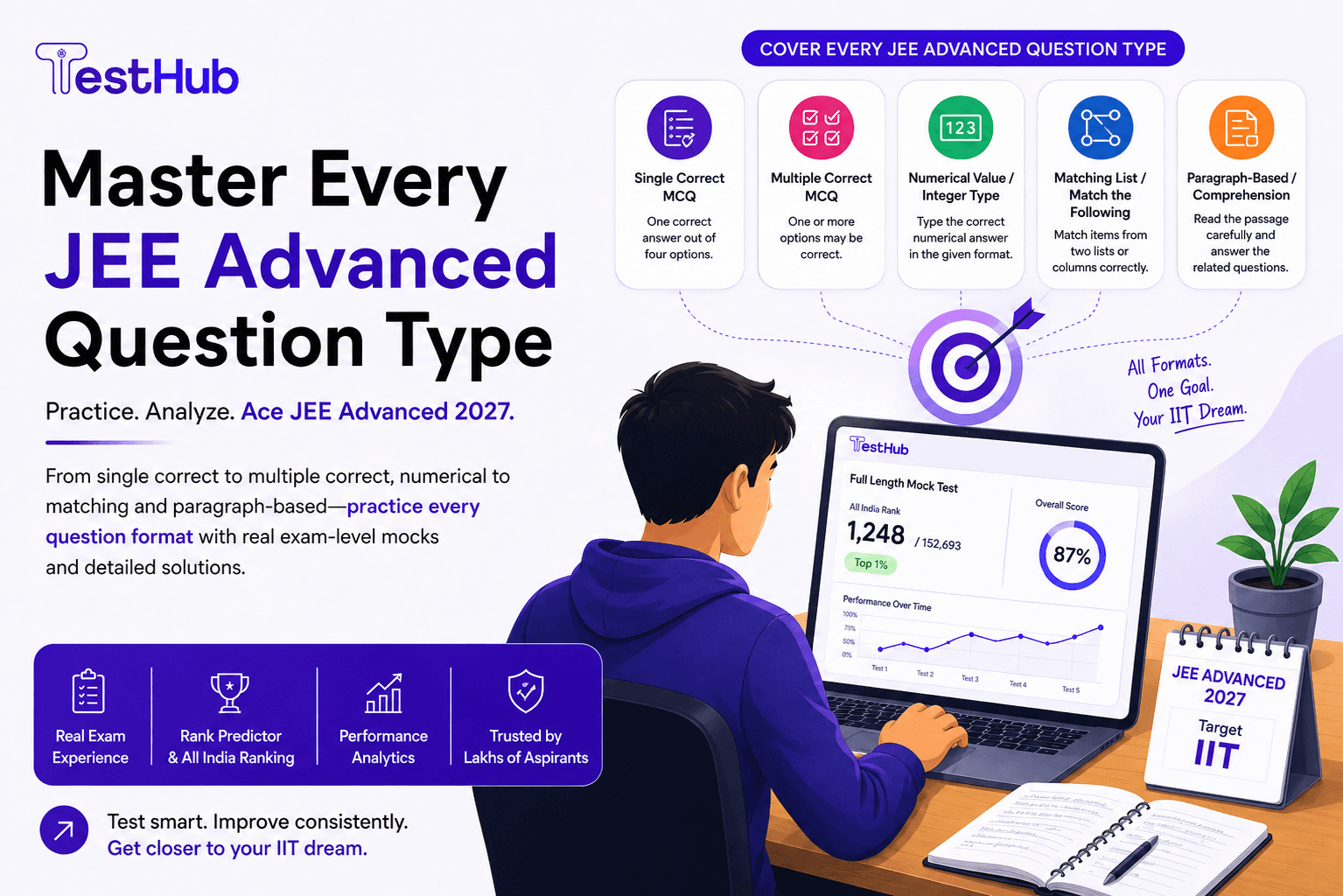
26 Aug 2026 · TestHub Team
Types of Questions in JEE Advanced: A Complete Breakdown (2027 Guide)
JEE Advanced tests more than subject knowledge - it tests how well you handle different question formats, marking schemes, and strategic risks. This guide covers every major JEE Advanced question type, including single-correct, multiple-correct, numerical, matching, and paragraph-based questions, with practical strategies for approaching each.

26 Aug 2026 · TestHub Team
Best Test Series for JEE Main 2027
Choose the right JEE 2027 test series by focusing on current exam patterns, detailed solutions, trend-based analytics, All-India benchmarking, and relevant PYQ practice - not just the number of tests offered.

17 Aug 2026 · TestHub Team
Best Apps and Websites for JEE Mock Tests Preparation (2027 Guide)
Choosing the best JEE mock test app depends on your preparation stage and what you actually need from a testing platform. This guide compares the major categories—from coaching apps and free PYQ platforms to dedicated mock test websites—and explains how to choose the right option for JEE Main and Advanced preparation.

12 Aug 2026 · TestHub Team
Why TestHub Is One of the Best Platforms for JEE Main & Advanced Preparation in 2027
TestHub is a JEE-focused preparation platform offering All-India test series, detailed solutions, performance analytics, PYQs, a 50,000+ question bank, and rank prediction to help JEE Main and Advanced aspirants prepare smarter and improve their performance