
TestHub Team
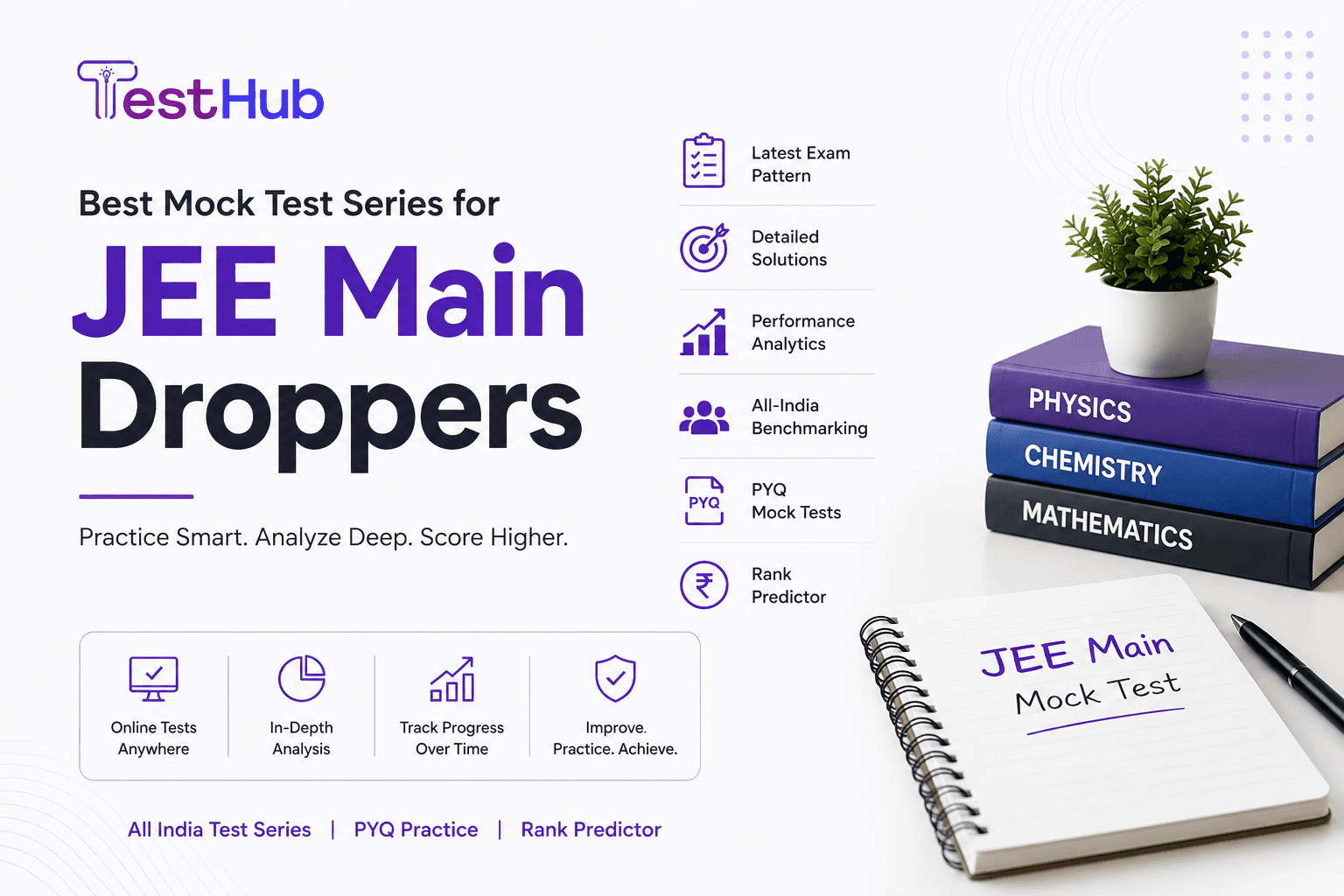
Best Mock Test Series for JEE Main Droppers: A Complete Guide
Choosing the right mock test series can make or break your JEE Main drop year. Learn what features matter most for droppers, the common mistakes to avoid, and how to use mock tests, analytics, and PYQs to turn your second attempt into a higher rank.
Taking a drop year for JEE Main is a high-stakes decision; you're trading a year of your life for a shot at a significantly better rank. That trade only pays off if your preparation this time is genuinely different from last time, not just a repeat of the same routine with more hours. And for most droppers, the single biggest lever for improvement isn't more content revision; it's better, more frequent testing.
This guide covers what makes a mock test series actually useful for droppers specifically, how it should differ from a first-attempt strategy, and how to avoid wasting a second year on the same mistakes.
Why Droppers Need a Different Testing Strategy
If you're repeating JEE Main, you already know the syllabus reasonably well; the gap usually isn't conceptual; it's execution: speed, accuracy, silly mistakes, or panic under exam pressure. A test series built for first-time aspirants often spends too much time on foundational practice. Droppers need something more targeted: high-frequency, full-syllabus mocks that stress-test exam behavior, not just topic recall.
The core question for a dropper isn't "do I know this topic?" it's "why did I lose marks on this topic last time, and has that pattern actually changed?"
What to Look for in a Mock Test Series as a Dropper
1. High Test Frequency With Full-Syllabus Coverage
Since droppers have more preparation time than first-attempters, the test series should be able to support a higher volume, ideally weekly or twice-weekly full-length mocks in the months closer to the exam, not just monthly ones. Consistency in testing frequency is what converts a drop year into measurable improvement.
2. Detailed, Mistake-Level Solutions
This matters even more for droppers than for first-timers. If you made a mistake on a topic last year and make the same kind of mistake again this year, that's a signal the underlying issue was never actually fixed. A test series with only answer keys can't catch this; you need step-by-step solutions that show exactly where and why marks were lost, so you can track whether specific error patterns are actually disappearing over time.
3. Performance Analytics You Can Track Over Months
A single test's analytics tell you about one day. What droppers really need is trend data: are your silly mistakes decreasing month over month? Is your speed on organic chemistry actually improving, or did you just get an easier paper? Look for a platform with dashboards that show performance over time, not just per-test breakdowns.
4. PYQ-Based Mock Papers
By the time you're in a drop year, previous year questions (PYQs) should already be familiar territory, but a test series that keeps blending genuine PYQ patterns into new mocks ensures you're staying sharp on the actual difficulty and style NTA uses, rather than drifting toward generic, invented questions that don't reflect the real exam.
5. All-India Rank Benchmarking
This is critical for droppers specifically, because your reference point can't just be "did I improve compared to last year's score"; it needs to be "how do I compare to this year's competition," since the applicant pool changes every year. An All-India test series benchmarked against a large student pool gives a far more realistic sense of where you'd actually rank.
6. A Rank Predictor to Set Realistic Targets
Droppers often carry either overconfidence ("I'll definitely improve significantly") or anxiety ("what if this year is wasted too") into their prep. A rank predictor tool that converts your mock scores into a realistic percentile estimate helps replace both extremes with actual data, so your target rank is grounded in your current performance, not just hope.
A Sample Testing Approach for Droppers
● First 2–3 months: Chapter-wise and sectional tests to rebuild sharpness on weaker topics, alongside 1–2 full mocks per month
● Middle phase (months 4–7): Full-syllabus mocks weekly, combined with PYQ practice to stay aligned with real exam patterns
● Final 6–8 weeks: Full-length mocks 2–3 times a week, prioritizing detailed post-test analysis over sheer volume, plus timed revision of previously flagged weak areas
Common Mistakes Droppers Make With Test Series
● Repeating the same test series without checking if it's actually working: if your percentile plateaus for 8–10 tests in a row, the feedback quality may be the problem, not just your effort.
● Skipping solution review because I already know the syllabus: knowing the syllabus and eliminating a specific error pattern are two different things.
● Testing too infrequently early on, then cramming mocks at the end: consistent testing across the year builds real exam stamina; last-minute cramming doesn't.
● Ignoring analytics trends: a single bad test doesn't matter much; a consistent downward or flat trend over a month does, and it needs to change your approach.
Where TestHub Fits for Droppers
TestHub offers an All-India test series with detailed, step-by-step solutions, subject-wise performance analytics, integrated PYQ practice, and a rank predictor all built to help you track real improvement over a full preparation cycle, not just individual test scores. If you're deciding on a testing plan for your drop year, our guide on how to analyse your JEE Advanced mock tests is a useful next step for getting more out of every attempt. For the latest exam pattern and eligibility details for repeat attempts, always cross-check the official JEE Main website.
Final Thoughts
A drop year only pays off if this year's preparation is measurably different from last year's and testing frequency, solution quality, and trend-based analytics are what actually create that difference. Choose a mock test series that helps you track whether your specific error patterns are disappearing over time, not just one that hands you a score and moves on.
Ready to build a testing plan for your drop year? Try TestHub's free mock tests and get detailed, subject-wise analytics to track real improvement from day one.
Ready to Make Your Drop Year Count?
Practice with TestHub's JEE Main mock test series designed for serious aspirants. Take exam-level mock tests, track your progress with detailed analytics, and improve your rank with every attempt.
Frequently Asked Questions
Common questions readers ask about this topic.
How many mock tests should a JEE dropper take per week?
In the months closer to the exam, 2–3 full-length mocks per week is a reasonable target, along with regular chapter-wise or sectional tests earlier in the year.
Is it worth switching test series mid-year as a dropper?
If your rank or percentile has plateaued for 8–10 tests despite consistent effort, it's worth evaluating whether the test series' feedback quality is the limiting factor, not just your preparation.
Do droppers need harder mock tests than first-time attempters?
Not necessarily harder, but they benefit more from mocks that closely mirror real exam difficulty and previous year question patterns, since the goal is refining execution, not building foundational understanding.
How is a drop year strategy different from a first-attempt strategy?
A first-attempt strategy usually balances learning and testing. A drop year should shift much more heavily toward frequent full-syllabus testing and detailed error analysis, since the conceptual base is typically already in place.
More on the blog
2 Sept 2026 · TestHub Team
JEE Main 2027 Syllabus PDF: Complete Chapter List
Get the complete JEE Main 2027 syllabus chapter-wise for Physics, Chemistry, and Mathematics, along with the exam pattern, removed topics, and practical preparation tips to plan your JEE Main 2027 preparation effectively.

29 Aug 2026 · TestHub Team
TestHub AI Analysis: How Smart Analytics Fix Your Mistakes Faster
TestHub’s AI-powered mock test analysis goes beyond your score to identify chapter-wise weaknesses, time-management issues, conceptual and calculation errors, and performance trends—helping you turn every mock test into a clear, actionable plan for improvement.
26 Aug 2026 · TestHub Team
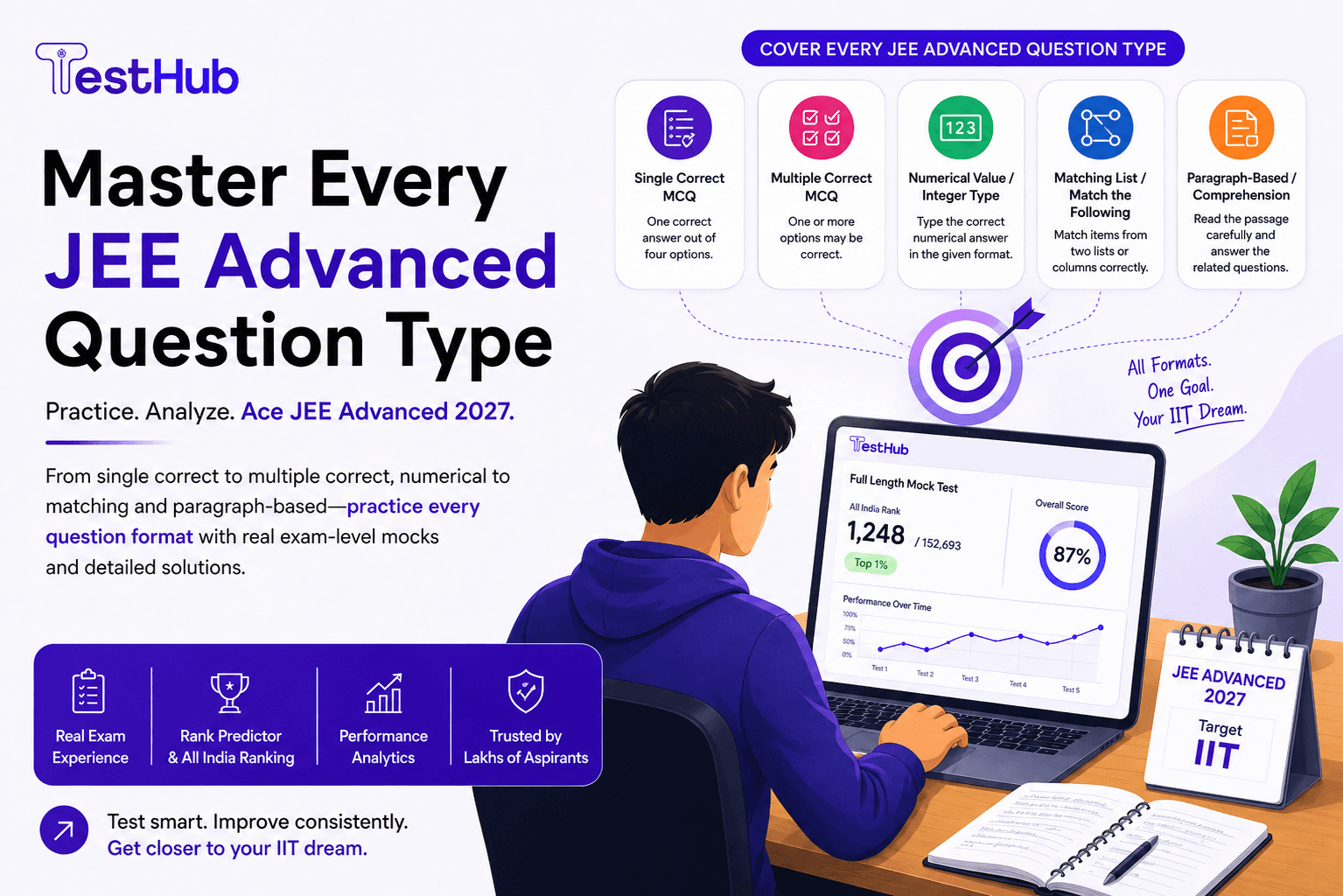
Types of Questions in JEE Advanced: A Complete Breakdown (2027 Guide)
JEE Advanced tests more than subject knowledge - it tests how well you handle different question formats, marking schemes, and strategic risks. This guide covers every major JEE Advanced question type, including single-correct, multiple-correct, numerical, matching, and paragraph-based questions, with practical strategies for approaching each.

26 Aug 2026 · TestHub Team
Best Test Series for JEE Main 2027
Choose the right JEE 2027 test series by focusing on current exam patterns, detailed solutions, trend-based analytics, All-India benchmarking, and relevant PYQ practice - not just the number of tests offered.

17 Aug 2026 · TestHub Team
Best Apps and Websites for JEE Mock Tests Preparation (2027 Guide)
Choosing the best JEE mock test app depends on your preparation stage and what you actually need from a testing platform. This guide compares the major categories—from coaching apps and free PYQ platforms to dedicated mock test websites—and explains how to choose the right option for JEE Main and Advanced preparation.

12 Aug 2026 · TestHub Team
Why TestHub Is One of the Best Platforms for JEE Main & Advanced Preparation in 2027
TestHub is a JEE-focused preparation platform offering All-India test series, detailed solutions, performance analytics, PYQs, a 50,000+ question bank, and rank prediction to help JEE Main and Advanced aspirants prepare smarter and improve their performance