
TestHub Team
JEE Advanced Preparation Tips and Strategy 2026: The Complete Guide to Cracking IIT
Crack JEE Advanced 2026 with this complete preparation guide covering smart study strategies, subject-wise tips, high-weightage topics, best books, and mock test planning to boost your IIT rank.
Every year, lakhs of students in India sit down with one dream: to walk through the gates of an IIT. But only a few thousand actually make it. What separates those who crack JEE Advanced from those who don't is rarely raw intelligence. It is almost always strategy, consistency, and the right preparation approach.
JEE Advanced 2026 will be conducted on May 17, 2026, by IIT Roorkee, and the clock is already ticking. If you are a Class 11 student who just started, or a Class 12 student staring at the calendar with anxiety, this guide is built for you. We have broken everything down in plain, simple language, no jargon, no fluff.
Read it once, bookmark it, and come back every time you feel lost. Let's get you into an IIT.
Table of contents
JEE Advanced 2026 Exam Pattern — Everything You Need to Know
How to Build a Realistic Study Timetable That You Will Actually Follow
Subject-Wise Preparation Strategy for Physics, Chemistry & Maths
Why Mock Tests Are the Real Game-Changer for JEE Advanced 2026
JEE Advanced 2026 Exam Pattern — Everything You Need to Know
One of the biggest preparation mistakes students make is studying for months without truly understanding how the exam is structured. You wouldn't run a marathon without knowing the route, right?
Here is the basic structure to know before you start with:
Feature | Details |
|---|---|
Mode of Exam | Computer-Based Test (CBT) |
Number of Papers | 2- Paper 1 and Paper 2 (both compulsory) |
Duration | 3 hours each (6 hours on exam day) |
Subjects | Physics , Chemistry , Mathematics |
Question Types | MCQs (Single & Multiple Correct), Numerical Answer Type(NAT), Matching Type |
Language | English and Hindi |
Negative Marking | Yes - varies by question type |
Now, the most critical thing to understand and accept: JEE Advanced has a dynamic pattern which changes every year, testing a deeper understanding of Physics, Chemistry, and Mathematics. The questions are designed to assess analytical skills, logical reasoning, and multi-concept application.
This means you cannot simply memorise last year's paper format and hope for the best. The exam will surprise you, and the only way to be ready for surprises is to practise under real exam conditions repeatedly. Which brings us to mock tests. More on that in later sections.
Subject-Wise High-Weightage Topics to Prioritise in 2026
Smart preparation is not about studying everything equally. It is about knowing where your time gives you the highest return. Check the JEE Advanced 2026 syllabus and refer to previous year papers to understand the difficulty level and the type of questions asked. Here is a subject-wise breakdown of the topics that have historically carried the most weight in JEE Advanced — based on past paper analysis:
Physics
Unit | Key topics to Master |
|---|---|
Mechanics | Kinematics ,Rotational Motion , Laws of Motion , Gravitation |
Electricity & Magnetism | Electrostatics, Current Electricity, EMI, Magnetic Effects |
Optics | Ray Optics, Wave Optics, Optical Instruments |
Modern Physics | Photoelectric Effect, Nuclear Physics, Atomic Structure |
Thermodynamics | Laws of Thermodynamics, Kinetic Theory of Gases |
Waves | Sound Waves, SHM, Wave Motion |
Reality check: JEE Advanced loves combining Mechanics with Thermodynamics or Electrostatics with Magnetism. This is where many students lose marks — you need to solve at least 3–4 hybrid problems daily.
Chemistry
Unit | Key Topics to Master |
|---|---|
Physical Chemistry | Mole Concept, Equilibrium, Thermodynamics, Electrochemistry, Kinetics |
Organic Chemistry | Reaction Mechanisms, Named Reactions, Hydrocarbons, Biomolecules |
Inorganic Chemistry | Chemical Bonding, P-Block Elements, Coordination Compounds, Metallurgy |
Mathematics
Unit | Key Topics to Master |
|---|---|
Calculus | Differentiation, Integration, Differential Equations, Limits |
Algebra | Complex Numbers, Matrices, Probability, Permutations & Combinations |
Coordinate Geometry | Conic Sections, Straight Lines, Circles |
Vectors & 3D | Vector Algebra, 3D Geometry |
Trigonometry | Inverse Trigonometry, Trigonometric Equations |
Topper Insight: Every topper starts with their weakest topics first. By exam time, those weak areas become strengths. Don't solve one chapter completely and move on — rotate through Algebra → Calculus → Coordinate Geometry → Trigonometry daily. This maintains sharpness across all areas.
Best Books for JEE Advanced 2026 — Topper-Approved List
Walk into any IITian's room and ask what books they studied. You will hear the same names repeated. Why? Because these books work. The trap most students fall into is buying too many books and finishing none of them properly.
The golden rule: one great book per subject, completed thoroughly, beats five books read halfway.
Start with NCERTs to get hold of concepts and basics, then move to books that cover the JEE Advanced syllabus with ample question banks and simple language.
Physics Books
Book | Author | Best Used For |
|---|---|---|
Concepts of Physics Vol 1 & 2 | H.C. Verma | Concept building + chapter exercises |
Problems in General Physics | I.E. Irodov | Advanced-level problem practice |
NCERT Physics Class 11 & 12 | NCERT | Foundational reading — never skip |
DC Pandey Series | Arihant | Chapter-wise progressive practice |
Chemistry Books
Book | Author | Best Used For |
|---|---|---|
NCERT Chemistry Class 11 & 12 | NCERT | Inorganic base — absolutely non-negotiable |
Physical Chemistry | O.P. Tandon | Numericals and Physical Chem concepts |
Organic Chemistry | M.S. Chauhan | Reaction mechanisms + practice |
Concise Inorganic Chemistry | J.D. Lee | In-depth Inorganic preparation |
Mathematics Books
Book | Author | Best Used For |
|---|---|---|
Problems in Calculus of One Variable | I.A. Maron | Calculus mastery |
Coordinate Geometry | S.L. Loney | Geometry fundamentals + problems |
Algebra for JEE Advanced | Hall & Knight | Advanced Algebra practice |
Previous Year Papers (2007–2025) | Pattern recognition + self-testing |
Pro Tip: The biggest mistake is ignoring NCERT basics and blindly solving random problems. Without conceptual clarity, advanced questions will feel impossible. VEDANTU Do not treat NCERT as a "lower level" book — for Chemistry especially, it is the Bible.
How to Build a Realistic Study Timetable That You Will Actually Follow
Here's something nobody says out loud: most JEE timetables fail not because the student is lazy, but because the timetable was unrealistic from Day 1. If you are planning 14-hour study days with zero breaks, you will crash within a week.
The goal is to build a schedule that is sustainable for months, not one that looks impressive on paper but breaks down by Thursday.
Framework for a Workable JEE Advanced 2026 Study Plan
Step 1 — Know your productive hours. Are you sharper at 6 AM or 9 PM? Whatever your peak focus window is, put your toughest subject there. Don't waste your best hours on tasks you can do half-asleep.
Step 2 — Plan weekly, not just daily. Break large chapters into daily achievable tasks to avoid last-minute panic. Allocate fixed slots for theory, problem-solving, revision, and rest, this ensures steady progress without fatigue
Step 3 — Never skip revision slots. Most students plan for new topics every day and forget that what you studied last week is already fading. Revision is not optional, it is the entire point.
Sample Daily Schedule — JEE Advanced 2026 Aspirant
Time | Activity |
|---|---|
6:00 AM – 6:30 AM | Wake up, freshen up, light reading |
6:30 AM – 9:00 AM | Subject 1 — Theory + Concept Study |
9:00 AM – 9:30 AM | Breakfast + Break |
9:30 AM – 12:30 PM | Subject 2 — Theory + Problem Solving |
12:30 PM – 1:30 PM | Lunch + Complete rest |
1:30 PM – 4:00 PM | Subject 3 — Theory + Concept Study |
4:00 PM – 4:30 PM | Physical activity / Walk / Break |
4:30 PM – 6:30 PM | Previous Year Questions + Mock Practice |
7:30 PM – 9:30 PM | Formula revision + Short notes review |
9:30 PM – 10:00 PM | Mock test error analysis or weak topic revisit |
10:00 PM | Sleep — 7 to 8 hours, non-negotiable |
Important: Rotate which subject gets the morning slot every 2–3 days. This prevents you from developing a bias where one subject gets your best hours every single day.
Month-Wise Study Plan Overview
Subject-Wise Preparation Strategy for Physics, Chemistry & Maths
How to Prepare Physics for JEE Advanced 2026
Physics in JEE Advanced does not test whether you memorised a formula. It tests whether you understand what that formula actually means. When you derive a formula yourself, you understand its limitations and variations — and students who do this can solve twisted problems simply because they knew why a formula works, not just what it is.
Practical tips for Physics:
Start with Mechanics — it is the foundation for almost every other Physics chapter. Waves, Thermodynamics, and Fluid Mechanics all connect back to Mechanics concepts.
After completing each chapter in H.C. Verma, solve the chapter's exercises in both volumes before moving on. Don't jump ahead.
For Modern Physics and Optics, heavily focus on previous year JEE Advanced questions. These sections tend to repeat patterns more than other chapters.
Visualise problems. Understanding motion through everyday examples, waves through musical instruments, and circuits through water flow helps students retain concepts significantly longer.
How to Prepare Chemistry for JEE Advanced 2026
Chemistry is the most scoring subject in JEE Advanced — but only if you treat its three parts as three different subjects, because they genuinely are.
Physical Chemistry is essentially Mathematics with chemical formulas. Treat it like Maths — daily numerical practice is the only way to get better. Focus on Mole Concept, Thermodynamics, Electrochemistry, and Chemical Equilibrium.
Organic Chemistry is about logic, not memorisation. Understand Organic and Physical Chemistry deeply — don't mug up reactions blindly. Once you understand why electrons move in a particular direction during a reaction, all its variations and products become obvious. Named Reactions and Reaction Mechanisms are where most marks lie.
Inorganic Chemistry is memory-heavy but manageable. Make concise, chapter-wise notes. Revise them every single week — not once a month. And never, ever skip NCERT for Inorganic. Every topper begins with NCERT books — the examiners base every concept on NCERT fundamentals, especially for Inorganic Chemistry.
How to Prepare Mathematics for JEE Advanced 2026
Mathematics is where the real rank difference is created. The gap between Rank 100 and Rank 1000 is often decided in this paper.
Calculus first, always. It is the highest-scoring and most frequently tested area. Master Differentiation, Integration, and Differential Equations before moving to other units.
Coordinate Geometry is fast, reliable marks once you are comfortable with the standard forms. Practise it daily — even 30 minutes.
For Algebra and Probability, JEE Advanced rarely asks straightforward questions. You need to practise problem types you have never seen before — which is exactly why mock tests matter so much here.
Advanced Maths questions have 4 to 5 steps. Practise identifying these steps before solving. Write down the roadmap first — this prevents costly mid-solution errors that waste both time and marks.
Why Mock Tests Are the Real Game-Changer for JEE Advanced 2026
Read this section carefully. If there is one thing that separates students who crack JEE Advanced from those who do not, it is this: the quality and frequency of mock test practice.
You can study every chapter perfectly, solve every exercise in H.C. Verma, and still perform below your potential on exam day because sitting for 6 hours under pressure, managing time across two papers, and making smart decisions about which questions to skip is a completely different skill from studying at home. And like every skill, it needs to be practised.
The key to strengthening exam-day time management, speed, and accuracy is to practise previous year question papers and IIT JEE mock tests. The focus should be on developing exam-day temperament, not just preparing the syllabus.
Toppers often attempt mock tests under strict timing — they simulate exam-day pressure with What Mock Tests Actually Give You
Phase | Months | Focus |
|---|---|---|
Foundation Phase | June – September 2025 | Complete Class 11 syllabus, NCERT base |
Advanced Phase | October – January 2026 | Class 12 + deep-dive into JEE-level problems |
Mock Test Phase | February – April 2026 | Full-length mocks + targeted weak area revision |
Final Revision | May 1–16, 2026 | Light revision, formula sheets, rest well |
Benefit | Why it Matters |
|---|---|
Time management training | You learn which questions to attempt, skip, and return to |
Exam temperament | Reduces anxiety and panic on actual exam day |
Weakness identification | Shows exactly which chapters are costing you marks |
Pattern familiarity | Reduces shock factor on exam day |
Speed & accuracy improvement | Consistent practice sharpens both measurably |
All-India rank benchmarking | Tells you where you actually stand vs other aspirants |
How to Get Maximum Value from Every Mock Test
Most students make one big mistake they take a mock test, check the score, feel good or bad about it, and move on. That is half the benefit wasted.
Review all attempted and unattempted questions to understand mistakes. Identify frequent errors or conceptual gaps. Revise weak topics and practise similar question types. Track progress across multiple mock tests for continuous improvement.
Here is the right mock test routine:
Take the mock test in full exam conditions — no phone, no breaks, strict 3-hour timer per paper
Spend at least 60–90 minutes on analysis after the test
Categorise every wrong answer — was it a concept gap, a calculation error, or poor time management?
Revisit those specific chapters within the next 48 hours
Log your mistake patterns in a notebook — you will start seeing repeating trends
This is exactly where TestHub.in comes in. At TestHub.in, the JEE Advanced 2026 mock test series is designed to mirror the actual exam — same paper structure, same question types, same difficulty curve that JEE Advanced is known for. Every test comes with subject-wise performance analytics, so you know precisely where you are losing marks not just your overall score.
Mock Test Frequency — A Practical Guide
Preparation Phase | Recommended Mock Test Frequency |
|---|---|
6+ months before exam | 1 full-length mock per week |
3–6 months before exam | 2 full-length mocks per week |
Last 2 months | 3–4 full-length mocks per week |
Last 2 weeks | 1 mock every 2 days + heavy analysis |
Maintain a dedicated file for JEE Advanced previous year question papers — at least the last 10 years. Don't just solve them; analyse your performance, keep a log of mistakes and tricky questions, and note if you are making mistakes in some pattern — from one particular topic or some other recurring hurdle.
Conclusion
If you have read this far, you already have something most aspirants don't — a clear, honest picture of what JEE Advanced 2026 demands and how to go about it without losing your mind in the process.
Cracking JEE Advanced 2026 comes down to four things done consistently: strong concepts, smart subject-wise strategy, regular mock test practice, and disciplined revision. There is no secret shortcut beyond that. Every topper will tell you the same thing.
You have the roadmap. Now it is time to execute — one chapter, one mock test, one mistake corrected at a time.
Frequently Asked Questions
Common questions readers ask about this topic.
When is JEE Advanced 2026?
JEE Advanced 2026 is scheduled for May 17, 2026, conducted by IIT Roorkee.
How many hours should I study for JEE Advanced 2026?
Most toppers recommend 8–10 focused hours daily, with dedicated slots for theory, problem-solving, and revision.
Is NCERT enough for JEE Advanced 2026?
NCERT is essential for Inorganic Chemistry and building foundational concepts, but advanced reference books are needed for Physics and Mathematics.
How many mock tests should I take for JEE Advanced 2026?
Ideally 2–3 full-length mock tests per week in the final 2–3 months, with thorough analysis after every test.
Which subject is most important for JEE Advanced 2026?
All three subjects are equally important, but Mathematics and Physics tend to have the highest difficulty and differentiate ranks the most.
More on the blog
2 Sept 2026 · TestHub Team
JEE Main 2027 Syllabus PDF: Complete Chapter List
Get the complete JEE Main 2027 syllabus chapter-wise for Physics, Chemistry, and Mathematics, along with the exam pattern, removed topics, and practical preparation tips to plan your JEE Main 2027 preparation effectively.

29 Aug 2026 · TestHub Team
TestHub AI Analysis: How Smart Analytics Fix Your Mistakes Faster
TestHub’s AI-powered mock test analysis goes beyond your score to identify chapter-wise weaknesses, time-management issues, conceptual and calculation errors, and performance trends—helping you turn every mock test into a clear, actionable plan for improvement.
26 Aug 2026 · TestHub Team
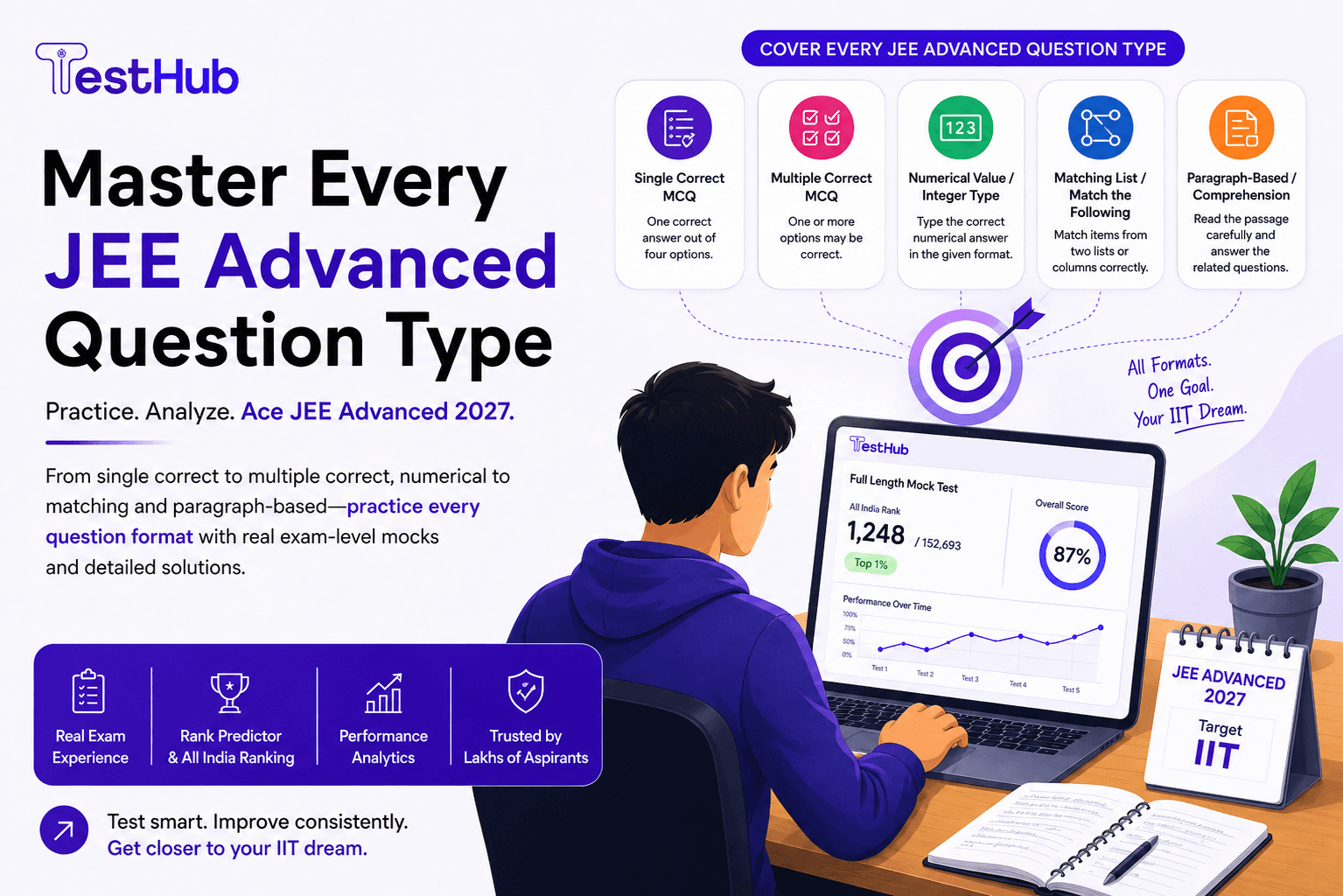
Types of Questions in JEE Advanced: A Complete Breakdown (2027 Guide)
JEE Advanced tests more than subject knowledge - it tests how well you handle different question formats, marking schemes, and strategic risks. This guide covers every major JEE Advanced question type, including single-correct, multiple-correct, numerical, matching, and paragraph-based questions, with practical strategies for approaching each.

26 Aug 2026 · TestHub Team
Best Test Series for JEE Main 2027
Choose the right JEE 2027 test series by focusing on current exam patterns, detailed solutions, trend-based analytics, All-India benchmarking, and relevant PYQ practice - not just the number of tests offered.

17 Aug 2026 · TestHub Team
Best Apps and Websites for JEE Mock Tests Preparation (2027 Guide)
Choosing the best JEE mock test app depends on your preparation stage and what you actually need from a testing platform. This guide compares the major categories—from coaching apps and free PYQ platforms to dedicated mock test websites—and explains how to choose the right option for JEE Main and Advanced preparation.

12 Aug 2026 · TestHub Team
Why TestHub Is One of the Best Platforms for JEE Main & Advanced Preparation in 2027
TestHub is a JEE-focused preparation platform offering All-India test series, detailed solutions, performance analytics, PYQs, a 50,000+ question bank, and rank prediction to help JEE Main and Advanced aspirants prepare smarter and improve their performance