
TestHub Team
Types of Questions in JEE Advanced: A Complete Breakdown (2027 Guide)
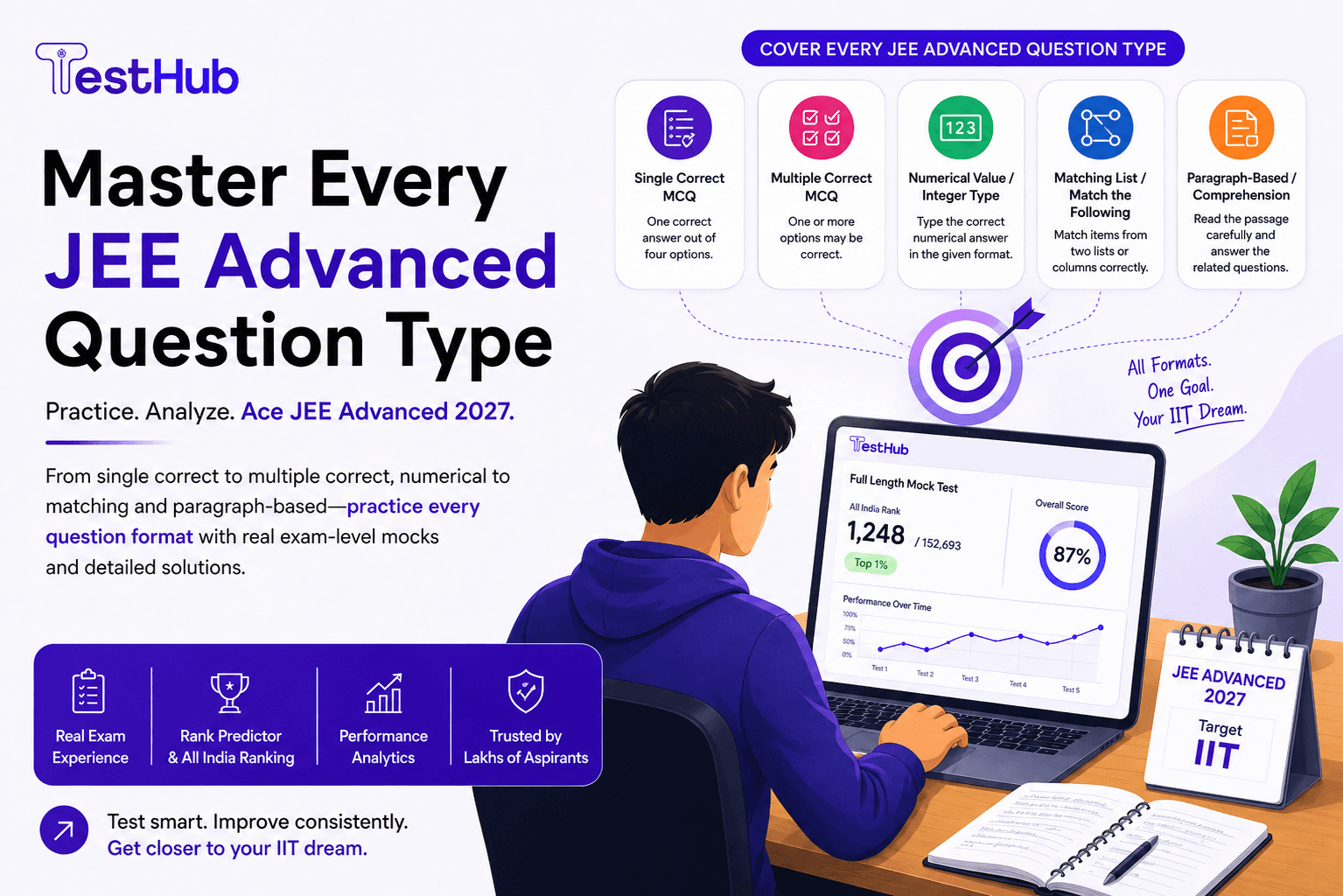
JEE Advanced tests more than subject knowledge - it tests how well you handle different question formats, marking schemes, and strategic risks. This guide covers every major JEE Advanced question type, including single-correct, multiple-correct, numerical, matching, and paragraph-based questions, with practical strategies for approaching each.
JEE Advanced doesn't just test what you know; it tests how well you understand the exact format each question demands. Unlike JEE Main, where most questions follow a familiar single-correct MCQ or numerical pattern, JEE Advanced mixes multiple distinct question types, each with its own marking scheme, negative marking rules, and strategic approach. Walking into the exam without a clear grasp of these formats is one of the most common reasons capable students lose marks they shouldn't.
This guide breaks down every question type you'll encounter in JEE Advanced, how each is marked, and how to approach them strategically.
Why Question Types Matter So Much in JEE Advanced
JEE Advanced runs across two compulsory papers, Paper 1 and Paper 2, three hours each, covering Physics, Chemistry, and Maths. You have to attempt both; skip one, and you're disqualified- no exceptions. Inside each paper, questions are split into sections, and each section plays by its own rules.
One thing worth flagging upfront: the exact mix of question types has shifted from year to year. What follows is a solid, reliable picture of how JEE Advanced has typically worked, but treat it as a guide, not gospel. Always double-check the current year's exact pattern on the official JEE Advanced website as your exam gets closer.
1. Single Correct MCQ
The simplest format: (A) (B) (C) (D), one of which is right. It is a direct test of conceptual clarity, but that does not mean questions will be easy; JEE Advanced may use this type of question to help test concepts that have a slight conceptual catch in them, which the students might not have grasped at the 'surface level'.
Marking: Full marks for correct answer, negative marking for incorrect answer (typical).
Strategy: These are marked with real negative marks, so only do these if you are fairly sure of the answer. If you are not 100% sure, first rule out answers that are clearly incorrect to increase your chances of getting a right answer.
2. Multiple Correct MCQ (Multi-Select)
In this case, one or more of the four options might be right, and you must choose all that are right and nothing else. This format is considered one of the most difficult in JEE Advanced, as partial knowledge can work against you if you choose an additional wrong answer along with the correct ones.
Marking pattern: The marking scheme for multiple-correct questions is as follows:
Full Marks: +4 — If only (all) the correct option(s) is/are chosen.
Partial Marks: +3 — If all the four options are correct but ONLY three options are chosen.
Partial Marks: +2 — If three or more options are correct but ONLY two options are chosen, and both of them are correct.
Partial Marks: +1 — If two or more options are correct but ONLY one option is chosen, and it is a correct option.
Zero Marks: 0 — If none of the options is chosen (i.e. the question is unanswered).
Negative Marks: −2 — In all other cases.
Strategy: This format rewards precision over guessing. If you're only confident about one or two options out of four, it's often safer to select just those than to guess on the remaining ones and risk losing all your marks. Practicing multi-correct questions specifically, not just single-correct ones, is essential, since the skill of identifying all correct options is different from spotting just one.
3. Numerical Value / Integer Type Questions
These questions have no options at all; you calculate a numerical answer and type it directly into the exam interface, often as a non-negative integer or a decimal value up to a specified precision. Because there's nothing to select from, these questions rely entirely on your calculation being correct.
Marking pattern (typical): Full marks for the correct value. In many recent years, these have carried little to no negative marking, making them comparatively lower-risk.
Strategy: Because these often carry reduced or no negative marking, they're worth attempting even with partial confidence; an educated, worked-through attempt is usually better than leaving them blank. Speed and calculation accuracy matter more here than in any other format, since there's no shortcut through elimination.
4. Matching List / Match-the-Following Type
In this format, you're given two columns or lists, and you need to correctly match items from one to the other; for example, matching physical quantities to their correct units or scenarios to correct outcomes. These questions often test how well you can connect multiple related concepts simultaneously, rather than a single isolated idea.
Marking pattern (typical): Full marks for a completely correct match; often zero or negative marks for even a single incorrect pairing, depending on the year's exact rules.
Strategy: Since a single wrong pairing can cost you the entire question's marks, treat these as high-precision questions. Work through each match methodically rather than guessing on uncertain pairs; a partially guessed match rarely pays off given the marking risk.
5. Paragraph-Based / Comprehension Type Questions
These questions include a short passage or scenario and then two or more questions related to this passage or situation. Correct interpretation of the set-up is as important as the knowledge of the subject and is essential to answering the linked questions.
Strategy: Take time to read the paragraph carefully; otherwise, you might be tempted to answer several related questions incorrectly. In some years and papers, the test format of JEE Advanced matches the list, while in other years and papers, it is based on a paragraph. Therefore, always check the format of the paper you are attempting.
How to Build Familiarity With Every Format Before Exam Day
Knowing the theory behind each question type isn't the same as being comfortable executing them under time pressure. The most reliable way to build that comfort is consistent, format-specific practice:
Practice each question type separately at first, so you understand the distinct thought process each demands, rather than treating all questions the same way
Use previous year questions to see exactly how each format has actually been used, since real exam framing often differs from generic practice material
Take full-length, mixed-format mocks regularly through an All-India test series, so you experience switching between formats under real-time pressure, the way the actual exam demands
Review detailed solutions after every mock, specifically noting whether mistakes came from the concept itself or from misjudging the specific question format's marking risk.
Final Thoughts
JEE Advanced's mix of single-correct, multiple-correct, numerical, and matching or paragraph-based questions means subject knowledge alone isn't enough; you need format-specific strategy for each type, especially around where negative marking risk is highest. Building that comfort well before exam day, through consistent full-format mock practice, is what turns theoretical understanding into an exam-ready skill.
Want to practice every JEE Advanced question format under real exam conditions? Try TestHub's mock tests and build format-specific confidence with detailed, step-by-step solutions after every attempt.
Practice Every JEE Advanced Question Format — Free
Don't just read about question types — practice them. Get full-length, mixed-format mock tests with detailed, step-by-step solutions so you build real exam-day confidence, not just theory.
Frequently Asked Questions
Common questions readers ask about this topic.
Which JEE Advanced question type carries the highest risk?
Multiple Correct MCQs and Matching-type questions generally carry the highest risk, since even one incorrect selection can cost you the entire question's marks despite partial knowledge.
Should I attempt numerical value questions even if I'm not fully confident?
Often yes, since these questions typically carry little to no negative marking in recent years; a worked-through, educated attempt is usually better than leaving them blank. Always confirm the exact marking scheme for the current year.
Does the exact mix of question types change every year?
Yes. JEE Advanced's format is not fixed and has varied across recent years, including shifts between match-the-list and paragraph-based sections. Always check the official pattern released closer to your exam year.
How can I practice multi-correct and matching-type questions specifically?
Look for a test series and PYQ resource that includes all major question formats in its mock papers, not just single-correct MCQs, so you build format-specific comfort rather than only practicing the easiest type.
More on the blog
2 Sept 2026 · TestHub Team
JEE Main 2027 Syllabus PDF: Complete Chapter List
Get the complete JEE Main 2027 syllabus chapter-wise for Physics, Chemistry, and Mathematics, along with the exam pattern, removed topics, and practical preparation tips to plan your JEE Main 2027 preparation effectively.

29 Aug 2026 · TestHub Team
TestHub AI Analysis: How Smart Analytics Fix Your Mistakes Faster
TestHub’s AI-powered mock test analysis goes beyond your score to identify chapter-wise weaknesses, time-management issues, conceptual and calculation errors, and performance trends—helping you turn every mock test into a clear, actionable plan for improvement.

26 Aug 2026 · TestHub Team
Best Test Series for JEE Main 2027
Choose the right JEE 2027 test series by focusing on current exam patterns, detailed solutions, trend-based analytics, All-India benchmarking, and relevant PYQ practice - not just the number of tests offered.

17 Aug 2026 · TestHub Team
Best Apps and Websites for JEE Mock Tests Preparation (2027 Guide)
Choosing the best JEE mock test app depends on your preparation stage and what you actually need from a testing platform. This guide compares the major categories—from coaching apps and free PYQ platforms to dedicated mock test websites—and explains how to choose the right option for JEE Main and Advanced preparation.

12 Aug 2026 · TestHub Team
Why TestHub Is One of the Best Platforms for JEE Main & Advanced Preparation in 2027
TestHub is a JEE-focused preparation platform offering All-India test series, detailed solutions, performance analytics, PYQs, a 50,000+ question bank, and rank prediction to help JEE Main and Advanced aspirants prepare smarter and improve their performance

12 Aug 2026 · TestHub Team
Most Repeated Topics in JEE Main Last 5 Years
Discover the most repeated JEE Main topics from the last five years and learn which Physics, Chemistry, and Maths chapters deserve priority. Use these proven trends to focus your revision, practice PYQs smarter, and maximize your marks without trying to treat every chapter equally.