

TestHub Team
Most Repeated Topics in JEE Main Last 5 Years
Discover the most repeated JEE Main topics from the last five years and learn which Physics, Chemistry, and Maths chapters deserve priority. Use these proven trends to focus your revision, practice PYQs smarter, and maximize your marks without trying to treat every chapter equally.
If you're reading this at 11 PM with three chapters still left to revise and an exam date that keeps getting closer, you already know the feeling there's just too much syllabus and never quite enough time. You've probably asked yourself at some point: if I could only prioritize a few chapters right now, which ones would actually move the needle?
That's exactly what this guide is for. Based on trend analysis across the last five years of JEE Main papers, certain chapters show up again and again not necessarily the same exact questions, but the same core concepts, formats, and problem types. Knowing these can help you study smarter in the time you have left, instead of spreading yourself thin across everything equally.
One honest note before we dive in: NTA doesn't officially publish a fixed chapter-wise weightage. What follows is a pattern built from analysing actual past papers a strong, reliable guide, but not a guarantee of what will appear this year. Use it to prioritize, not to skip anything entirely.
Physics: Where the Marks Actually Come From
If physics has been feeling like the hardest subject to "cover completely," here's some relief a handful of chapters have consistently carried the heaviest weight across recent years:
Current Electricity: one of the most reliably repeated chapters year after year, often the single highest-weightage topic in the paper
Mechanics: (Rotational Motion, collision, Work-Energy-Power) forms a large, dependable chunk of the paper almost every session
Electrostatics: consistently present, usually paired conceptually with Current Electricity
Ray Optics and Optical Instruments: a near-permanent fixture across the last several years
Electromagnetic Induction & AC: shows up reliably, often testing similar problem structures year to year
Modern Physics and Semiconductors: smaller in isolation, but combined with the above, this cluster regularly accounts for a large share of the total physics score
If you only had two weeks left, these are the chapters worth revisiting first not because the rest doesn't matter, but because these consistently give you the most marks per hour of revision.
Chemistry: The Organic-Physical Combination That Keeps Repeating
Chemistry tends to feel the most "learnable" under time pressure, and the data backs that up: a smaller set of chapters covers a disproportionate share of recurring questions:
Coordination Compounds: one of the most consistently tested inorganic chapters across recent years
Chemical Equilibrium: appears reliably, often with similar problem structures each year
Thermodynamics: a steady presence, and one that rewards formula-based practice heavily
Aldehydes, Ketones, and Carboxylic Acids: a recurring organic chemistry chapter that's genuinely worth mastering rather than skimming
Electrochemistry and d-/f-Block Elements: smaller individually but combine into a meaningful, repeatable share of the paper
Chemical Kinetics and Solutions: consistently present, and generally considered high-return for the effort involved
Chemistry, more than any other subject, rewards focused revision of NCERT-based concepts; many of these chapters test the same underlying ideas with only the numbers or framing changed each year.
Maths: Calculus and Geometry Do the Heavy Lifting
If maths feels the most unpredictable, that's understandable; it's often the lengthiest section. But even here, patterns hold up clearly across the last five years:
Calculus (Limits, Continuity, Differentiability, Integration) the single largest contributor to the maths section almost every year
3D Geometry and Coordinate Geometry: together, one of the most reliably repeated clusters in the paper
Algebra and Binomial Theorem: consistently present, often in similar question formats
Sequence and Series: smaller individually, but a dependable, near-guaranteed presence
Vector Algebra: regularly tested, and generally considered a high-return, formula-driven topic
If your calculus and coordinate geometry are strong, you're already covering a significant portion of the maths paper before touching anything else.
How to Actually Use This List
Knowing which chapters repeat is only useful if it changes what you do next. A few practical ways to apply this:
Don't skip the rest of the syllabus: these are priority chapters, not the only chapters. NTA can and does test outside these patterns.
Practice with real previous year questions: not just theory, so you internalize how these topics are actually framed in the exam, not just what the concept means in a textbook.
Track your accuracy specifically on these chapters: in every mock test — if you're still losing marks here, that's the first thing to fix, since these chapters carry the most weight.
Revisit this list a few weeks before your exam: not just once early in your prep — familiarity fades, and a quick refresh close to the exam date pays off disproportionately.
Turning This Into Practice, Not Just a Reading List
Reading a list of chapters is easy. Actually testing yourself on them, consistently, is what makes the difference. Free PYQ practice built around these exact repeated patterns is one of the most efficient ways to convert this list into real exam readiness, since you're practicing the actual style of question these chapters tend to produce, not just generic problems.
Once you've revised these chapters, an All-India test series with detailed, topic-wise solutions will show you clearly whether you've actually closed the gap, or whether a specific chapter still needs more work. For the latest official syllabus and exam pattern, always check the official JEE Main website
Final Thoughts
You don't need to feel like every single chapter carries equal weight on your remaining prep time; some genuinely give you more return per hour than others. Use this list to guide your priorities, but keep testing yourself honestly to confirm those chapters are actually converting into marks, not just familiarity.
Want to test yourself on exactly these patterns? Try TestHub's free PYQ practice and mock tests and see clearly where you stand on the chapters that matter most.
Ready to Master the Most Repeated JEE Topics?
Practice high-priority JEE Main topics with TestHub’s free PYQs and mock tests. Identify weak areas, track your performance, and prepare smarter for the exam.
Frequently Asked Questions
Common questions readers ask about this topic.
Are these exact topics guaranteed to appear in my exam?
No. These are trend-based patterns from analysing past papers, not a confirmed prediction. Treat them as a smart prioritization tool, not a shortcut to skip other chapters.
Should I only study these repeated topics if I'm running out of time?
These chapters are a good place to start or revisit first, but a strong JEE Main score still requires covering the full syllabus. Use this list to prioritize your remaining time, not to narrow your preparation entirely.
How is this different from just checking the syllabus?
The syllabus tells you what could be asked. This kind of chapter-wise trend analysis tells you what has actually been asked most consistently, making it a more practical guide for where to focus limited revision time.
Does this pattern apply the same way across January and April sessions?
Broadly yes, since both sessions draw from the same syllabus and pattern, though the exact number of questions per chapter can shift slightly between sessions and shifts.
More on the blog
2 Sept 2026 · TestHub Team
JEE Main 2027 Syllabus PDF: Complete Chapter List
Get the complete JEE Main 2027 syllabus chapter-wise for Physics, Chemistry, and Mathematics, along with the exam pattern, removed topics, and practical preparation tips to plan your JEE Main 2027 preparation effectively.

29 Aug 2026 · TestHub Team
TestHub AI Analysis: How Smart Analytics Fix Your Mistakes Faster
TestHub’s AI-powered mock test analysis goes beyond your score to identify chapter-wise weaknesses, time-management issues, conceptual and calculation errors, and performance trends—helping you turn every mock test into a clear, actionable plan for improvement.
26 Aug 2026 · TestHub Team
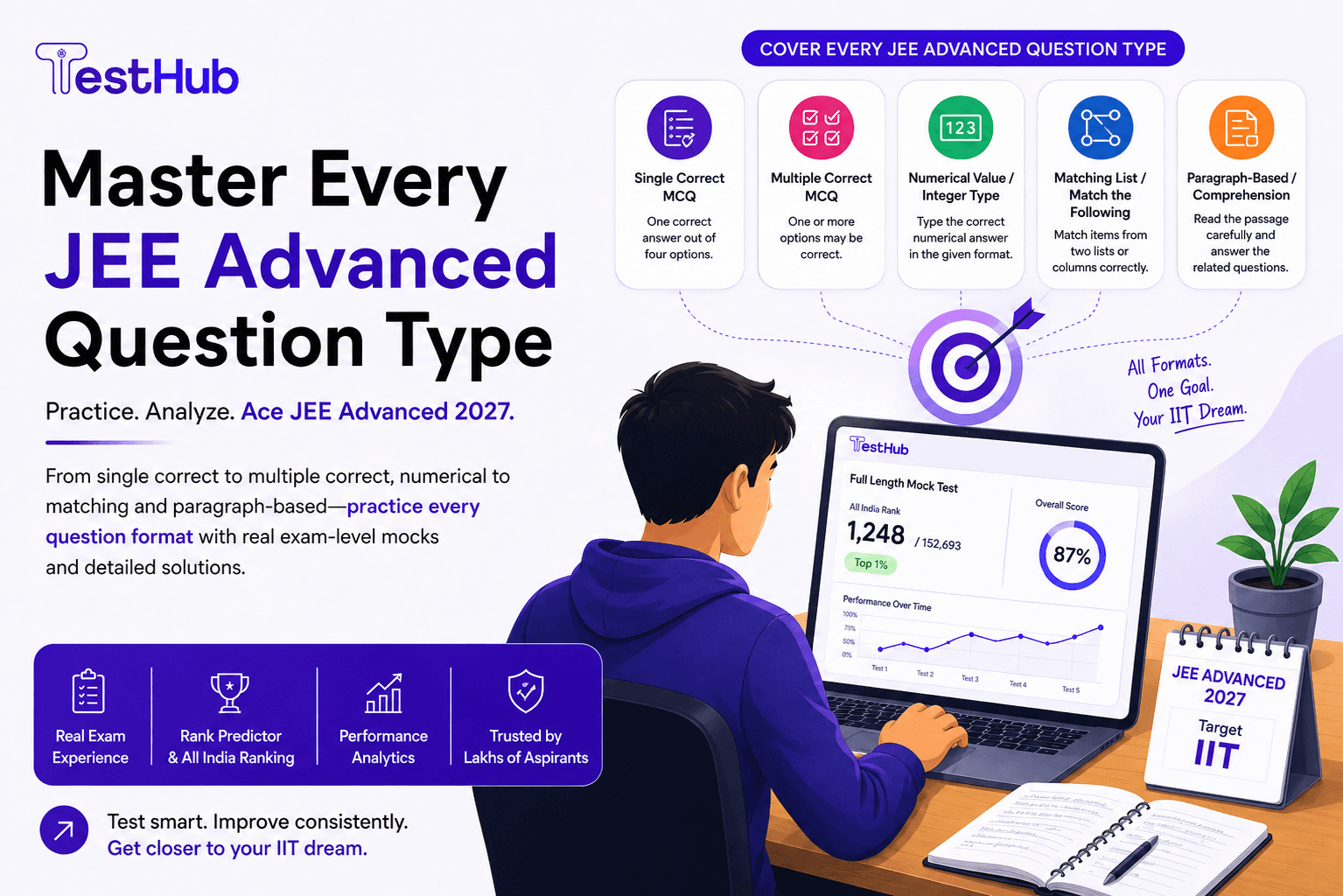
Types of Questions in JEE Advanced: A Complete Breakdown (2027 Guide)
JEE Advanced tests more than subject knowledge - it tests how well you handle different question formats, marking schemes, and strategic risks. This guide covers every major JEE Advanced question type, including single-correct, multiple-correct, numerical, matching, and paragraph-based questions, with practical strategies for approaching each.

26 Aug 2026 · TestHub Team
Best Test Series for JEE Main 2027
Choose the right JEE 2027 test series by focusing on current exam patterns, detailed solutions, trend-based analytics, All-India benchmarking, and relevant PYQ practice - not just the number of tests offered.

17 Aug 2026 · TestHub Team
Best Apps and Websites for JEE Mock Tests Preparation (2027 Guide)
Choosing the best JEE mock test app depends on your preparation stage and what you actually need from a testing platform. This guide compares the major categories—from coaching apps and free PYQ platforms to dedicated mock test websites—and explains how to choose the right option for JEE Main and Advanced preparation.

12 Aug 2026 · TestHub Team
Why TestHub Is One of the Best Platforms for JEE Main & Advanced Preparation in 2027
TestHub is a JEE-focused preparation platform offering All-India test series, detailed solutions, performance analytics, PYQs, a 50,000+ question bank, and rank prediction to help JEE Main and Advanced aspirants prepare smarter and improve their performance