
TestHub Team
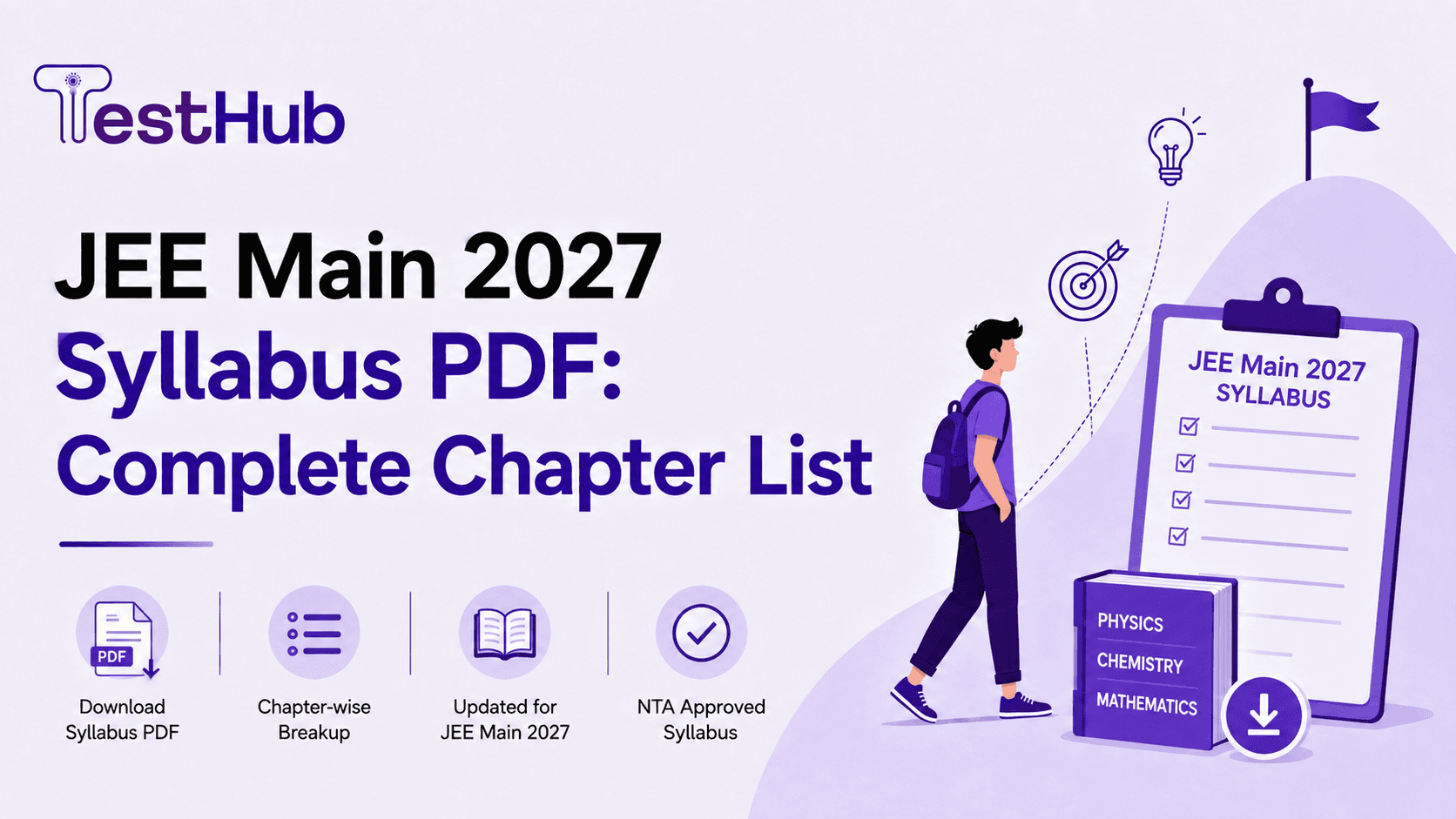
JEE Main 2027 Syllabus PDF: Complete Chapter List
Get the complete JEE Main 2027 syllabus chapter-wise for Physics, Chemistry, and Mathematics, along with the exam pattern, removed topics, and practical preparation tips to plan your JEE Main 2027 preparation effectively.
On the very first day of JEE Main 2027 preparation, you need to download and understand the syllabus. You can learn exactly which chapters to study and which ones NTA has dropped and not waste weeks studying stuff which won't even appear in your exam!
This guide offers a detailed chapter-wise description of the JEE Main 2027 syllabus for Physics, Chemistry, Mathematics, the exam pattern, and some tips to utilise the syllabus for your preparation plan.
Has NTA Released the JEE Main 2027 Syllabus Yet?
Not officially. The National Testing Agency (NTA) has not yet released a separate PDF of the syllabus for JEE Main 2027. The official syllabus is supposed to be published along with the Information Bulletin towards the end of October 2026, near the registration period.
However, you don't have to wait. The 2027 syllabus is likely to remain similar to the 2026 syllabus, as the previous one was compressed during 2024 and has remained unchanged since then. Now it is safe to begin preparation with the present (2026) syllabus; just check the official PDF at jeemain.nta.nic.in when it is released.
Just a word of warning: don't get any random PDF of "reduced syllabus" from social media or from an unofficial website. Use only those sources that are well defined and have their syllabus based on the latest notification issued by the NTA.
JEE Main 2027 Exam Pattern (Quick Recap)
Before jumping into chapters, here's the pattern context that shapes how you should study:
Paper 1 (B.E./B.Tech): Physics, Chemistry, and Mathematics, 25 questions each (20 MCQs + 5 numerical value questions), 100 marks per subject
Total marks: 300, computer-based mode, 3-hour duration
Paper 2A (B.Arch): Mathematics, Aptitude, and Drawing Test
Paper 2B (B.Planning): Mathematics, Aptitude, and Planning-based questions
Since Physics, Chemistry, and Maths carry equal weightage in Paper 1, there's no room to "skip" a subject; a balanced study plan across all three matters more than ever.
JEE Main 2027 Physics Syllabus: Chapter List
Physics is generally considered the most time-consuming section because of its numerical depth. Here are the major chapters/units:
Units and Measurements
Kinematics
Laws of Motion
Work, Energy and Power
Rotational Motion
Gravitation
Properties of Solids and Liquids
Thermodynamics
Kinetic Theory of Gases
Oscillations and Waves
Electrostatics
Current Electricity
Magnetic Effects of Current and Magnetism
Electromagnetic Induction and Alternating Currents
Electromagnetic Waves
Optics (Ray Optics and Wave Optics)
Dual Nature of Matter and Radiation
Atoms and Nuclei
Electronic Devices (Semiconductors)
Experimental Skills
High-weightage areas to prioritize: Electrostatics, Current Electricity, and Mechanics (Kinematics + Laws of Motion) consistently dominate the question paper year after year.
JEE Main 2027 Chemistry Syllabus: Chapter List
Chemistry is split into three parts: Physical, Inorganic, and Organic, and is usually the most scoring section if you prepare it systematically.
Physical Chemistry
Some Basic Concepts in Chemistry
Atomic Structure
Chemical Bonding and Molecular Structure
Chemical Thermodynamics
Solutions
Equilibrium
Redox Reactions and Electrochemistry
Chemical Kinetics
Inorganic Chemistry
Classification of Elements and Periodicity in Properties
p-Block Elements (Groups 13–18)
d- and f-Block Elements
Coordination Compounds
Organic Chemistry
Purification and Characterisation of Organic Compounds
Basic Principles of Organic Chemistry
Hydrocarbons
Organic Compounds Containing Halogens
Organic Compounds Containing Oxygen
Organic Compounds Containing Nitrogen
Biomolecules
Principles Related to Practical Chemistry
Note: Chapters like Solid State, Polymers, Environmental Chemistry, s-Block Elements, Gaseous State, Metallurgy, and Surface Chemistry subtopics were removed in the 2024 revision and remain excluded; don't waste time on them.
JEE Main 2027 Mathematics Syllabus: Chapter List
Maths carries the highest weightage in the overall paper and rewards accuracy and speed. Key chapters include:
Sets, Relations and Functions
Complex Numbers and Quadratic Equations
Matrices and Determinants
Permutations and Combinations
Binomial Theorem
Sequence and Series
Limit, Continuity and Differentiability
Integral Calculus
Differential Equations
Coordinate Geometry
Three-Dimensional Geometry
Vector Algebra
Statistics and Probability
Trigonometry
High-weightage areas to prioritize: Calculus (Limits, Continuity, Differentiability, Integral Calculus), Coordinate Geometry, and Vectors + 3D Geometry combined tend to carry the most marks.
How to Use This Syllabus Effectively
Downloading your syllabus is simple, but using it effectively is what will get you to move your score. The easy way is to:
Read each of the three syllabi through and honestly judge if the chapters are OK or if they need work.
The above chapters are the ones to focus on by prioritizing the weightage: Do not dedicate the same amount of time to all chapters; dedicate more hours to those that have more weight.
Study NCERT first: The entire syllabus of JEE Main is based on NCERT books of class 11 and class 12. Learn NCERT first and then refer to others.
Test yourself on a regular basis: It is not the same to read a chapter as it is to be exam-ready for it. Full-length mocks and chapter-wise tests unveil your actual weak areas.
This is where a structured system can come in handy more than anything else than a static PDF. TestHub offers tests that check your understanding after each chapter, PYQ practice, and mocks based on a similar syllabus, which you can attempt instantly after finishing a chapter; the analytics on TestHub will highlight the chapter(s) that need more focus before the next mock (your chapter above).
Ready to test what you've learned? Start your first free mock test on TestHub, no card required.
Prepare Smarter for JEE Main 2027
Practice with updated mock tests, PYQs, detailed solutions, and performance analytics to strengthen your JEE Main 2027 preparation
Frequently Asked Questions
Common questions readers ask about this topic.
Has the JEE Main 2027 syllabus changed from 2026?
There will be no significant changes. At the moment, there is no new syllabus for 2027, and the syllabus was slashed in 2024.
Where can I download the official JEE Main 2027 syllabus PDF?
It will be published on the official NTA website (jeemain.nta.nic.in) in the Information Bulletin/Syllabus section, which is expected to be in October 2026.
Is the JEE Main syllabus the same as JEE Advanced?
No. JEE Main takes NCERT class 11th and 12th as the syllabus, while for JEE Advanced it covers a number of topics apart from NCERT.
Should I start preparing before the official 2027 PDF is released?
Yes. This is the same syllabus as 2024, so you can use this current syllabus and then double-check when it is published with the official PDF.
More on the blog

29 Aug 2026 · TestHub Team
TestHub AI Analysis: How Smart Analytics Fix Your Mistakes Faster
TestHub’s AI-powered mock test analysis goes beyond your score to identify chapter-wise weaknesses, time-management issues, conceptual and calculation errors, and performance trends—helping you turn every mock test into a clear, actionable plan for improvement.
26 Aug 2026 · TestHub Team
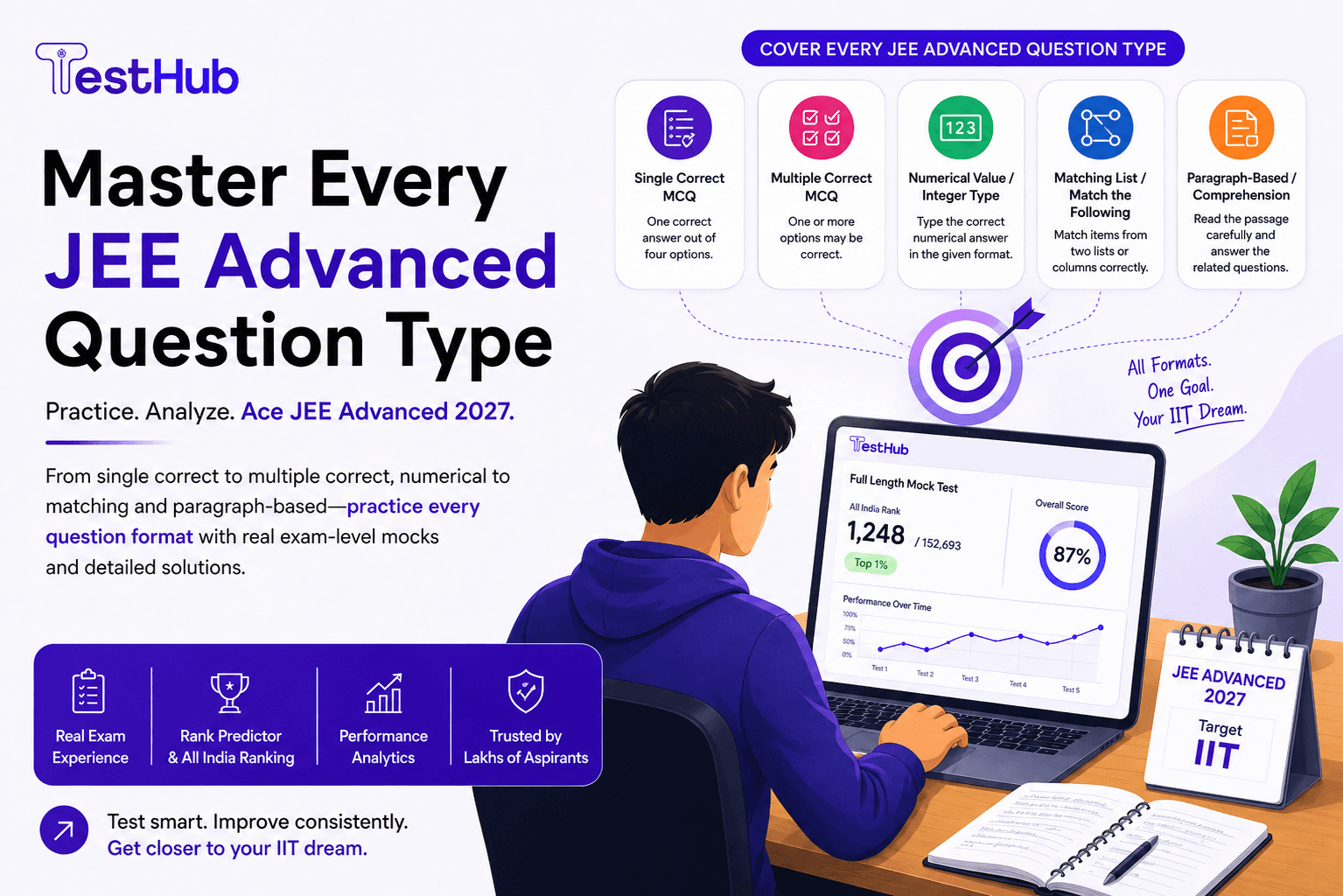
Types of Questions in JEE Advanced: A Complete Breakdown (2027 Guide)
JEE Advanced tests more than subject knowledge - it tests how well you handle different question formats, marking schemes, and strategic risks. This guide covers every major JEE Advanced question type, including single-correct, multiple-correct, numerical, matching, and paragraph-based questions, with practical strategies for approaching each.
26 Aug 2026 · TestHub Team
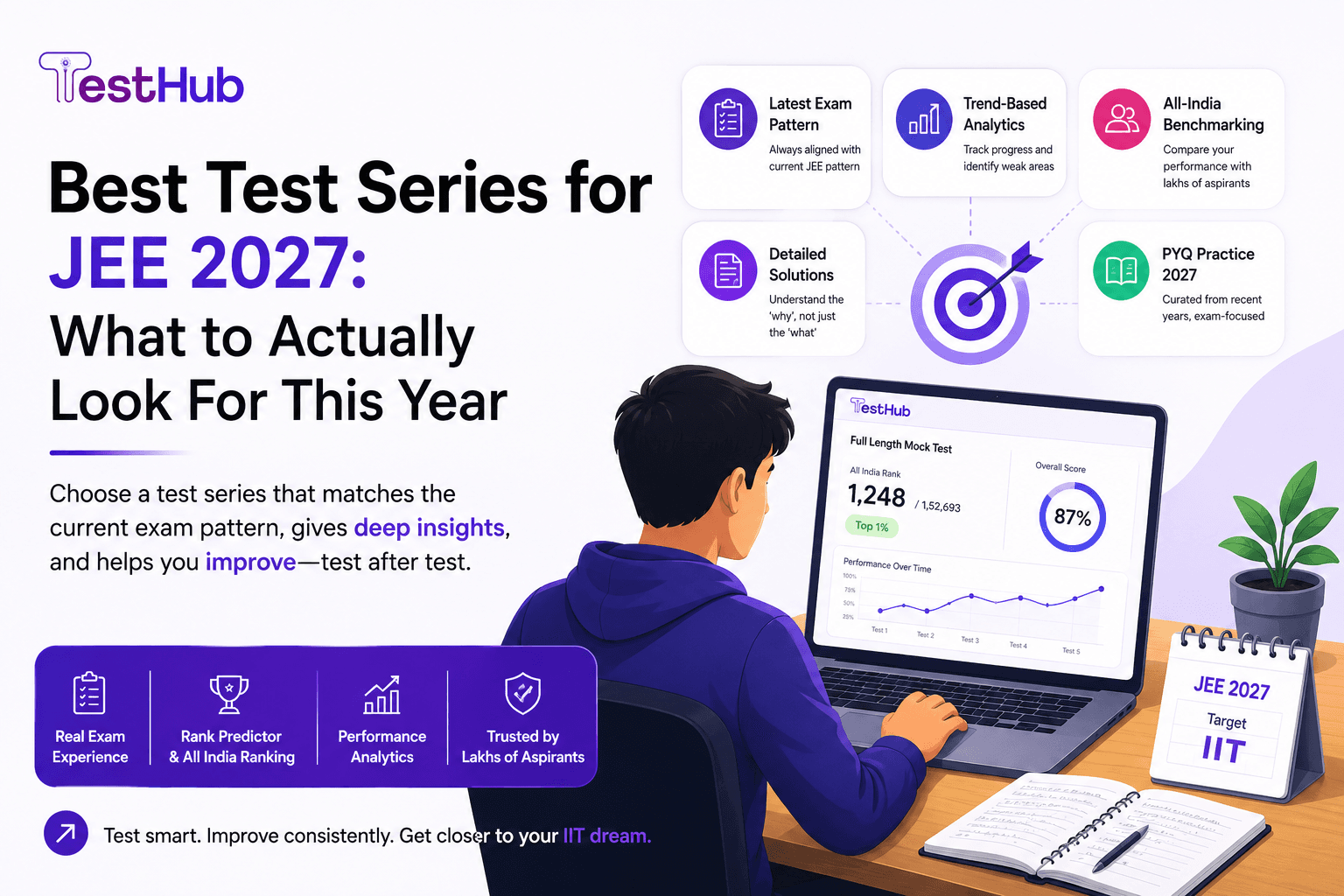
Best Test Series for JEE Main 2027
Choose the right JEE 2027 test series by focusing on current exam patterns, detailed solutions, trend-based analytics, All-India benchmarking, and relevant PYQ practice - not just the number of tests offered.
17 Aug 2026 · TestHub Team
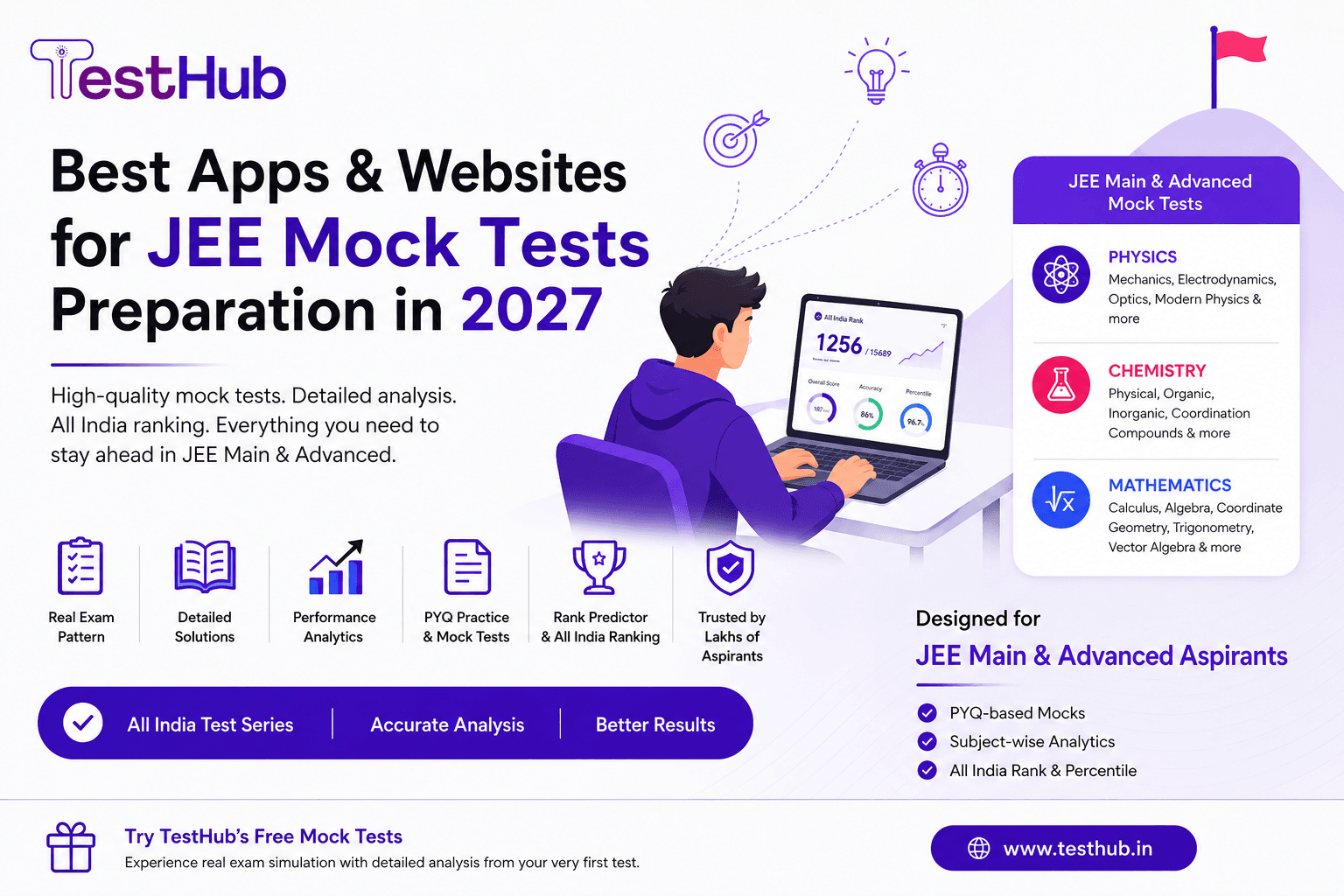
Best Apps and Websites for JEE Mock Tests Preparation (2027 Guide)
Choosing the best JEE mock test app depends on your preparation stage and what you actually need from a testing platform. This guide compares the major categories—from coaching apps and free PYQ platforms to dedicated mock test websites—and explains how to choose the right option for JEE Main and Advanced preparation.

12 Aug 2026 · TestHub Team
Why TestHub Is One of the Best Platforms for JEE Main & Advanced Preparation in 2027
TestHub is a JEE-focused preparation platform offering All-India test series, detailed solutions, performance analytics, PYQs, a 50,000+ question bank, and rank prediction to help JEE Main and Advanced aspirants prepare smarter and improve their performance

12 Aug 2026 · TestHub Team
Most Repeated Topics in JEE Main Last 5 Years
Discover the most repeated JEE Main topics from the last five years and learn which Physics, Chemistry, and Maths chapters deserve priority. Use these proven trends to focus your revision, practice PYQs smarter, and maximize your marks without trying to treat every chapter equally.