

TestHub Team
CBSE Class 12 Result 2026 — Expected Date, How to Check & Revaluation
CBSE Class 12 Result 2026 is expected soon. Check the expected result date, steps to download your marksheet, and complete details about revaluation and verification process.
The CBSE board results are among the most important events in the academic lives of millions of Class 12 students across India. They play a big role in college admissions, scholarship opportunities, and the path students choose ahead. The 2026 board exams are over, and students are now waiting for their results.
The CBSE Class 12 results for 2026 are expected to be announced around April 30, 2026, or in the first few days of May. This timeline may be slightly faster due to the onscreen marking. For official updates, it is best to keep checking cbse.gov.in regularly.
Results are usually declared in the afternoon, most often between 12 PM and 2 PM IST, along with an official announcement. They are released simultaneously on the official websites, DigiLocker, and the UMANG app. Read the full blog to know more about the Class 12 results for 2026
Table of contents:
How to Check Your CBSE Class 12th Result 2026?
CBSE provides multiple ways to access your results so that heavy traffic on one platform doesn't leave you stranded. Here is a breakdown of all available methods:
Method 1: Official CBSE Website
Visit results.cbse.nic.in or cbse.gov.in.
Click on the "Class XII Senior Secondary Result 2026" link.
Enter your roll number, school number, admit card ID, and date of birth.
Click submit.
Your result will appear on screen.
Download a PDF copy and save it immediately — don't rely on coming back later.
Method 2: DigiLocker
DigiLocker handles server traffic far better than the CBSE portal.
Visit digilocker.gov.in or use the DigiLocker app.
Log in using your Aadhaar-linked mobile number.
Go to the Education section and select CBSE.
Click on CBSE Class XII Result 2026.
Enter your roll number, school number, admit card ID, and year (2026).
Click Get Document.
The DigiLocker marksheet is officially valid for college admissions—it carries the same legal weight as the physical document.
Method 3: UMANG App
Download the UMANG app.
Go to the CBSE service section, enter your credentials, and access your result.
This is especially useful for students in areas with unstable internet connections
Method 4: SMS (For No-Internet Situations)
Open your messaging app.
Type your message in this format: CBSE12 <Roll Number> <School Number> <Centre Number>
For example: CBSE12 1234567 65432 1234
Send this to the official CBSE SMS number, which is published on cbse.gov.in on the result day.
What Your Mark Sheet Will Show?
Once your result loads, here is what you will find on the provisional marksheet:
Subject-wise Marks Theory and practical marks listed separately for each subject. | Total Marks & Percentage Aggregate score across all five main subjects. |
Grades Letter grade (A1, A2, B1, B2, C, etc.) assigned per subject. | Qualifying Status Pass, Compartment, or Essential Repeat clearly mentioned. |
The result you download on declaration day is provisional. Original physical marksheets are dispatched to schools by CBSE after a few weeks. Colleges accept the downloaded copy for provisional admission
Passing Marks and Compartment Rules
To pass CBSE Class 12 boards, a student must secure a minimum of 33% in each subject, theory and practical marks combined. If a student gets less than that in one or two subjects, they have to take a compartment exam instead of failing the whole year. This allows a second chance to pass those specific papers without having to repeat the entire year.
The compartment option is a genuine second chance, not a consolation prize. Many students have improved significantly through it and gone on to excellent colleges.
Failing in three or more subjects results in an essential repeat, meaning the student must reappear for all subjects the following year. If you find yourself in the compartment zone, don't panic, the compartment exam is typically held in July, giving a reasonable window to prepare.
Revaluation, Verification and Rechecking: Complete Process
Step 1: Apply for a Photocopy of the Answer Book
Before anything else, you need to request a photocopy of your evaluated answer sheet. You cannot apply for verification or revaluation without this. The application window opens shortly after the results for a week. The fee for this is ₹700 per subject for Class 12. Once you receive the photocopy, review your answers carefully against the official marking scheme. This step often reveals where marks were lost
Step 2: Verification of Marks
Verification is not a re-evaluation of answers. It is a checking process where the CBSE ensures that all answers have been evaluated, all marks have been correctly totalled, and no section has been left unmarked.
CBSE uses a digital evaluation process called On-Screen Marking (OSM) to reduce human error. However, like any system, small mistakes can still happen occasionally. The fee is ₹500 per subject. Applications must be submitted within about four days of the result declaration.
Step 3: Revaluation of Specific Questions
If verification does not change your marks and you still believe a specific answer was evaluated incorrectly, you can apply for revaluation of up to 10 questions. A new subject expert reviews those questions again. The fee is ₹100 for each question. It's important to remember that grades can go up, stay the same, or even go down. You have to accept what happened. The official Pariksha Sangam portal handles the whole process. No offline applications or letters to regional offices are accepted.
Remember:
Once you apply for revaluation, the result is binding. If the marks go down, the lower score becomes your official mark. Apply only after carefully studying your photocopy and being reasonably confident of an error.
Fee Structure for Revaluation Services 2026
Service | Who It's For | Fee (2026) |
Photocopy of Answer Book | All students (mandatory first step) | ₹700 / subject |
Verification of Marks | Students suspecting totalling errors | ₹500 / subject |
Revaluation of Answers | Students are confident of the marking error | ₹100 / question |
All payments are made online through the CBSE portal. There are no offline payment options, and fees are generally non-refundable.
Conclusion
The CBSE Class 12 result is an important milestone, but what matters most is how you move forward. If you're improving scores or preparing for the next step, consistent practice is key.
TestHub’s 12th Board Test Series helps you do exactly that with exam-level questions, CBSE-aligned patterns, and clear performance insights to strengthen weak areas and build confidence. It’s a smarter way to stay prepared and maximise your results.
Ace Your CBSE Class 12 Boards with Smart Practice
Get exam-ready with our 12th Board Test Series—designed as per the latest CBSE pattern to help you improve where it matters most.
Frequently Asked Questions
Common questions readers ask about this topic.
When will the CBSE Class 12 Result 2026 be declared?
The CBSE Class 12 Result 2026 is expected to be declared around April 30, 2026, or in early May 2026, likely earlier than usual due to the on-screen marking system. Students should check the official website cbse.gov.in for updates.
Which website should I check for the CBSE Class 12 Result 2026?
The result will be available on cbse.gov.in and results.cbse.nic.in. It can also be accessed via DigiLocker and the UMANG app, which often handle traffic better on result day.
What details do I need to check my CBSE Class 12 Result 2026?
You will need your roll number, school number, admit card ID, and date of birth. Keep these details ready in advance for quick access.
What are the minimum passing marks in CBSE Class 12?
Students must score at least 33% in each subject (theory and practical combined) to pass. If a student scores below 33% in one or two subjects, they may appear for compartment exams.
What should I do if my CBSE Class 12 marks are lower than expected?
Download and save your result first. Then apply for a photocopy of your answer sheet through the Pariksha Sangam portal within the given window (usually 4–5 days). After reviewing it, you can decide whether to apply for verification or revaluation.
More on the blog
7 Oct 2026 · TestHub Team
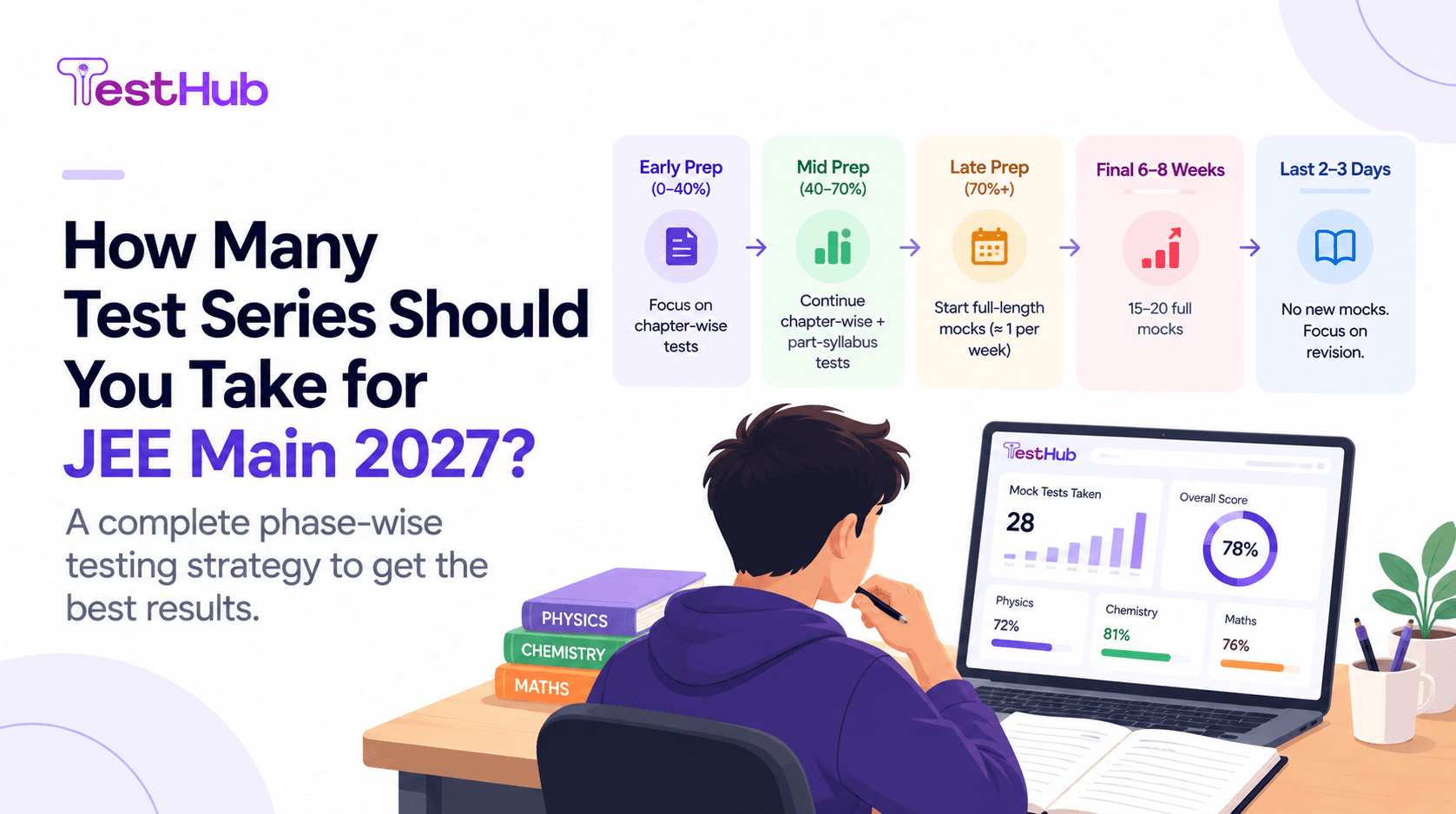
How Many Test Series Should You Take for JEE Main 2027
For most JEE Main 2027 aspirants, 20–40 full-length mock tests are a realistic target, concentrated in the final 3–4 months before the exam. But test count alone isn't enough—consistent analysis, mistake tracking, and a phase-wise testing strategy are what actually turn mock tests into score improvement.
7 Oct 2026 · TestHub Team
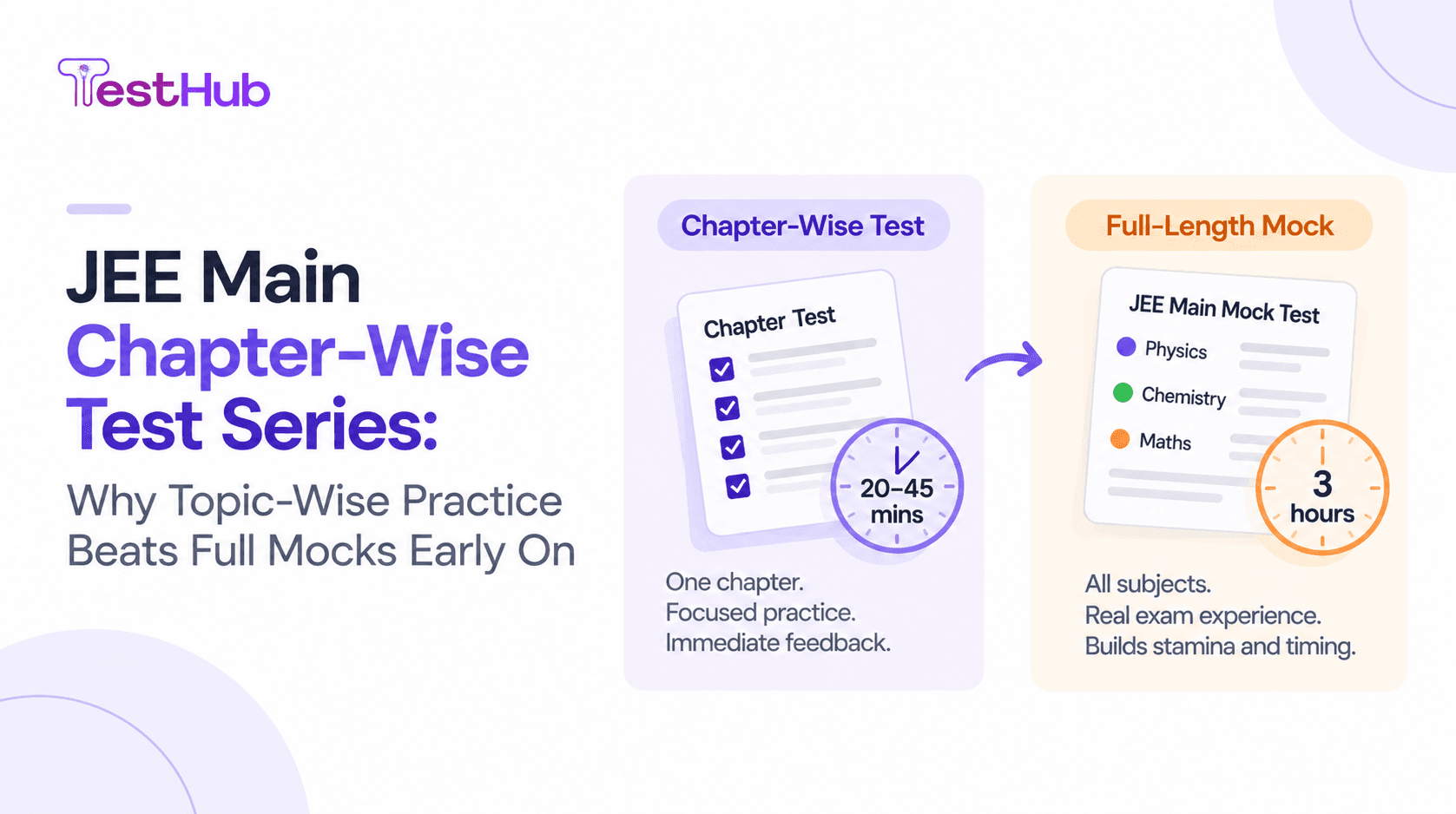
JEE Main Chapter-Wise Test Series: Why Topic-Wise Practice Beats Full Mocks Early On
Chapter-wise JEE Main tests are ideal early in preparation because they provide focused practice and immediate feedback without the pressure of a full-length mock. Learn when to use chapter-wise, subject-wise, and full-length tests to build your preparation progressively and improve your JEE Main performance.
7 Oct 2026 · TestHub Team
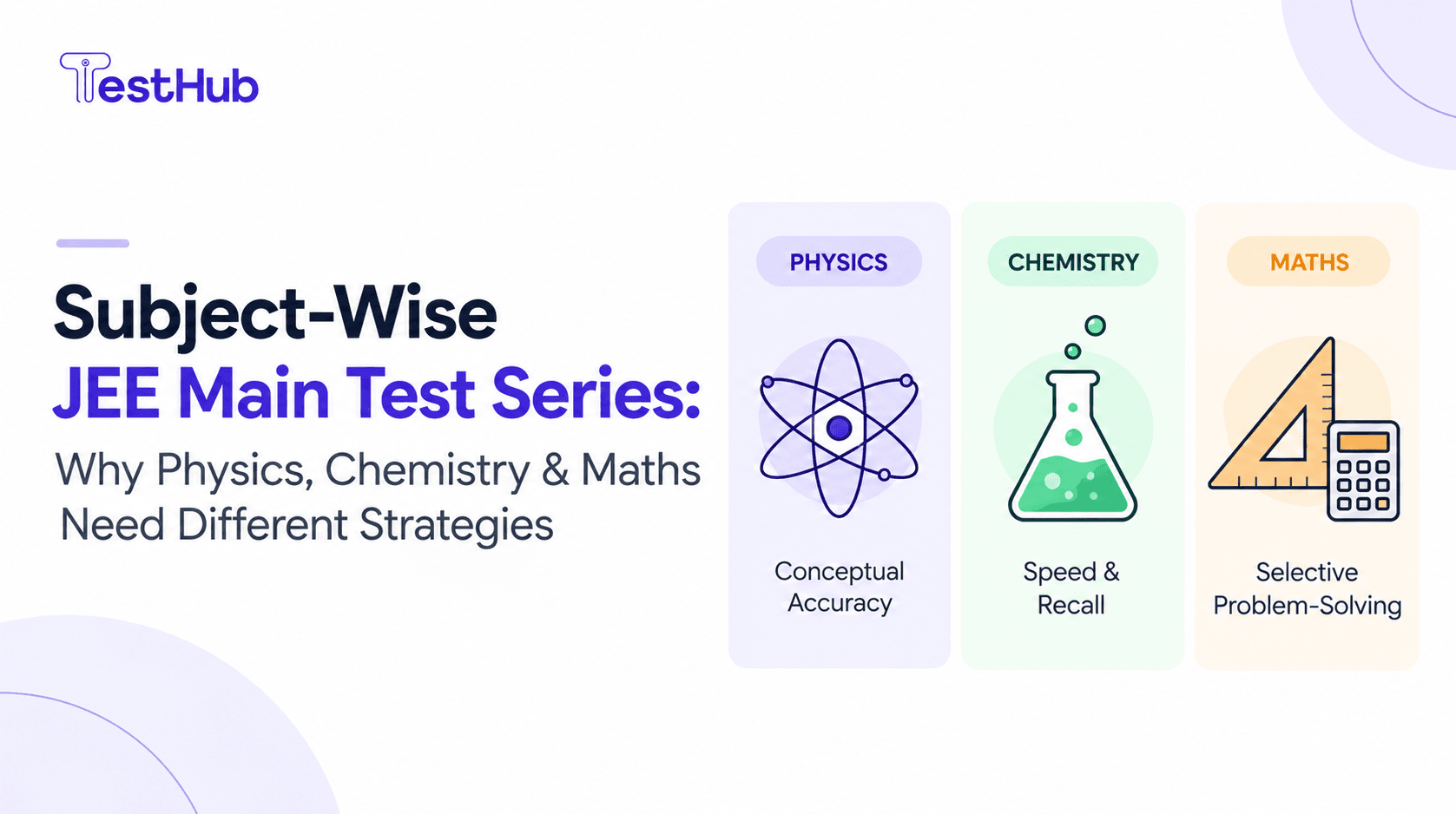
Subject-Wise JEE Main Test Series: Why Physics, Chemistry & Maths Need Different Strategies
Physics, Chemistry, and Maths require different strategies in JEE Main. Chemistry rewards speed and recall, Physics demands conceptual accuracy, and Maths requires selective problem-solving and time management. A subject-wise and chapter-wise test series helps students practice according to these differences and identify whether lost marks come from knowledge gaps, conceptual errors, or poor question selection.

28 Sept 2026 · TestHub Team
Best JEE Test Series in Kota vs Online: What Actually Works in 2027
Every JEE 2027 aspirant eventually faces the choice between Kota coaching and online preparation. This guide compares both options across cost, discipline, faculty access, test series quality, flexibility, and pressure to help you choose the approach that fits your preparation style, budget, and goals.
17 Sept 2026 · TestHub Team
What Is AiYaaR? TestHub's AI Doubt-Solving Assistant Explained
Stuck on a tricky JEE question late at night? AiYaaR, TestHub’s AI study companion, is built to help you solve doubts, understand concepts, analyze mistakes, and plan your next steps. Unlike generic doubt solvers, AiYaaR uses your TestHub preparation history - including test performance, topic-wise progress, mistakes, and study plans—to provide personalized guidance. From “why did I get this wrong?” to “what should I practice next?”, AiYaaR connects every doubt to your larger JEE preparation journey.
2 Sept 2026 · TestHub Team
JEE Main 2027 Syllabus PDF: Complete Chapter List
Get the complete JEE Main 2027 syllabus chapter-wise for Physics, Chemistry, and Mathematics, along with the exam pattern, removed topics, and practical preparation tips to plan your JEE Main 2027 preparation effectively.
