
TestHub Team
How to Prepare for JEE Main 2026
Learn how to prepare for JEE Main 2026 effectively. Get subject-wise preparation tips, study schedule, revision strategy, and mock test plan to score 99+ percentile.
JEE Mains can be tough for students; it involves practice and dedication. Students face numerous difficulties in online classes. This article guides students on how to start preparing for JEE 2026 with a study plan, preparation strategy, timetable, and subject-wise tips to crack the exam. Students should take mock tests and online test series and go through previous years' question papers to understand the exam pattern.
Overview of JEE Main 2026
Mode of Exam | Online (computer-based test), except for the B.Arch Drawing section (offline) |
Duration | Paper 1 – 3 hours (B.Tech) |
Exam Shifts | First Shift: 9 AM – 12 Noon |
Question Type | 20 MCQs per subject |
Marking Scheme | +4 for correct answer |
Students can take both sessions, and the highest score will be considered for admission.
JEE Main Papers
Paper 1: For BTech/BE with 75 multiple-choice questions totaling 300 marks.
Paper 2A (B.Arch): 77 questions, 400 marks, including a drawing section conducted offline.
Paper 2B (B.Plan): 100 multiple-choice questions, 400 marks, conducted fully online.
How to Prepare for JEE Main 2026
Students should find a private and silent place for online classes to avoid disturbances.
Students should focus on NCERT first, especially for Chemistry, to build a strong foundation.
Revision should be a continuous process during regular studies.
Choose one reliable source per subject and revise it thoroughly.
Maintain consistency in studies instead of irregular long study hours.
Record online sessions so they can be rewatched anytime.
Take mock tests and online test series regularly.
Read theory first, then practice problems to understand concepts better.
Go through previous years' question papers to understand the exam.
Starting early helps in creating a structured study plan, reducing last-minute stress and boosting confidence.
Time Management Tips
Apply the 80/20 rule – spend 80% time on important topics and 20% on weaker areas.
Avoid distractions like social media while studying.
Follow a daily schedule of 6–8 hours, including 2–3 hours of practice questions.
Practice with a timer to improve speed and accuracy.
Conclusion
This article provides detailed information about JEE Main 2026 and can be beneficial for all candidates preparing for the Joint Entrance Examination (Main). It covers exam details, preparation strategies, study plans, and important tips. Students should regularly visit the official NTA website to stay updated.
Frequently Asked Questions
Common questions readers ask about this topic.
How to crack JEE Mains in 2026?
The 90-60-30 rule means 90 minutes for topic revision, 60 minutes for MCQs, and 30 minutes for quick formula review.
Should I take coaching for IIT JEE 2026?
Yes, coaching can help a lot. Students can study school subjects on their own, but for JEE Main and Advanced, guidance is important. Teachers can clear doubts, suggest study methods, and guide preparation.
What is the syllabus of JEE 2026?
The JEE Main 2026 syllabus covers Physics, Chemistry, and Maths from Class 11 and 12 NCERT books. Students should check the official NTA syllabus for updates.
How to prepare for JEE 2026?
Students must have a proper study plan, preparation strategy, timetable, and subject-wise tips. Taking mock tests and online test series is important.
What are the 12th board eligibility criteria for JEE Mains 2026?
There is no minimum 12th board percentage required for JEE Mains 2026. Any student who has passed 12th grade can appear for the exam.
More on the blog
2 Sept 2026 · TestHub Team
JEE Main 2027 Syllabus PDF: Complete Chapter List
Get the complete JEE Main 2027 syllabus chapter-wise for Physics, Chemistry, and Mathematics, along with the exam pattern, removed topics, and practical preparation tips to plan your JEE Main 2027 preparation effectively.

29 Aug 2026 · TestHub Team
TestHub AI Analysis: How Smart Analytics Fix Your Mistakes Faster
TestHub’s AI-powered mock test analysis goes beyond your score to identify chapter-wise weaknesses, time-management issues, conceptual and calculation errors, and performance trends—helping you turn every mock test into a clear, actionable plan for improvement.
26 Aug 2026 · TestHub Team
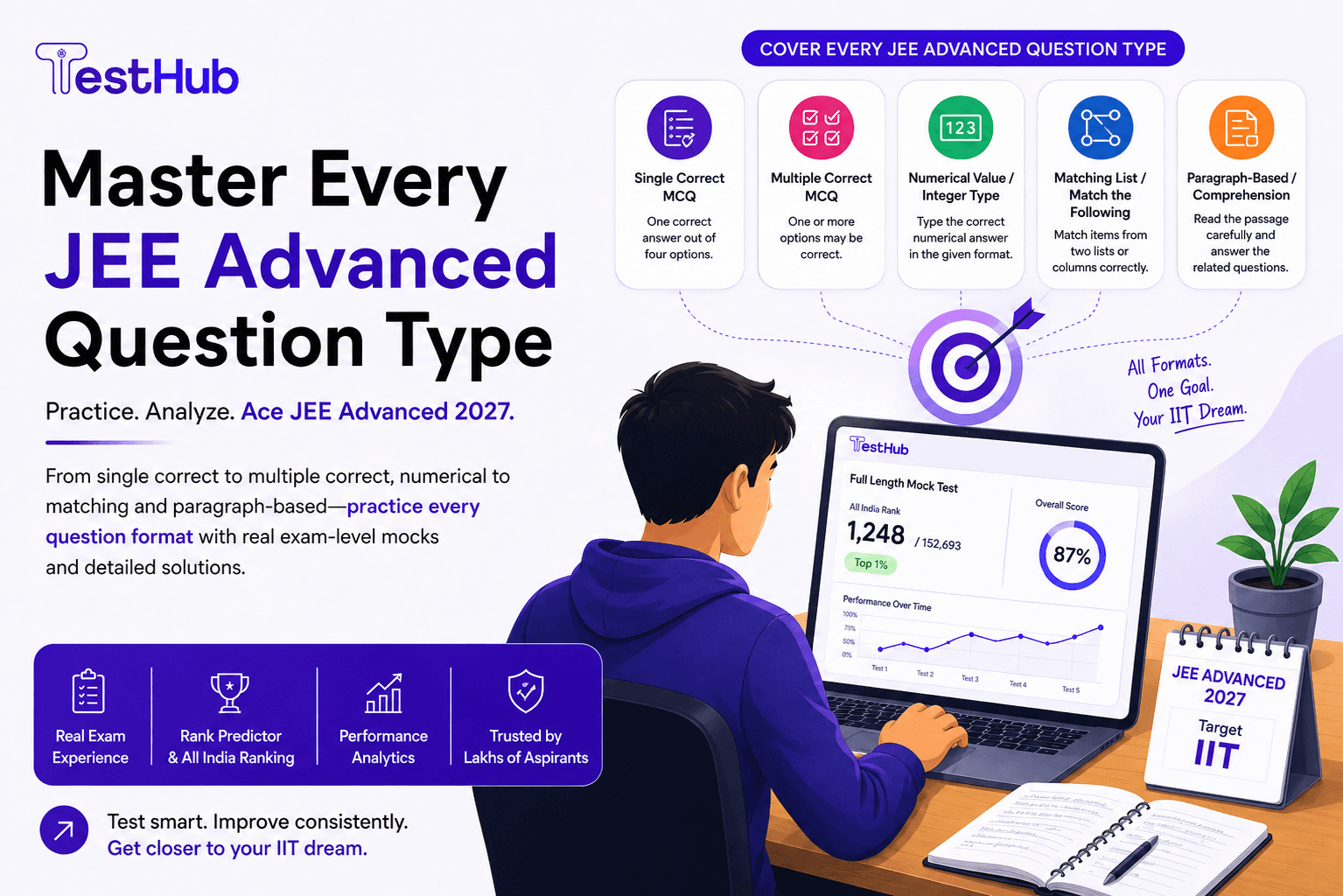
Types of Questions in JEE Advanced: A Complete Breakdown (2027 Guide)
JEE Advanced tests more than subject knowledge - it tests how well you handle different question formats, marking schemes, and strategic risks. This guide covers every major JEE Advanced question type, including single-correct, multiple-correct, numerical, matching, and paragraph-based questions, with practical strategies for approaching each.

26 Aug 2026 · TestHub Team
Best Test Series for JEE Main 2027
Choose the right JEE 2027 test series by focusing on current exam patterns, detailed solutions, trend-based analytics, All-India benchmarking, and relevant PYQ practice - not just the number of tests offered.

17 Aug 2026 · TestHub Team
Best Apps and Websites for JEE Mock Tests Preparation (2027 Guide)
Choosing the best JEE mock test app depends on your preparation stage and what you actually need from a testing platform. This guide compares the major categories—from coaching apps and free PYQ platforms to dedicated mock test websites—and explains how to choose the right option for JEE Main and Advanced preparation.

12 Aug 2026 · TestHub Team
Why TestHub Is One of the Best Platforms for JEE Main & Advanced Preparation in 2027
TestHub is a JEE-focused preparation platform offering All-India test series, detailed solutions, performance analytics, PYQs, a 50,000+ question bank, and rank prediction to help JEE Main and Advanced aspirants prepare smarter and improve their performance