
TestHub Team
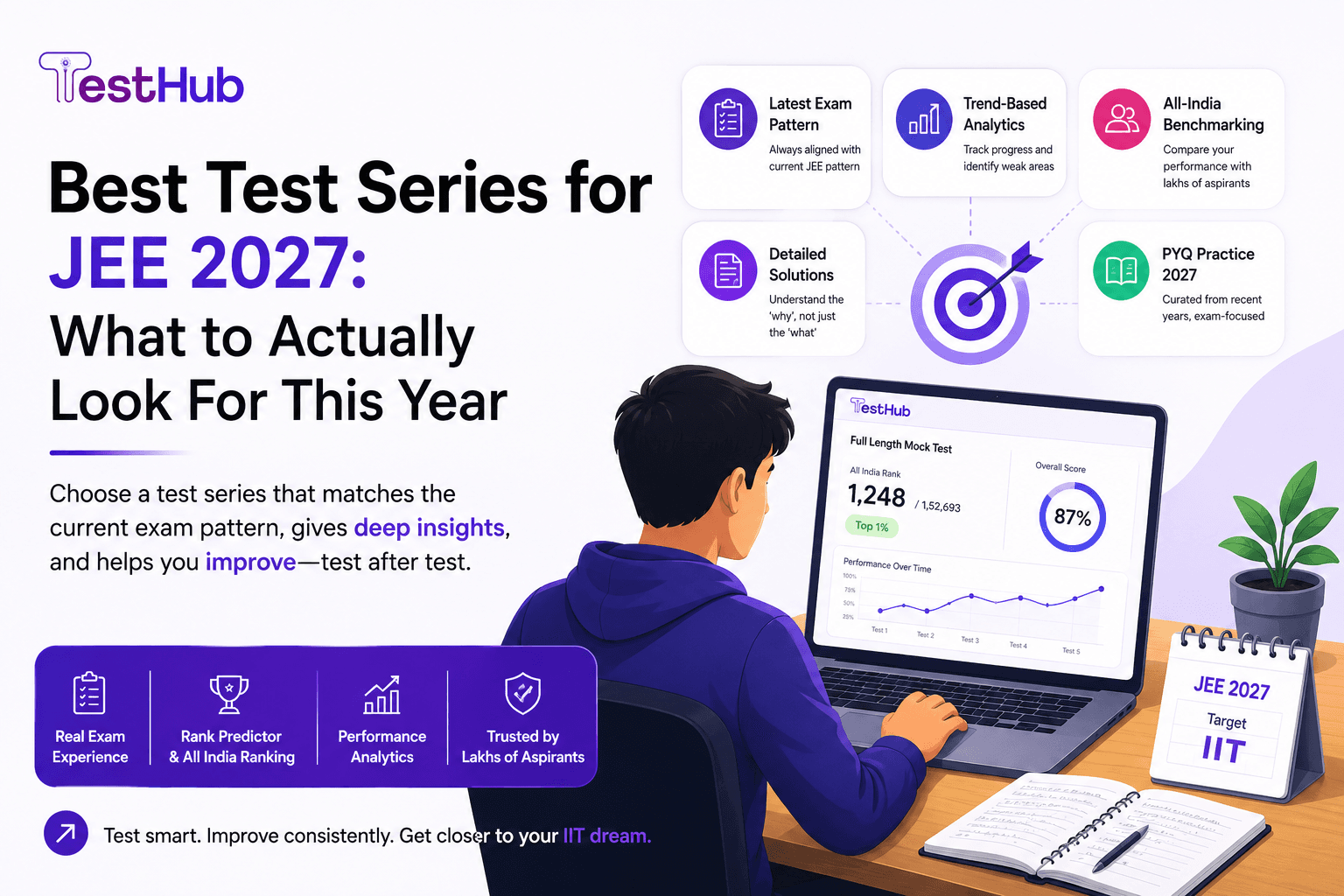
Best Test Series for JEE Main 2027
Choose the right JEE 2027 test series by focusing on current exam patterns, detailed solutions, trend-based analytics, All-India benchmarking, and relevant PYQ practice - not just the number of tests offered.
Every prep cycle, a fresh wave of "best test series" lists shows up online, and most of them read the same as last year's: same generic criteria, same vague "top picks," nothing that actually reflects what's changed. But JEE prep in 2027 isn't identical to 2025 or 2026. Patterns shift, analytics tools have gotten sharper, and the sheer number of test series options has made picking the right one more confusing, not less.
So instead of another recycled checklist, here's a genuinely useful look at what matters for choosing a test series this year and why some of the old advice needs updating.
The Test Series Landscape Has Changed
A few years ago, "test series" mostly meant a stack of papers with an answer key at the back. That bar has moved. Students now expect and genuinely benefit from platforms that pair testing with real analytics: where exactly you're losing marks, how you compare to other aspirants, and whether your mistakes are actually decreasing over time. A test series that's still just handing you a score in 2027 is behind, not competitive.
That shift matters because it changes what "best" should even mean this year. It's not about who has the most tests. It's about who gives you the clearest picture of what to fix next.
1. Confirm It's Built on the Current Pattern, Not Last Year's
NTA has a track record of tweaking JEE Main's format, marking scheme, optional questions, and section structure. A test series that hasn't updated for the current cycle is quietly training you on an exam that no longer exists. Before trusting any platform, cross-check its pattern against the official JEE Main website. This sounds obvious, but it's the single most overlooked check students skip.
2. Solutions Should Explain the "Why," Not Just the "What"
This hasn't changed year to year, but it's still where most test series fall short. An answer key tells you whether you got it right. A real solution walks through why it was a concept gap, a careless slip, or whether you just ran out of time. Without that distinction, you'll keep repeating the same mistake test after test without ever realizing it's the same mistake.
3. Analytics Should Show Trends, Not Just Single-Test Snapshots
This is genuinely one of the bigger shifts worth paying attention to in 2027. A single test's breakdown tells you about one day. What actually matters is whether your specific weak areas are improving across tests and whether your silly-mistake count is dropping. Is a particular chapter still costing you marks three tests in a row? Look for a platform whose dashboards track this over time, not just per-test.
4. All-India Benchmarking Is Non-Negotiable
Your own score improving is good. Knowing how that score stacks up against thousands of other aspirants attempting the same competition is what actually tells you your rank potential. An All-India test series gives you that real-world context a number in isolation doesn't.
5. PYQ Integration Should Feel Current, Not Recycled
Previous year questions remain one of the sharpest tools for understanding how JEE actually phrases and structures problems. But a test series that keeps recycling the same old PYQ sets year after year isn't giving you the full picture. Look for PYQ practice that's kept current and genuinely reflects recent exam patterns, not just a static archive.
6. Don't Confuse Test Volume With Test Quality
More tests can feel productive, but 300 mediocre papers with shallow feedback teach you less than 100 well-built ones with real analysis behind each. If a platform is marketing itself purely on "1000+ tests," ask what actually happens after you finish one of them; that's the part that decides whether the volume is worth anything.
7. Check Whether It Actually Fits Your Prep Stage
A first-time attempter and a dropper don't need the same thing from a test series. First-timers usually benefit from a mix of chapter-wise and full-length testing to build exam temperament gradually. Droppers need higher-frequency, full-syllabus mocks with trend-based analytics to confirm whether last year's specific mistakes are actually going away. The "best" test series genuinely depends on where you're starting from.
What This Looks Like in Practice
TestHub's approach for the 2027 cycle is built around exactly these shifts an All-India test series aligned to the current JEE pattern, detailed step-by-step solutions on every question, subject- and chapter-wise analytics that track your progress across tests (not just within one), and free PYQ practice that stays current with recent exam trends. Whichever platform you choose, run a free sample test first and specifically check the solution depth and analytics before committing to anything paid.
If you're deciding between a paid and free approach entirely, our guide on how to choose the best mock test series for JEE Main walks through that decision in more depth.
A Quick Gut-Check Before You Subscribe
Does the pattern actually reflect this year's exam format?
Are the solutions detailed enough to explain your mistakes, not just confirm them?
Can you see your progress trend across multiple tests, not just one?
Is your score benchmarked against a real All-India student pool?
Does the PYQ content feel current, not recycled from years ago?
If most of these check out, you've likely found a genuinely strong option for 2027 regardless of how it's marketed.
Final Thoughts
The "best" test series for JEE 2027 isn't the one with the flashiest marketing or the longest test list it's the one that keeps up with how the exam and expectations have evolved: current pattern alignment, solutions that explain mistakes rather than just confirm them, and analytics that show real progress over time. Check for those specifically, and you'll make a far better decision than any generic "top 5" list could give you.
Ready to see where you stand for the 2027 cycle? Try TestHub's free mock tests and get detailed, trend-based analytics from your very first attempt.
Ready to Choose the Right JEE Test Series for 2027?
Prepare for JEE 2027 with TestHub's All-India mock tests, detailed solutions, PYQ practice, and trend-based analytics to track your progress and improve your rank.
Frequently Asked Questions
Common questions readers ask about this topic.
What's actually different about choosing a test series in 2027 compared to previous years?
The bigger shift is that students now reasonably expect trend-based analytics and All-India benchmarking as standard, not as premium extras. A test series that's still just scoring papers without that depth is falling behind current standards.
How many mock tests should I be taking for the 2027 cycle?
Most students benefit from at least 25-30 full-length mocks in the final few months before the exam, alongside regular chapter-wise practice earlier on.
Is it worth switching test series mid-prep if the current one feels outdated?
If your platform hasn't updated its pattern to reflect the current exam format, or its analytics haven't improved to show trends across tests, it's worth reconsidering. An outdated test series can do more harm than good.
Should droppers use a different test series strategy than first-time attempters?
Not necessarily a different platform, but droppers generally need higher test frequency and stronger trend-tracking to confirm whether previous mistakes are genuinely improving, since they have more prep time to convert feedback into results.
More on the blog
2 Sept 2026 · TestHub Team
JEE Main 2027 Syllabus PDF: Complete Chapter List
Get the complete JEE Main 2027 syllabus chapter-wise for Physics, Chemistry, and Mathematics, along with the exam pattern, removed topics, and practical preparation tips to plan your JEE Main 2027 preparation effectively.

29 Aug 2026 · TestHub Team
TestHub AI Analysis: How Smart Analytics Fix Your Mistakes Faster
TestHub’s AI-powered mock test analysis goes beyond your score to identify chapter-wise weaknesses, time-management issues, conceptual and calculation errors, and performance trends—helping you turn every mock test into a clear, actionable plan for improvement.
26 Aug 2026 · TestHub Team
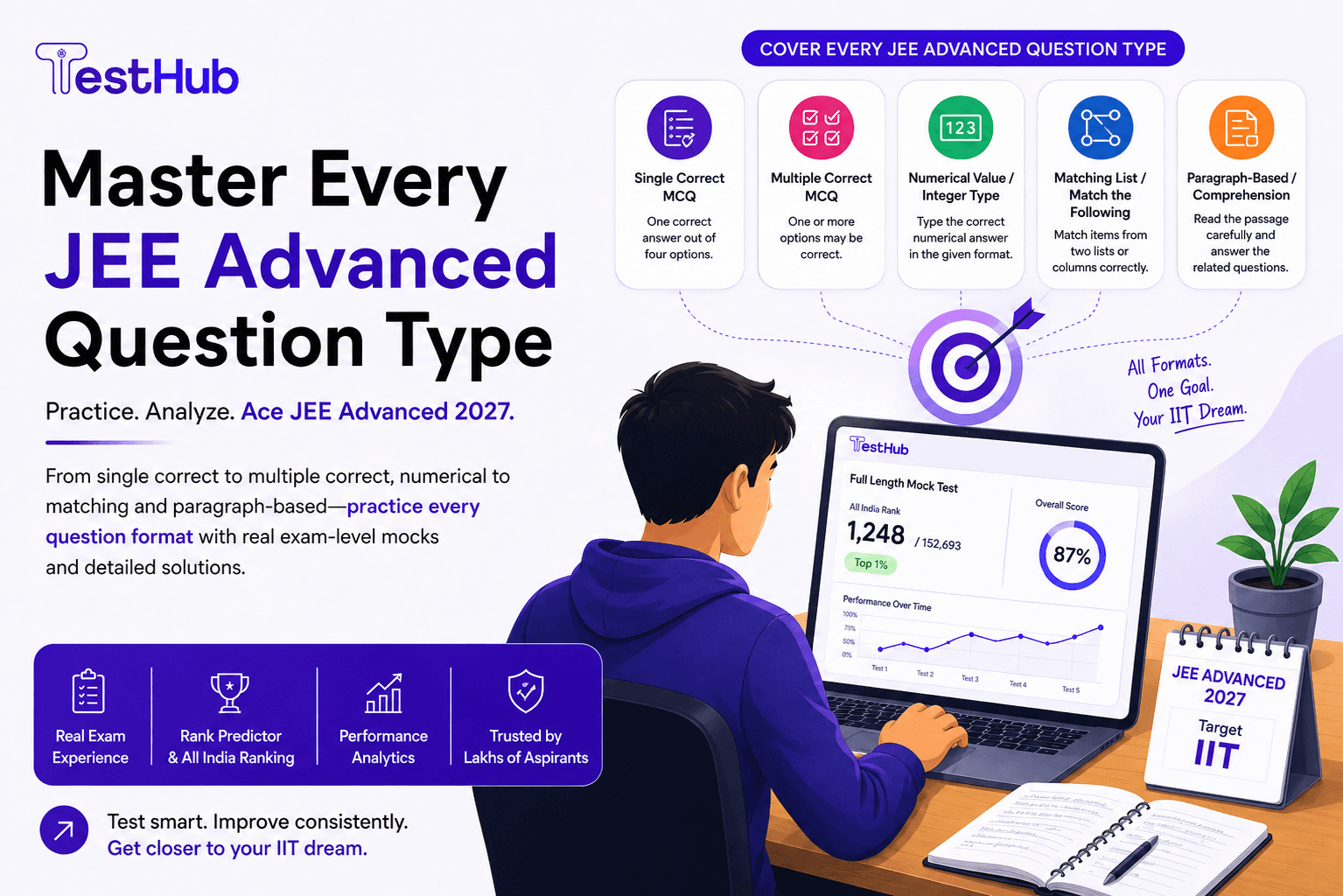
Types of Questions in JEE Advanced: A Complete Breakdown (2027 Guide)
JEE Advanced tests more than subject knowledge - it tests how well you handle different question formats, marking schemes, and strategic risks. This guide covers every major JEE Advanced question type, including single-correct, multiple-correct, numerical, matching, and paragraph-based questions, with practical strategies for approaching each.
17 Aug 2026 · TestHub Team
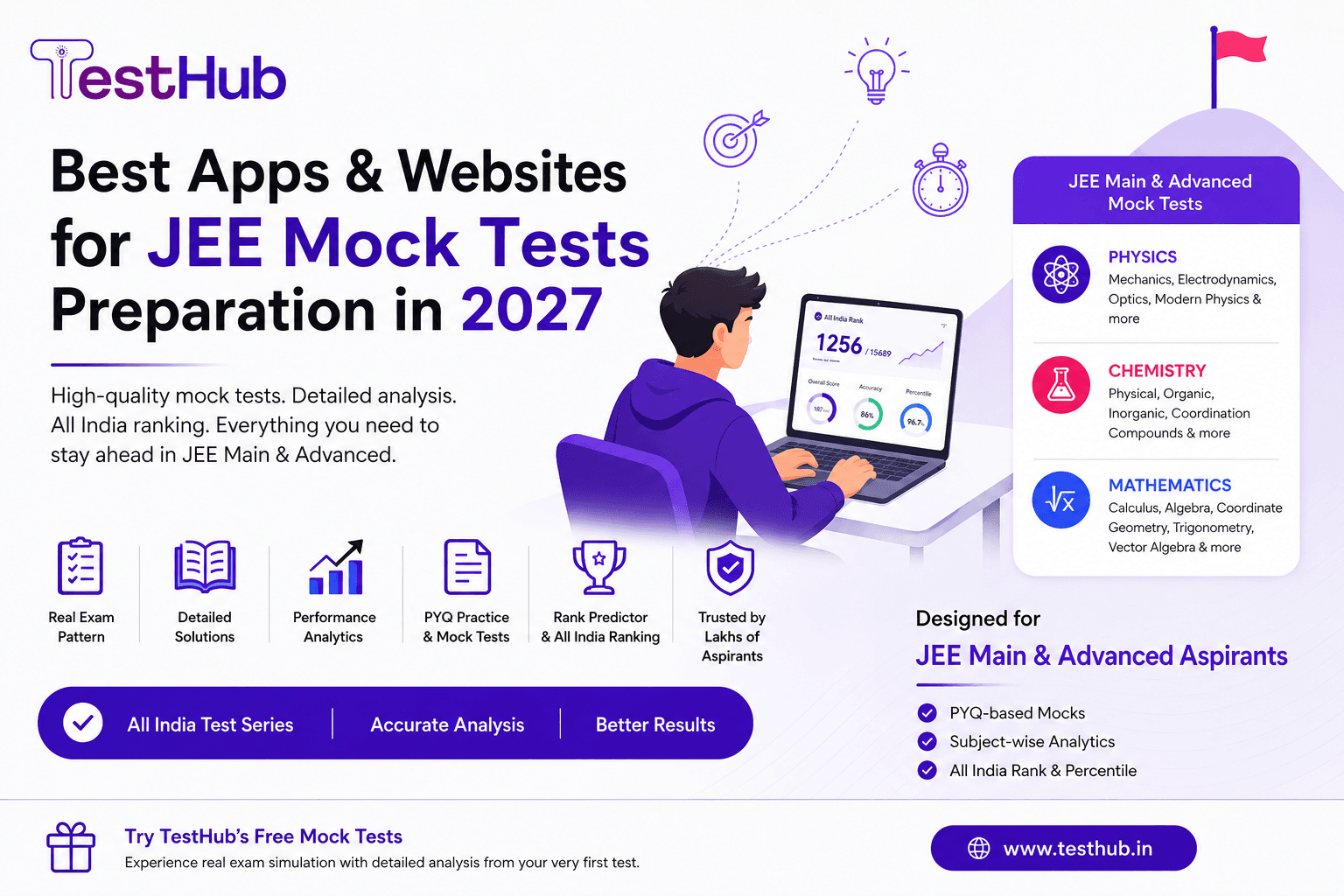
Best Apps and Websites for JEE Mock Tests Preparation (2027 Guide)
Choosing the best JEE mock test app depends on your preparation stage and what you actually need from a testing platform. This guide compares the major categories—from coaching apps and free PYQ platforms to dedicated mock test websites—and explains how to choose the right option for JEE Main and Advanced preparation.
12 Aug 2026 · TestHub Team
Why TestHub Is One of the Best Platforms for JEE Main & Advanced Preparation in 2027
TestHub is a JEE-focused preparation platform offering All-India test series, detailed solutions, performance analytics, PYQs, a 50,000+ question bank, and rank prediction to help JEE Main and Advanced aspirants prepare smarter and improve their performance
12 Aug 2026 · TestHub Team
Most Repeated Topics in JEE Main Last 5 Years
Discover the most repeated JEE Main topics from the last five years and learn which Physics, Chemistry, and Maths chapters deserve priority. Use these proven trends to focus your revision, practice PYQs smarter, and maximize your marks without trying to treat every chapter equally.