
TestHub Team
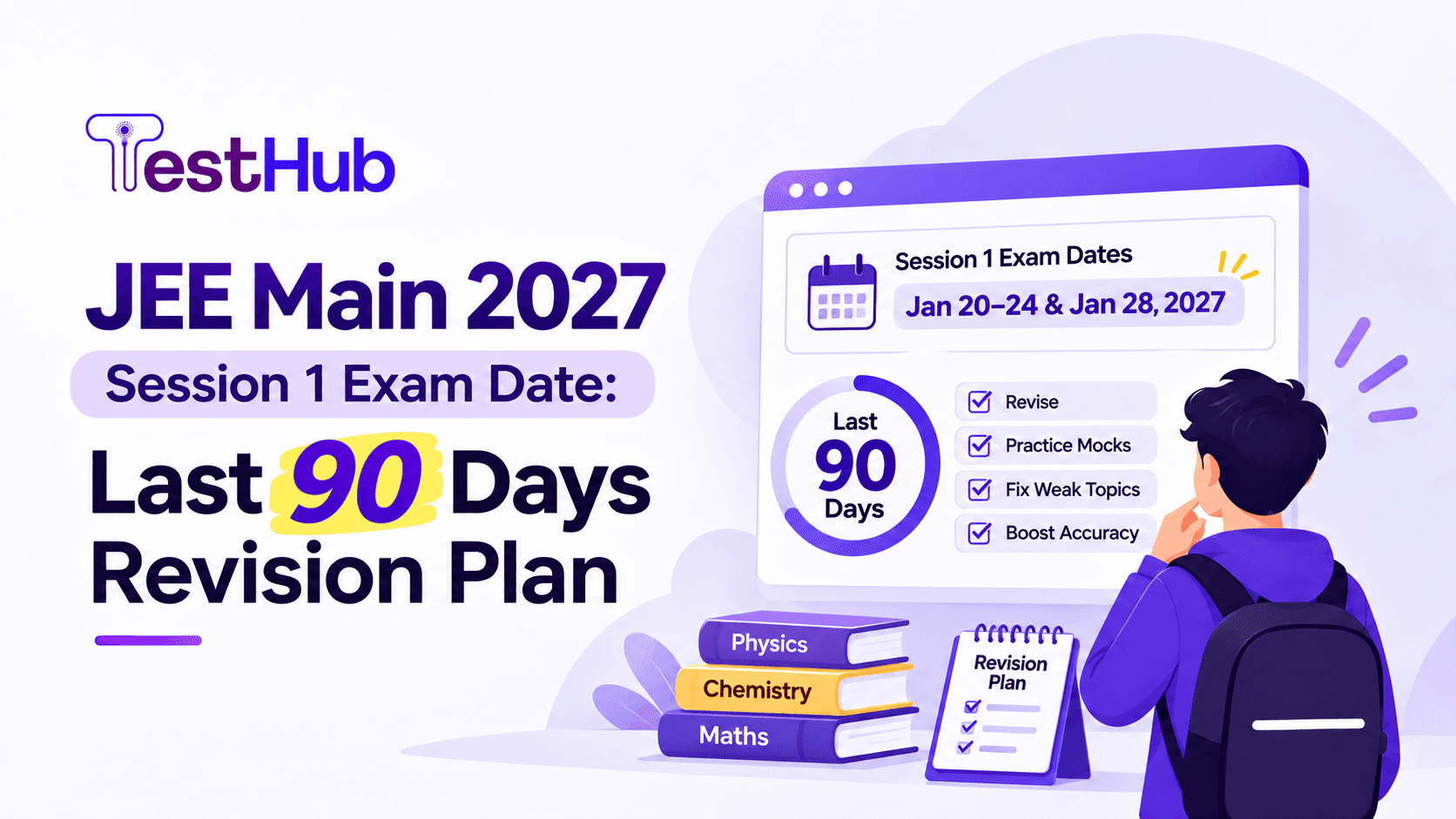
JEE Main 2027 Session 1 Exam Date: Last 90 Days Revision Plan
Prepare for JEE Main 2027 Session 1 with this 84-day study plan, featuring a week-by-week revision timetable, chapter prioritization using PYQs, mock test strategies, subject-wise time allocation, and final-week preparation tips to boost your score.
JEE Main 2027 Session 1 starts on January 20, 2027. NTA has just updated the schedule in their bulletin. The exam now runs on January 20, 21, 22, 23, 24 and 28. Previously, January 22-24 and 28-30 were listed. Those are out.
Today is October 28. This leaves 84 days. Close but not quite 90. This window is burned by most students when dealing with new chapters. Wrong move. This plan provides you with a week-by-week path that's also dates-based.
JEE Main 2027 Session 1 Dates You Can Trust
Old calendars are still floating around online. Check the date before you share any screenshot. The earlier version listed January 31 as a buffer day. The revised calendar removes buffer days. Only six days are listed. Your admit card shows which one is yours.
Each day has two shifts. Morning runs 9 AM to 12 noon. Afternoon runs 3 PM to 6 PM. Admit cards are listed for January 13, and fee payment closes November 22. Pay early. Everything else depends on it. Session 2 follows from April 2 to 7.
Weeks 1 to 4 (Oct 28 to Nov 24): Close the Gaps
Empty chapters earning fewer marks than hard chapters. If you leave a chapter untouched, it means you will never solve a set of free questions for that chapter. Start your syllabus list today! Indicate the strength, weak or not reviewed chapters. Be honest.
Work on the unaltered ones before the others. Options are based on PYQs last 5 years. Topics frequently appear in calculus, coordinate geometry, current electricity, modern physics and chemical bonding. Picture this. 2 untouched chapters and 9 days. Which goes first? The one most likely to have more PYQs. Always.
Begin one error book. Identify each miss as a concept gap, silly error, or time loss. The tag will guide you on what to correct. Sitting a full Mock each Sunday: November 1, 8, 15 and 22. This stage is included in the free mock tests. Begin your shift at 9 AM or 3 PM to fit the actual shifts.
Revision Plan for JEE Main 2027 Session 1: Weeks 5 to 8
Revision is not "rereading. Rereading feels productive. It isn't. Close the book and solve it. Allow one day for each Chapter. Big ones such as Calculus get two. Answer 30-40 questions in each chapter and proceed on to the next chapter.
Create three sheets of one page each: Formulas for Physics, Reactions for Chemistry, Identities for Maths. Read them every morning for 10 minutes. They will be your final week notes.
Add a second mock each week. Wednesday and Sunday work well from November 25. The JEE Main 2027 test series has 30 full tests, so there is no shortage. Then comes the part most students skip. Analysis. Give it as much time as the mock itself. Three hours of test, three hours of review. Sounds heavy? A mock without review is just practice at repeating the same mistakes. Tools like AiYaaR can speed up that review.
Weeks 9 to 11 (Dec 23 to Jan 12): Sit Every Mock Like the Real Thing
Sit every mock like the real exam. Same shift time. Same breaks. Phone in another room. Run a three-day loop: mock on day one, analysis on day two, weak-chapter repair on day three. That gives you seven mocks in three weeks. Enough.
Now think about marks. Paper 1 has 75 questions for 300 marks across three hours. Right answers earn four marks, and wrong ones cost one. A blind guess is a bad bet. Guess only when two options are gone.
Question 14 in Physics looks like a monster. Four minutes have passed. Skip it? Yes. Mark it and move on. Return only if time remains. Set a three-minute cap per question in every mock.
The Last Week (Jan 13 to 19)
The last week has been quiet. That is the plan. No new chapters, no new books, no new test series. Read your three sheets and your error notebook. Sit one light mock by January 15. Then stop testing.
Sound too relaxed? Good. Tired students make silly slips. Spend the energy on logistics instead.
Download the admit card on January 13 and print two copies
Check the center route on a map
Carry the ID named on your admit card
Sleep by 10:30 PM and wake at your shift time
Revise short sheets only
Subject Plan: Which Gets the Most Hours?
Which subject gets the most hours? Maths. Full stop. It needs the most practice to build speed. A fair split is 40 percent Maths, 35 percent Physics, and 25 percent Chemistry.
Chemistry is the fastest gain. Read NCERT line by line for Inorganic. Treat Organic reactions as maps, not lists. Physics punishes weak formulas. Solve numericals daily and keep the formula sheet in sight. Stick to one reference book per subject now. Unsure which? Check the best JEE Main books list.
Practice With Mocks That Match the Real Exam
TestHub offers a Free Test Series built on an NTA-style interface. The first mock is free, with no card needed. Start your free mock this Sunday. Run the analysis after every attempt. Then check your standing with the JEE Main rank predictor.
Aiming for IIT after Main? The JEE Advanced 2027 test series picks up where this plan ends. After January 28, compare your responses with the JEE Main answer key. More strategy posts live on the TestHub blog.
Prepare for JEE Main 2027 with Mock TestsPrepare for JEE Main 2027 with Mock Tests
Practice with NTA-style mock tests, analyse your performance, and improve your JEE Main preparation.
Frequently Asked Questions
Common questions readers ask about this topic.
When will be the JEE Main 2027 Session 1 Exam Date?
January 20 to 24 and January 28, 2027.
How many days are left?
About 84 as of October 28. The deadline for the countdown is Jan. 20.
Is it possible to complete the syllabus?
Yes. The higher the PYQ, the sooner the chapter will be discussed. If a particular chapter is light on content, save it for later. A second shot is given in the month of April.
How many mocks do you need to do?
About 20 in this window. Read each through thoroughly.
Should Session 1 be skipped?
No. Session 2 exists to improve a percentile for students unhappy with Session 1. Treat January as a real attempt.
More on the blog
15 Nov 2026 · TestHub Team
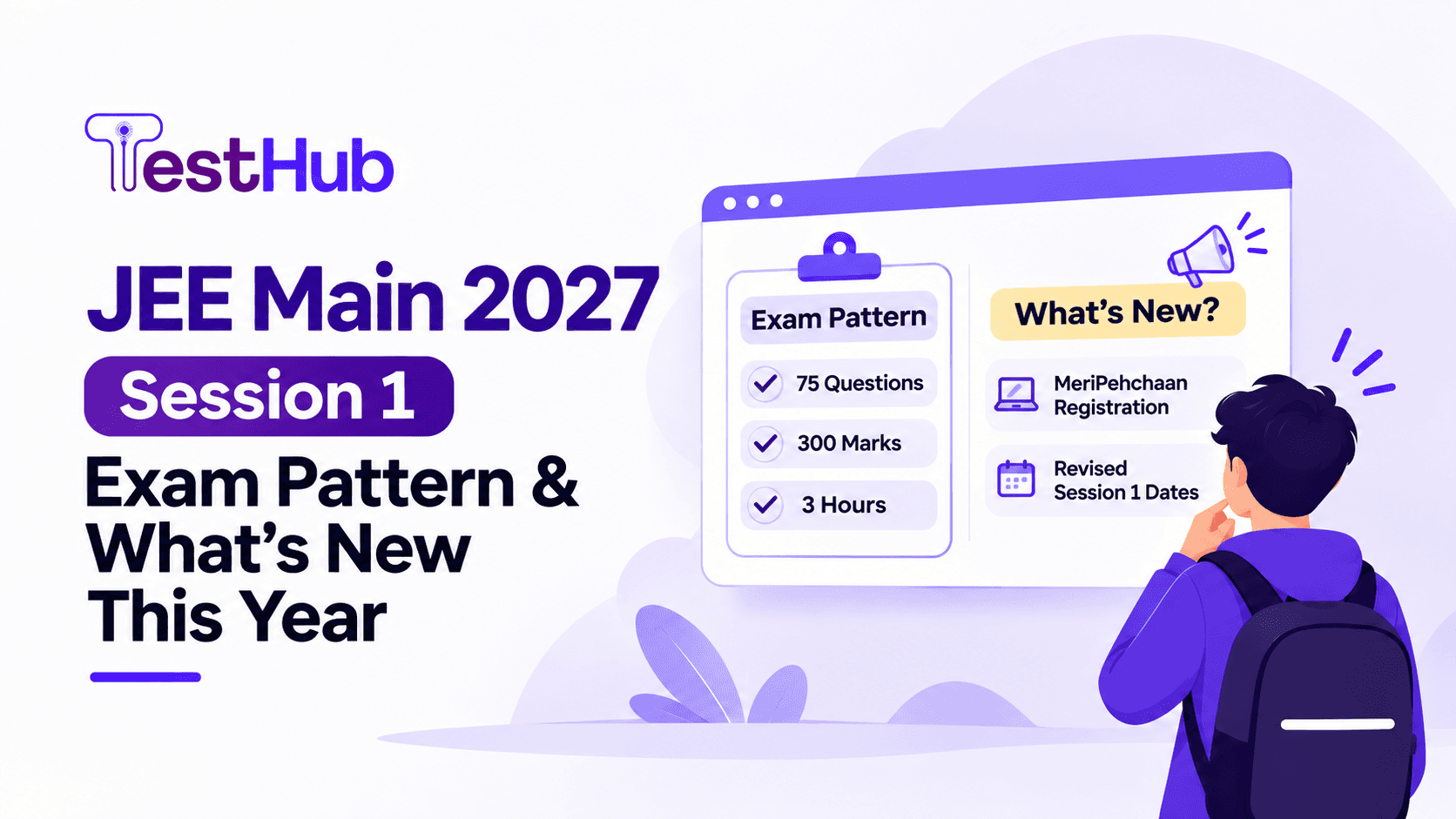
JEE Main 2027 Session 1 Exam Pattern & What's New This Year
JEE Main 2027 follows the same 75-question, 300-mark Paper 1 pattern as 2026, with no major changes to the exam structure. However, new MeriPehchaan-based registration requirements, revised Session 1 exam dates, and key application deadlines make it important for aspirants to stay updated.

29 Oct 2026 · TestHub Team
Preparation Companion: How TestHub Tracks Your Chapter-Wise Mastery
Most JEE aspirants track how much of the syllabus they've completed, but not how much they've actually mastered. TestHub's Preparation Companion turns real test and practice performance into a measurable readiness score, identifying weak chapters and recommending exactly what to focus on next. Combined with Custom Practice and mock tests, it helps you move from simply completing the syllabus to building genuine exam readiness.

21 Oct 2026 · TestHub Team
JEE Advanced Test Series 2027: Which One to Choose?
Choosing the best JEE Advanced Test Series 2027 depends on your preparation level, budget, and goals. Compare free mocks, JEE Main-focused plans, and combined Main + Advanced test series to find the right fit, with detailed solutions, performance analytics, and realistic rank predictions.

19 Oct 2026 · TestHub Team
JEE Main 2027 Registration: Dates, Fees & Application Form
Learn everything about JEE Main 2027 registration, including expected dates, eligibility criteria, required documents, application fees, and step-by-step form filling instructions. Prepare early and avoid common application mistakes.
7 Oct 2026 · TestHub Team
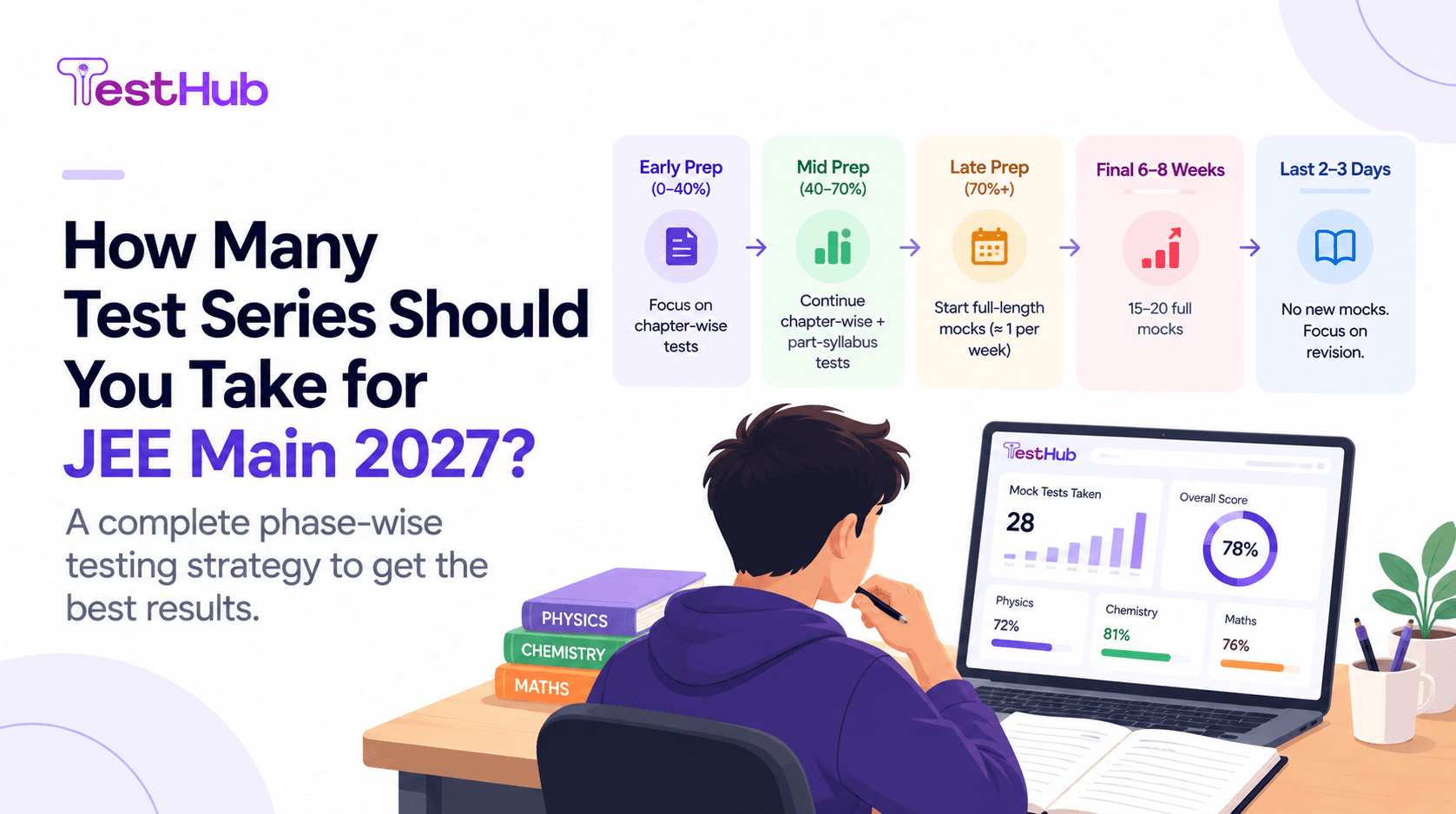
How Many Test Series Should You Take for JEE Main 2027
For most JEE Main 2027 aspirants, 20–40 full-length mock tests are a realistic target, concentrated in the final 3–4 months before the exam. But test count alone isn't enough—consistent analysis, mistake tracking, and a phase-wise testing strategy are what actually turn mock tests into score improvement.
7 Oct 2026 · TestHub Team
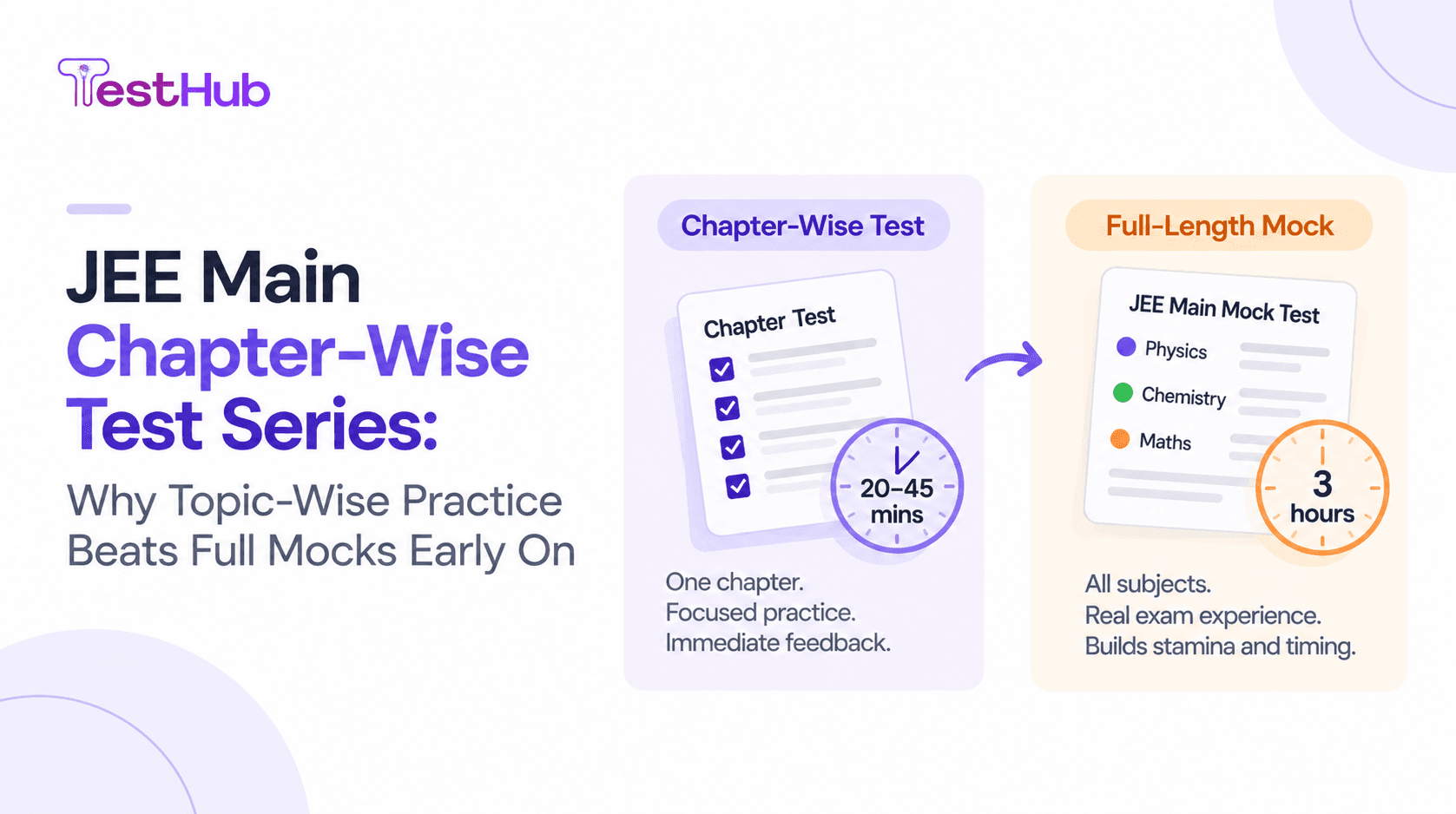
JEE Main Chapter-Wise Test Series: Why Topic-Wise Practice Beats Full Mocks Early On
Chapter-wise JEE Main tests are ideal early in preparation because they provide focused practice and immediate feedback without the pressure of a full-length mock. Learn when to use chapter-wise, subject-wise, and full-length tests to build your preparation progressively and improve your JEE Main performance.
