
Physics - Semiconductors Question with Solution | TestHub
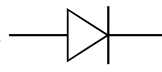
We studied ohm's law in the class. There are many devices that do not obey ohm's law. A very common and extremely useful device is a diode. A diode is an electronic device designed to conduct current in one direction and not in the other direction. In normal circuits, if we reverse the connection of a bulb, it still glows with the same brightness. But if a diode is reversed, the current drops to zero. The symbol for a diode is shown. The arrow points in the direction of conventional current allowed through the diode.
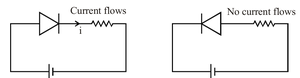
The graph compares current versus potential difference for a resistor and a silicon diode. The resistor obeys ohm's law and current can flow in either direction. A silicon diode starts conducting if there is a potential difference of across it or more. Above this value, it essentially behaves as a conductor. Below this threshold, it will not conduct current. The basic principle governing a diode can only be explained using quantum mechanics. Assume that once the diode starts conducting, it keeps conducting until the potential difference across it becomes negative.
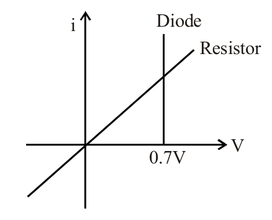
The point at which the two graphs intersect is given by
Options:
Answer:
Solution:
At the intersection:
Hence B.
