
Physics - Heat & Thermo Question with Solution | TestHub
Gay-Lussac was the first to carefully study the expansion of gases. The bulb A is filled with the gas to be studied and brought to 0°C by means of melting ice. By the stopcock E it is then shut off from the gas supply and connected with B which is completely filled with mercury up to the opening of the small tube at the top. If the gas in the bulb is at the same pressure as the outer air the mercury will stand in the open tube C at the same level as in B. The bulb A is then heated to any desired temperature, say to 90°C, and as the gas expands mercury is allowed to flow out of the stopcock at the bottom so that it is kept at the same level in B and C, thus maintaining the pressure constant. Part of the expanded air is in A at 90° and part in B at the temperature of the water bath which surrounds the tubes. The tube B is graduated, so that the exact volume of the expanded gas may be determined.
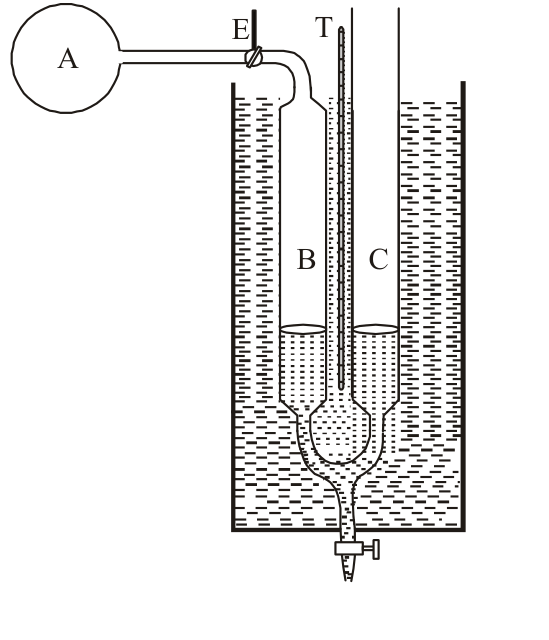
Regnault also was the first to make accurate measurements of the increase in pressure of a gas. The apparatus used is the same as that described above (figure) but when the bulb A is heated and the expanding gas begins to force down the mercury in B, more mercury is poured into C until the additional pressure again causes the mercury to exactly fill B. In this way the heated gas is kept confined in the bulb A, and its pressure is measured by the height of the mercury in C above that in B together with the height of the barometer.
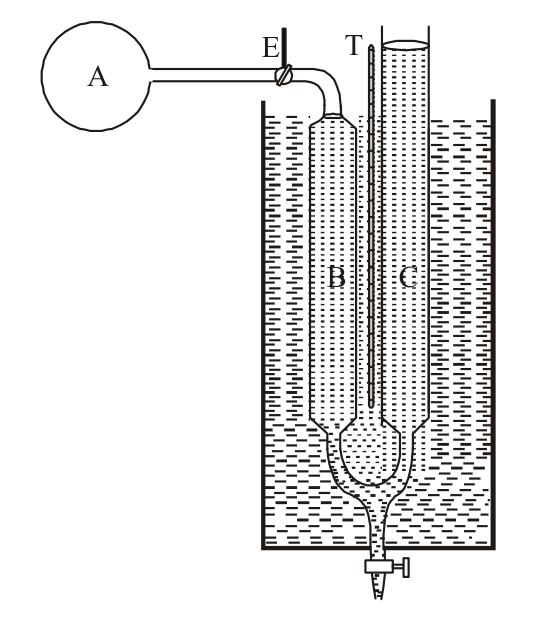
If Gay Lussac takes a tube and bulb which expands on heating (neglect the expansion of mercury), then
Options:
Answer:
Solution:
If the bulb and tube also expand, some of the expanded gas is accommodated in this expansion and the change in pressure is slightly less, so mercury removed is also lesser.
