
Physics - W.E.P. Question with Solution | TestHub
PhysicsW.E.P.Conservative force & potential energyMedium2 minQB
PhysicsMediuminteger
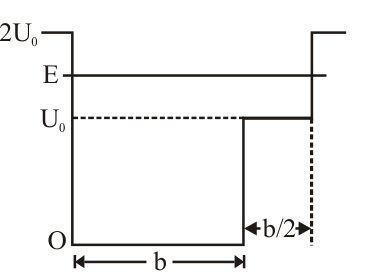
The potential energy of a particle of mass m as a function of its position along the x axis is as shown. (The discontinuous jumps in the value of U are not physically realistic but may be assumed to approximate a real situation.) The particle has a total mechanical energy E equal to . The period of motion of particle from origin O to is . Then
Answer:
6
Solution:
From O to b, U = 0 and KE = 3U0/2, so v1 = sqrt(3U0/m) and t1 = b sqrt(m/(3U0)). From b to 3b/2, U = U0 and KE = U0/2, so v2 = sqrt(U0/m) and t2 = (b/2) sqrt(m/U0). Total t = sqrt(mb^2/U0) (1/sqrt(3) + 1/2) = ((2 + sqrt(3))/2) sqrt(mb^2/(3U0)). Comparing with ((2 + sqrt(x))/2)(mb^2/(y U0))^(1/2) gives x = 3, y = 3, so x + y = 6.
Stream:JEESubject:PhysicsTopic:W.E.P.Subtopic:Conservative force & potential energy
⏱ 2mℹ️ Source: QB
Doubts & Discussion
Loading discussions...