
Physics - Modern Physics Question with Solution | TestHub
The idea that light can move matter is not new. Kepler suspected this 400 years ago when he noticed that the tail of a comet always points away from the sun. In the 1970s a Bell Labs scientist Ashkin aimed a parallel laser beam at micron sized transparent latex spheres suspended in water. The beam that Ashkin used was monochromatic with non-uniform intensity. The number of photons incident on one part of the latex sphere was different from the number of photons on the other part. This resulted in a transverse force (perpendicular to the axis) on the sphere due to the change in momentum of the photons. The force along the axis was caused by the change in momentum of photons along the axis. The spheres were seen to be drawn towards or away from the beam axis and then propelled along the beam away from the light source. Both forces were a result of radiation pressure.
Light can be viewed as a stream of photons which possess momentum. Any time it changes direction, it must exert a force. In all the cases, we will neglect partial reflection and absorption.
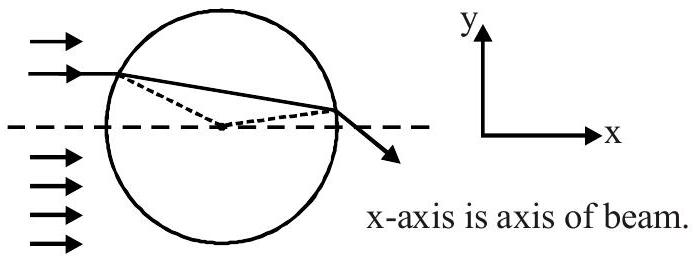
In which of the following cases does the incident light exert no net force on a refracting or reflecting body?
Options:(select one or more)
Answer:
Solution:
Force is opposite to the rate of change of light momentum.
For the symmetric source at twice the focal distance, the total incoming and outgoing momentum balance.
A parallel slab leaves the emerging ray direction unchanged.
The biprism and the reflecting mirror change net momentum; only A and B give zero net force in this ideal model.
