
Chemistry - Ideal Gas Question with Solution | TestHub
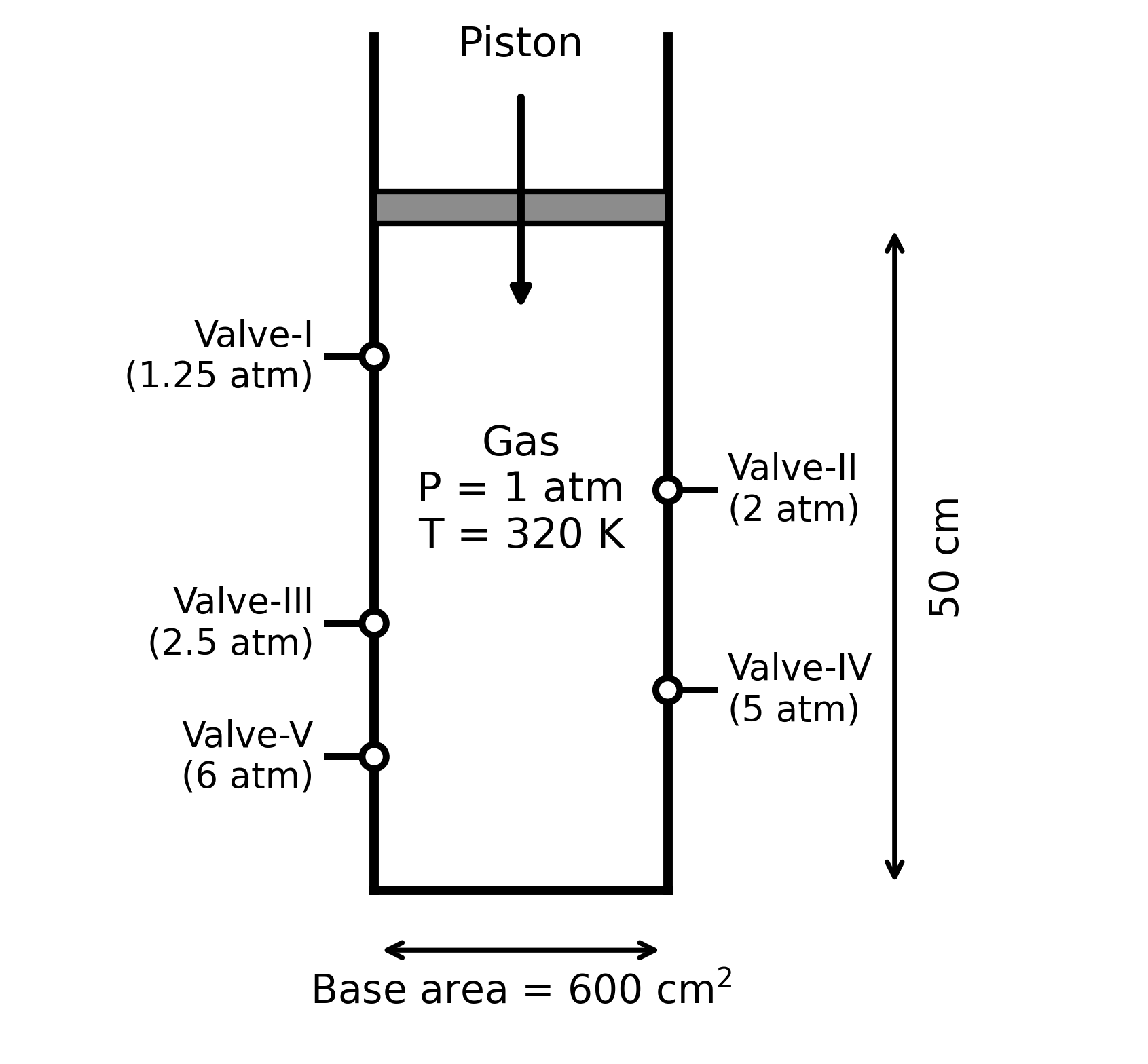
A cylindrical container (base area = 600 cm²) is fitted with a frictionless, massless piston and carries five valves - I, II, III, IV and V - on its side walls. The distances of the valves from the initial position of the piston are 10, 20, 30, 35 and 40 cm, respectively, and the initial height of the piston above the base is 50 cm. The valves open automatically if the pressure exceeds 1.25, 2.0, 2.5, 5.0 and 6.0 atm, respectively. Initially the gas is at P = 1 atm and T = 320 K and the system is in equilibrium. The piston is now pushed down slowly and isothermally. Neglect the volumes of the valve connectors.
During this slow isothermal compression, which of the following changes for the gas molecules?
Options:(select one or more)
Answer:
Solution:
Because the compression is isothermal, the average molecular speed and hence the average momentum per molecule are unchanged. Compression increases the number density, so molecules collide more frequently. Only the collision frequency changes. Hence (a).
