
Chemistry - CHEMICAL BONDING Question with Solution | TestHub
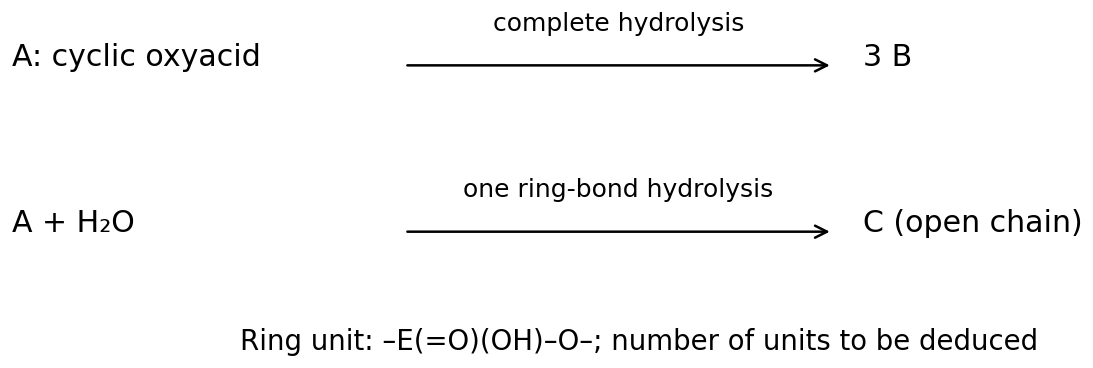
An element E has three singly occupied 3p orbitals in its ground-state atom and a filled 3s subshell. Its cyclic oxyacid A has empirical formula HEO₃ and molecular mass 240 g mol⁻¹ (H=1, E=31, O=16). Each E bears one =O and one OH, and the ring alternates E and O. On complete hydrolysis it gives B only. On controlled hydrolysis of one ring P–O bond it gives one open-chain molecule C without changing phosphorus oxidation states. Which assignment is correct?
Options:
Answer:
Solution:
The atomic configuration identifies E as phosphorus; the empirical-unit mass is 80, so240/80=3 units form the ring. The ring is trimetaphosphoric acid H₃P₃O₉, with three OH groups. One hydrolytic ring opening adds H₂O, cleaves one P–O linkage and creates two new OH ends, yielding H₅P₃O₁₀ with five ionizable OH groups. Complete hydrolysis adds three waters overall and gives three H₃PO₄ molecules. Each phosphorus remains +5 throughout; phosphorous and hypophosphorous acids are excluded.
