
Physics - W.E.P. Question with Solution | TestHub
A small rubber eraser is placed at one edge of a quarter-circle-shaped track of radius that lies in a vertical plane and has its axis of symmetry vertical (see figure); it is then released. The coefficient of friction between the eraser and the surface of the track is . Will the eraser reach the lowest point of the track?
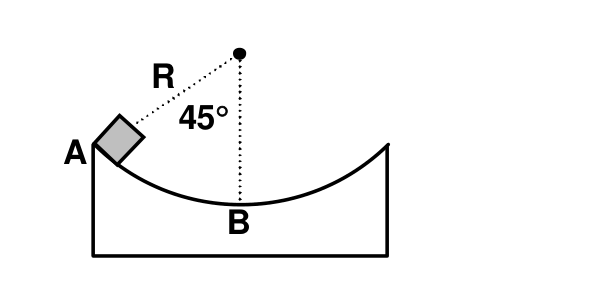
Options:(select one or more)
Answer:
Solution:
Underestimate the work done against friction, and compare it with the initial gravitational potential energy of the eraser.
First of all, investigate whether the rubber eraser will start moving at all. It will do so provided that , i.e. . This is clearly the case, since . So the eraser will start moving. (If the eraser would not even begin to slide, so (D) is correct.)
The determination of how the normal force acting on the eraser varies with position is difficult, but it is certain that the frictional force is always larger than its initial value of . This is because, after the initial release, the angle with the horizontal made by the slope on which the eraser moves decreases, and, in addition, the track has to provide a centripetal force for the moving eraser. The path to reach the lowest point of the track would be one-eighth of a circle, with a length of . The work done against friction can now be underestimated by taking the normal force as if it always had its initial value:
so (B) is correct and (A) is false. The gravitational potential energy difference between the initial position and the bottom of the track is . It can be seen that , i.e. the work to be done against friction is clearly larger than what can be provided by the gravitational potential energy. So the rubber eraser cannot reach the very lowest part of the track, and (C) is correct.
