
Physics - SHM Question with Solution | TestHub
A particle of massis attached to one end of a massless spring of force constant, lying on a frictionless horizontal plane. The other end of the spring is fixed. The particle starts moving horizontally from its equilibrium position at timewith an initial velocity. When the speed of the particle is, it collides elastically with a rigid wall. After this collision :
Options:(select one or more)
Answer:
Solution:
Let the equation of be,
Here, is the position of the particle at any time
is the amplitude of the
is the Angular frequency of
So, equation for the velocity will be,
Now, during collision speed of particle was
and time be
So, Substituting the values in equation of velocity we get,
As the energy will be conserve, so it will take same time to reach Equlibrium position first time,,
Time at which particle crosses equlibrium first time,
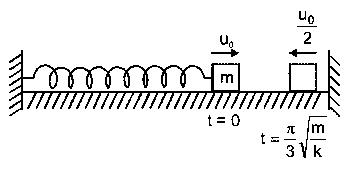
Now, for the second half of the Oscillation, particle dosen't undergo collision that's why it will have normal Time period,
Time taken for the particle to go to the left will be , as it was in the general case.
Here, is time period of .
So to come back to Equlibrium position for second time time required will be .
Now,
So total time required will be,
Here, is the angular frequency,,
Substituting it above we get,