
Physics - Heat & Thermo Question with Solution | TestHub
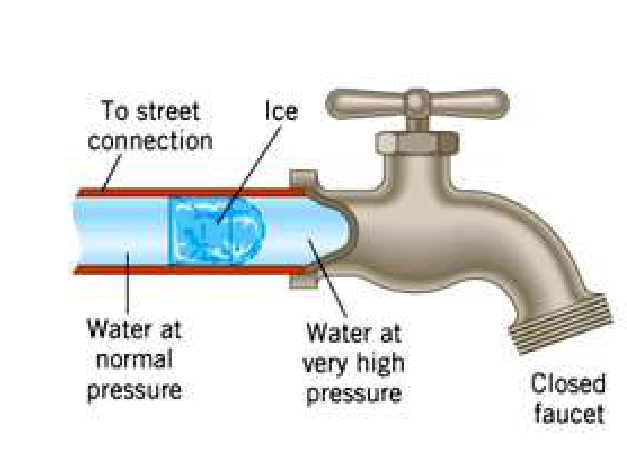
The fact that the density of ice is smaller than the density of water has an important consequence for homeowners, who have to contend with the possibility of bursting water pipes during severe winters. Water often freezes in a section of pipe exposed to unusually cold temperatures. The ice can form an immovable plug that prevents the subsequent flow of water, as Figure illustrates. When water (larger density) turns to ice (smaller density), its volume expands by 10%. When ice forms on the right side of the plug, the expanding ice pushes liquid to the right. But it has nowhere to go if the faucet is closed. As ice continues to form and expand, the water pressure between the plug and faucet rises. The bulk modulus of ice is much more than that of the water. So water gets compressed. Even a small increase in the amount of ice produces a large increase in the pressure. Therefore, the pipe can burst at any point where it is structurally weak. There is a simple way to prevent pipes from bursting. Simply open the faucet, so it drips a little. The excessive pressure will be relieved.
Which of the following phenomena can be explained on the basis of the principles in the passage?
Options:
Answer:
Solution:
Freezing water expands, as described in the passage.
In a sealed bottle this raises pressure and may burst the bottle.
