
Physics - Geometrical Optics Question with Solution | TestHub
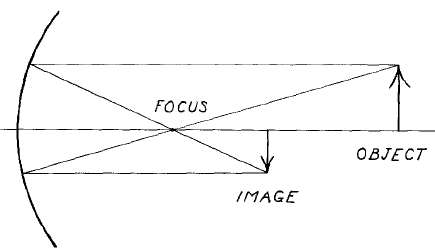
An optical puzzle, easy to construct and demonstrate, is the following. A rectangular strip of polished metal foil is bent into the shape of an arc, parallel to the long dimension (figure-1). If one looks at one's reflection in the concave surface of this arc, the image will appear inverted. But if the strip is now slowly rotated through about the line of sight (keeping the reflection in view all the while) the image will do a peculiar thing. It will flip over and turn right side up. That is, a rotation of the reflector will result in an image rotation of a full . The bent strip forms (approximately) a segment of a right circular cylinder, which has a fairly well defined focal length. A tall skinny object more than one focal length away, parallel to the long dimension of the strip (perpendicular to the cylinder axis), forms an inverted image (figure-2). But once the strip is rotated through -- the object distance remaining fixed -- the object lies inside the focal length for the curved section, so it appears non-inverted, i.e., right side up. In this second case the surface acts like a plane mirror, but not in every respect: if the man lifts his right hand, the image appears to lift its right hand as well, because in one section the mirror is plane and in the other it is curved.
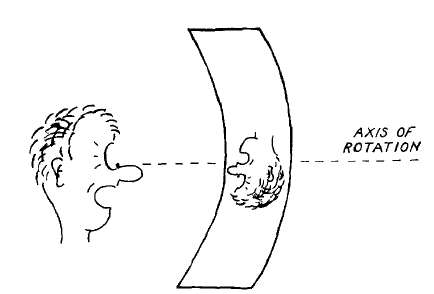
The man is situated at a distance of 100 cm from the reflecting surface shown in figure-1. What should be the radius of curvature for the effect shown to occur?
Options:
Answer:
Solution:
For the effect to take place, the man should be beyond the centre of curvature.
