
Physics - Elasticity Question with Solution | TestHub
When a force acts along a rod of length and cross-sectional area , its stress is . Strain is the fractional length change . Young's modulus is the ratio of stress to strain. The table lists average moduli.
Material | Average |
|---|---|
Bone | |
Rectus abdominus muscle | |
Resilin | |
Rubber | |
Common cartoid artery | |
Steel | |
Tendon |
Rigid solids such as bone have moduli of order and can lengthen by no more than 1% without breaking. Stretching changes atomic distances, creating a restoring force through changes in internal energy. Soft biological tissues differ from rigid solids. These soft materials are elastomers: long molecular chains joined by sulfur cross-links. Stretching elongates the chains until they are almost parallel, as shown. Elastomers may expand to three times their original length.
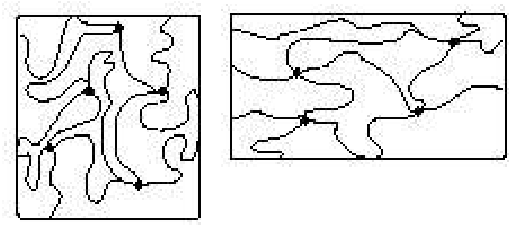
Unstretched (left); stretched (right).
Here is density, is the universal gas constant (), is absolute temperature and is the mean molecular weight between cross-links. Unlike rigid solids, an elastomer's modulus varies with applied stress between and .
Which of the following stress-strain graphs is consistent with the information presented in the table?
Options:
Answer:
Solution:
.
Stress-strain slope equals Young's modulus.
Graph A shows steel with the steeper slope.
