
Physics - Current Electricity Question with Solution | TestHub
Two cylindrical conductors with equal cross-sections and different resistivitiesandare put end to end. Find the charge at the boundary of the conductors if a currentflows from conductorto conductor.
Options:
Answer:
Solution:
According to ohm's law,
The problem is solved by the following steps:
Step I:Determine the electric field in both conductors.
The current density in the first conductor is
(Along the length of the conductor)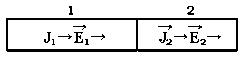
Similarly,(along the length of the conductor)
The electric field inside the first conductor is
(along the length of the conductor)
Step II:Consider small cylindrical region near the boundary and apply Gauss's law:
We consider a small cylindrical region at the boundary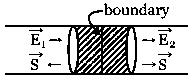
The area of the cylindrical region is
The net flux through this region is
According to Gauss's Law,
∴ The surface charge density at the boundary is
Putting the value of E1 and E2, we get
or
or
Charge at the boundary
