
Chemistry - STRUCTURAL ISOMERISM Question with Solution | TestHub
Treatment of this ketone with basic leads to rapid replacement of four hydrogen atoms by deuterium. Then, more slowly, one more nonaromatic hydrogen is replaced, while the remaining vinylic hydrogen is never replaced. How is this possible?
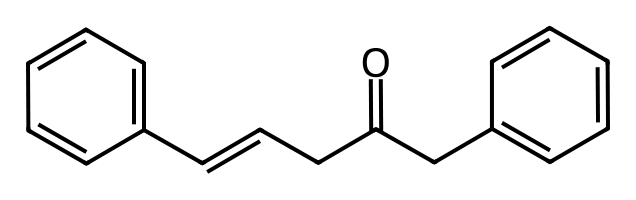
(the H on the vinylic carbon next to the alpha is the marked one)
Options:
Answer:
Solution:
The ketone is . The four alpha protons - the benzylic (2H) and the alpha next to the double bond (2H) - exchange rapidly by simple enolization and reversion; repetition replaces all four H by D. Enolization at the next to the double bond then gives a conjugated dienol, system, delocalised over O-C=C-C=C; through this dienol the remote vinylic hydrogen on the carbon bearing the phenyl group (the gamma position) exchanges more slowly. The marked hydrogen - the vinylic H on the carbon directly adjacent to the alpha (the beta position of the dienol) - is never removed by any enolization pathway, so it alone is not replaced.
