
Chemistry - STEREO ISOMERISM Question with Solution | TestHub
Match the following :
(I) 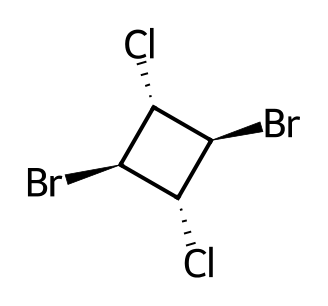 (II)
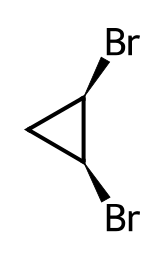
(III)  (IV)
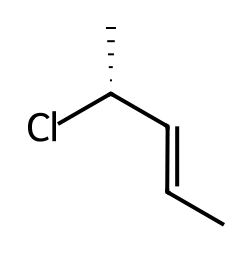
Column I | Column II |
|---|---|
(A) Plane of symmetry | (P) I |
(B) Centre of symmetry | (Q) II |
(C) Show geometrical isomerism | (R) III |
(D) Show optical isomerism | (S) IV |
Options:
Answer:
Solution:
Ans. A Q, R; B P; C P, Q, S; D S.
I (r-1,c-2-dibromo-t-3,c-4-dichlorocyclobutane with the Br atoms anti and the Cl atoms anti): inversion through the ring centre maps Br onto Br and Cl onto Cl (up onto down), so a centre of symmetry is present; cis/trans (diastereomeric) forms exist, so it shows geometrical isomerism : P, and C P.
II (cis-1,2-dibromocyclopropane): a plane of symmetry passes through C3 and the midpoint of the C1-C2 bond (meso); a trans diastereomer exists : Q, and C Q.
III (1,1-dibromo-2,2-dichlorocyclopropane): a plane of symmetry through C3 bisects the molecule; no stereoisomers exist : R.
IV (4-chloropent-2-ene): the double bond carries two different groups on each carbon (E/Z geometrical isomerism) and C4 is a stereocentre, so the molecule is chiral (optical isomerism) with no plane or centre of symmetry : S, and C S.
Hence A Q, R; B P; C P, Q, S; D S.
