
Chemistry - STEREO ISOMERISM Question with Solution | TestHub
Options:
Answer:
Solution:
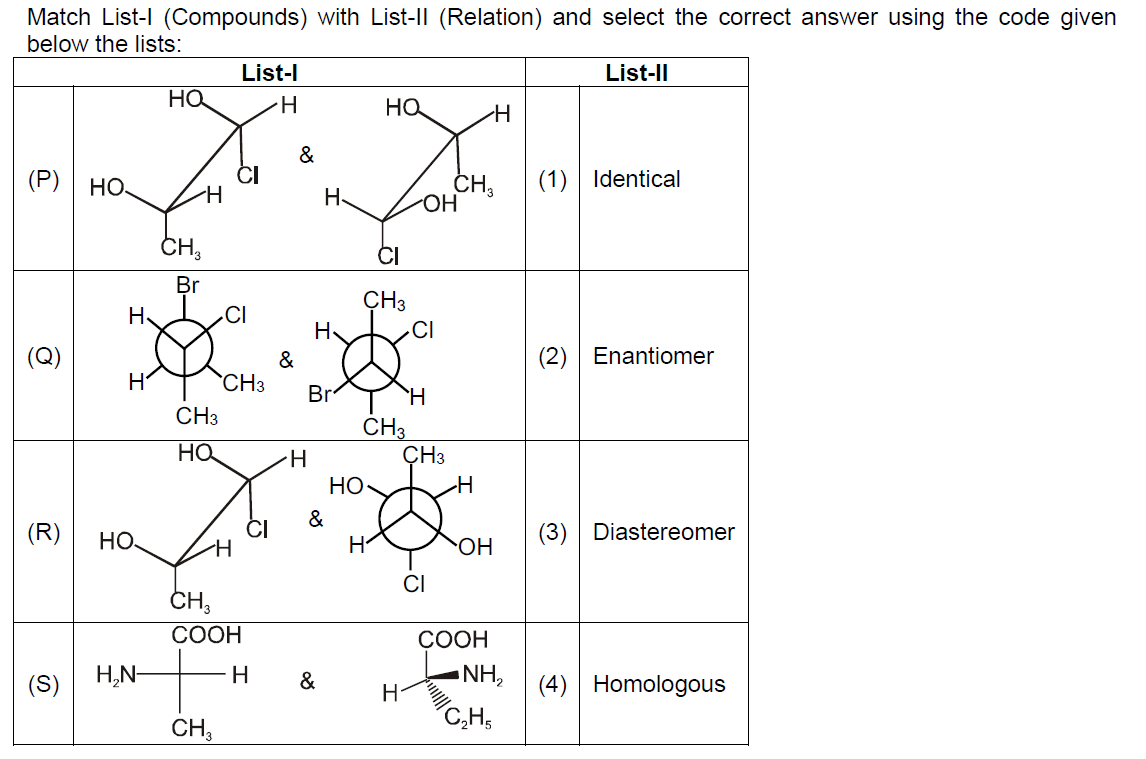
Pair (P): Identical
Structure 1: A sawhorse projection of a chlorodiol.
Structure 2: Another sawhorse projection of the same molecule.
Relationship: If you rotate Structure 2 by in the plane of the paper, it superimposes perfectly onto Structure 1.
The Cl group (bottom-left in P-2) rotates to become the Cl group (bottom-right in P-1).The CH group rotates to the other side similarly.The stereochemistry is preserved.
Pair (Q): Enantiomers
Structure 1: Newman projection of 2-bromo-3-chlorobutane.Front Carbon (with Cl): Cl is on the right, H on the left.Back Carbon (with Br): Br is up.
Structure 2: Newman projection of the same molecule.Front Carbon: Cl is on the left, H on the right. (Configuration is inverted compared to Structure 1).Back Carbon: Br is on the left. (Configuration is inverted compared to Structure 1).
Relationship: Both chiral centers are inverted (R,R S,S or R,S S,R). They are non-superimposable mirror images of each other.
Pair (R): Diastereomers
Structure 1: Sawhorse projection. Let's analyze the configuration. The substituents on the two carbons are arranged in a specific way (e.g., OH groups are syn-clinal).
Structure 2: Newman projection. By converting Structure 1 to a Newman projection or determining the R/S configuration:In Structure 1, let's say the configuration is .In Structure 2, analysis shows the configuration at one carbon remains the same while the other is inverted (e.g., ).
Relationship: Stereoisomers that are not mirror images of each other (different configuration at one or more, but not all, chiral centers) are diastereomers.
Pair (S): Homologous
Structure 1: . This is Alanine (-amino acid with 3 carbons).
Structure 2: . This is -Aminobutyric acid (-amino acid with 4 carbons).
Relationship: They possess the same functional groups and general formula but differ by a unit. Members of such a series are called homologues.