
Chemistry - Halogen Derivative Question with Solution | TestHub
Identify number of substrate those can give and reaction both.




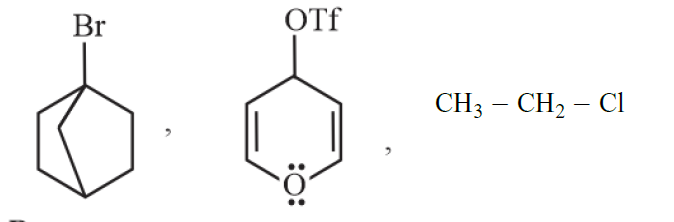


,
Answer:
Solution:
(1) Benzyl bromide (Ph–CH₂–Br) — primary but benzylic: carbocation is resonance-stabilized (Sɴ1) and low steric hindrance allows Sɴ2.
(3) Isopropyl bromide (sec-alkyl) — a normal secondary center: Sɴ2 with strong nucleophiles, Sɴ1 under weak-nucleophile/solvolysis conditions.
(4) Benzylic secondary (Ph–CH(R)–Br) — secondary benzylic; benzylic stabilization allows Sɴ1 while secondary geometry still permits Sɴ2.
(5) α-Alkoxy primary chloride (CH₃O–CH₂–CH₂–Cl) — adjacent oxygen stabilizes the cation (makes Sɴ1 feasible) while primary carbon remains accessible to Sɴ2.
(10) Cyclohexyl bromide (secondary cycloalkyl) — secondary center: Sɴ2 possible with good nucleophiles; Sɴ1 possible in strongly ionizing solvents (slower than benzylic/tertiary but feasible).
(11) Cyclopentylmethyl chloride (—CH₂–Cl on a cyclopentane side chain) — the primary benzylic-like/allylic-like character from the ring (hyperconjugation/strain relief) gives enough stabilization for Sɴ1 in polar media while still being a good Sɴ2 substrate.