Chemistry - Halogen Derivative Question with Solution | TestHub
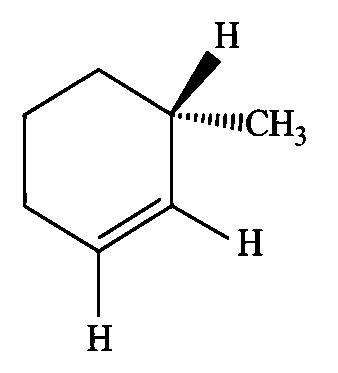
Indicate the major product of the following reaction:
Options:
Answer:
Solution:
The reaction of a secondary alkyl halide with a strong base () proceeds via an E2 elimination mechanism.
E2 elimination in a cyclohexane ring requires an anti-periplanar (trans-diaxial) arrangement of the leaving group and the -atom being abstracted.
In the reactant, the -Br group is on a wedge (up). For anti-periplanar elimination, the -atom must be on a dash (down).
At the upper -carbon, the - group is on a dash, but it cannot be eliminated. The -H atom is on a wedge, so it is syn-periplanar and cannot be eliminated.
At the lower -carbon, the -D atom is on a dash, making it anti-periplanar to the -Br group. The -H atom is on a wedge.
Therefore, the base abstracts the anti-periplanar -D atom, leading to the elimination of DBr and the formation of a double bond at the lower position.
The resulting product retains the -H atom on the newly formed vinylic carbon and the original stereochemistry at the upper allylic carbon, which corresponds to option (C).
Answer: