Chemistry - Halogen Derivative Question with Solution | TestHub

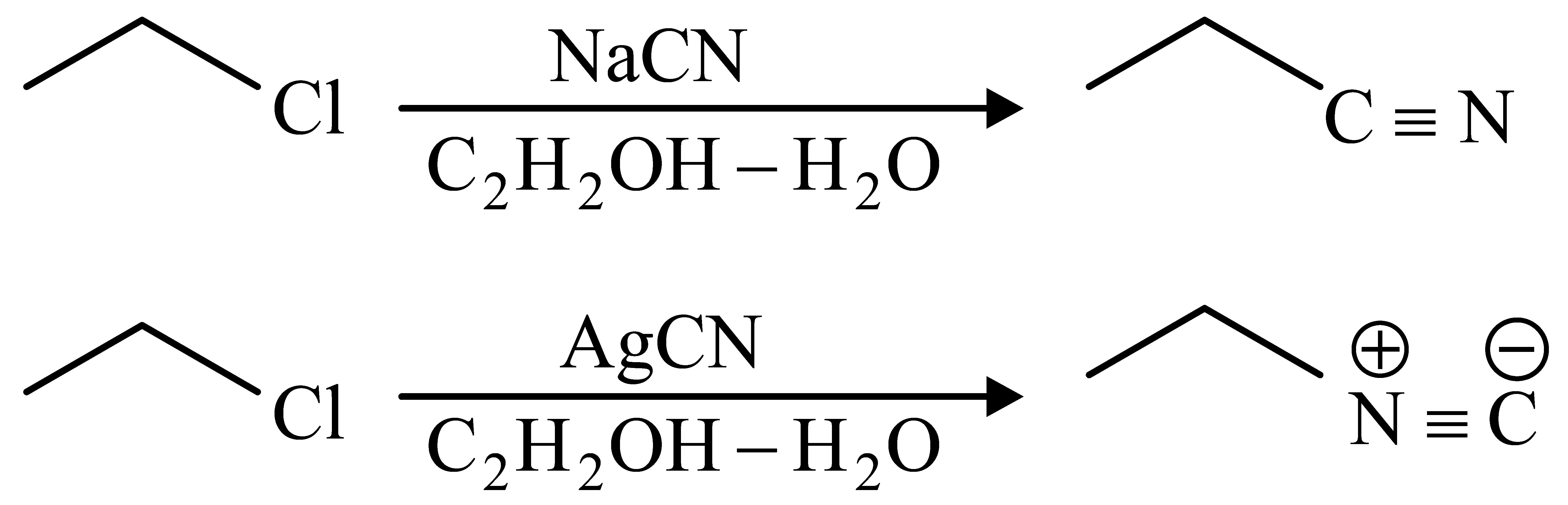
Considering the above reactions, the compound '' and compound '' respectively are
Options:
Answer:
Solution:
Groups like cyanides and nitrites possess two nucleophilic centres and are called ambident nucleophiles. Actually cyanide group is a hybrid of two contributing structures and therefore can act as a nucleophile in two different ways , i.e., linking through carbon atom resulting in alkyl cyanides and through nitrogen atom leading to isocyanides.
KCN is predominantly ionic and provides cyanide ions in solution. Although both carbon and nitrogen atoms are in a position to donate electron pairs, the attack takes place mainly through carbon atom and not through nitrogen atom since C—C bond is more stable than C—N bond. However, AgCN is mainly covalent in nature and nitrogen is free to donate electron pair forming isocyanide as the main product.