Chemistry - Electrochemistry Question with Solution | TestHub
An aqueous solution of X is added slowly to an aqueous solution of Y as shown in List I. The variation in conductivity of these reactions is given in List II. Match List I with List II and select the correct using answer the code given below the lists :
| List I | List II | ||
| a. | p. | Conductivity decreases and then increases | |
| b. | q. | Conductivity decreases and then does not change much | |
| c. | r. | Conductivity increases and then does not change much | |
| d. | s. | Conductivity does not change much and then increases |
Options:
Answer:
Solution:
p) (C2H5)3N added to CH3COOH
(C2H5)3NH+and CH3COO-ions generated in solution, conductivity increases & then remains constant as (C2H5)3N is not dissociated when in excess.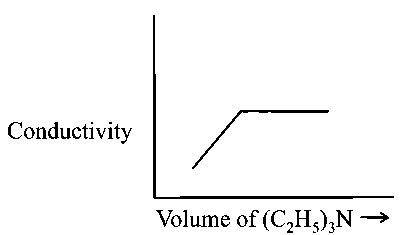
q) KIeqadded to AgNO3
ions replaced by
conductivity does not change till complete precipitation but later on with additional KI(aq)added conductivity will increase.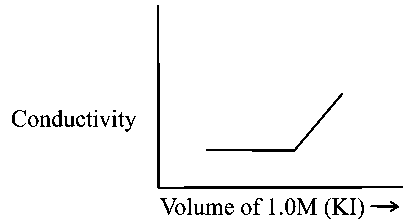
r) On addition of acetic acid to KOH. KOH fully dissociated replaced by
The net result is replacement of OH-by CH3COO-ions whose ionic mobility is less so conductivity will decrease first and then will not change much due to addition of CH3COOH(in excess) which will not be dissociated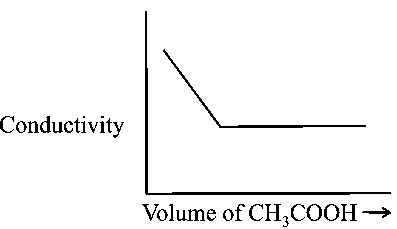
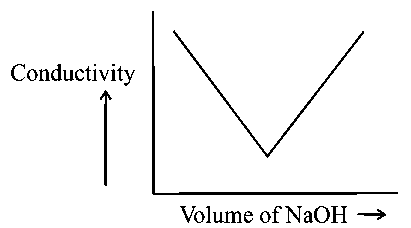
s) On addition of NaOH to HI
there will be replacement of H+by Na+whose mobility is less than H+which means conductivity will decrease first & then due to adding NaOH which is a strong electrolyte which fully dissociates, so conductivity will increase.