
Chemistry - CHEMICAL BONDING Question with Solution | TestHub
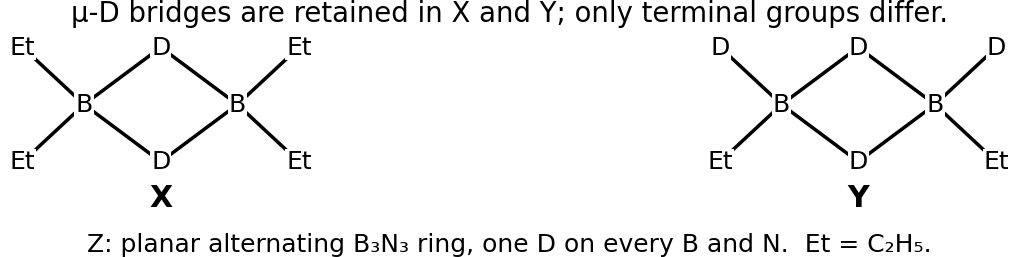
The scheme starts with the bridge skeleton of a diborane isotopologue B₂D₆. In X, each terminal D has been replaced by ethyl, but the two μ-D bridges remain; X is therefore (C₂H₅)₂B(μ-D)₂B(C₂H₅)₂. In Y, one terminal D on each B remains and one terminal ethyl group is present on each B. Z is a planar alternating B₃N₃ ring with B–D and N–D bonds. Ignore C–H bond counts when explicitly instructed. Which statements are correct?
Options:(select one or more)
Answer:
Solution:
The two μ-D atoms give two 3c–2e bridges in both X and Y. X has four terminal ethyl groups, hence four B–C σ bonds when internal ethyl bonds are excluded. Y has one terminal D and one terminal ethyl on each B: two, not six, B–D bonds in all. In Z, planar B/N centres can supply perpendicular p orbitals for π delocalisation. Treating a μ-D as an ordinary terminal bond would give incorrect electron and bond counts.
