
Chemistry - CHEMICAL BONDING Question with Solution | TestHub
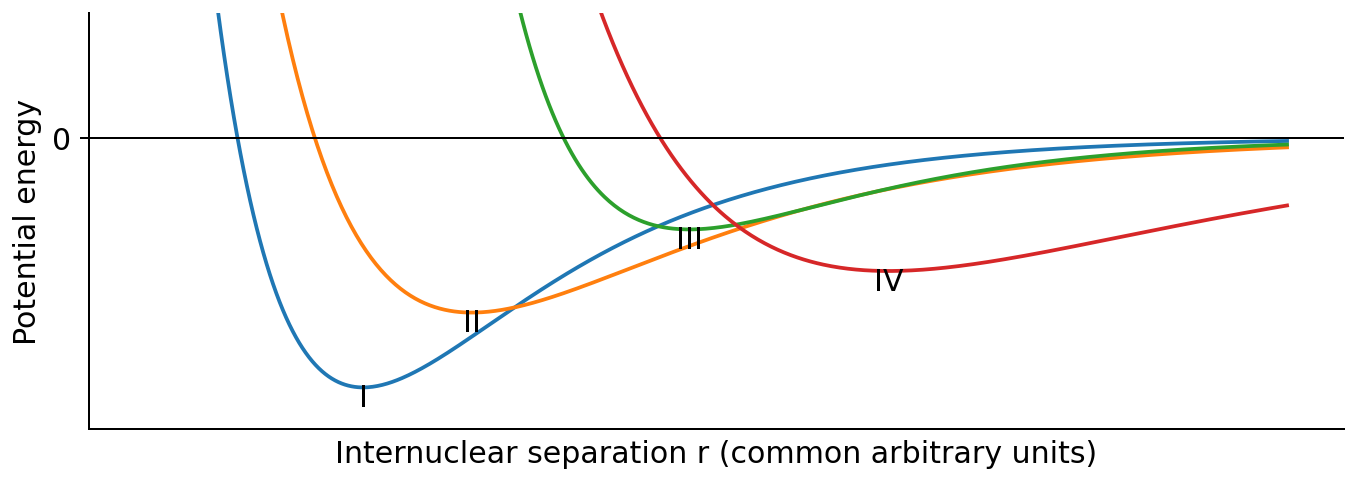
Four potential-energy curves are plotted on a common absolute energy scale, with each separated-atom limit set to zero. All correspond to bound diatomic species. Treat each minimum's horizontal position as equilibrium length and its depth as dissociation energy. Which conclusion is consistent with BOTH the figure and the elementary MO order for a 14-electron N₂-like species and its one-electron cation? Neglect vibrational zero-point energies.
Options:
Answer:
Solution:
Ionization of the 14-electron N₂-like species removes a bonding electron, lowering bond order from 3 to 2.5. The usual qualitative expectation is a longer weaker bond for the cation, consistent with I (shorter/deeper) and II (longer/shallower). Dissociation energy is the vertical depth, not the minimum's horizontal position. The force constant is the curvature at the minimum, not merely the depth or equilibrium distance; a depth comparison alone cannot rank it. Thus only A combines correct graph interpretation with the MO change.
