
Chemistry - Atomic Structure Question with Solution | TestHub
ChemistryAtomic StructureSchrödinger's EquationHard2 minPYQ_2017
ChemistryHardmatching list
The wave function, is a mathematical function whose value depends upon spherical polar coordinates of the electron and characterized by the quantum numbers and . Here is the distance from the nucleus, is colatitude and is azimuth. In the mathematical functions given in the Table, is the atomic number and is Bohr radius
| Column 1 | Column 2 | Column 3 |
| (I) orbital | (i) | (P)  |
| (II) orbital | (ii) One radial node | (Q) Probability density at the nucleus . |
| (III) orbital | (iii) | (R) Probability density is maximum at the nucleus. |
| (IV) orbital | (iv) -plane is a nodal plane | (S) Energy needed to excite an electron from state to state is times the energy needed to excite are electron from state to state. |
For the given orbital in column 1, the only correct combination for any hydrogen-like species is
Options:
Answer:
D
Solution:
incorrect, because, has no nodal plane.
correct, because orbital has radial node.
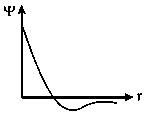
incorrect, because probability density for at nucleus is zero.
incorrect, because orbital has no radial node.
Stream:JEE_ADVSubject:ChemistryTopic:Atomic StructureSubtopic:Schrödinger's Equation
⏱ 2mℹ️ Source: PYQ_2017
Doubts & Discussion
Loading discussions...