Chemistry - ALCOHOL & ETHER Question with Solution | TestHub
The major products and in the following reaction are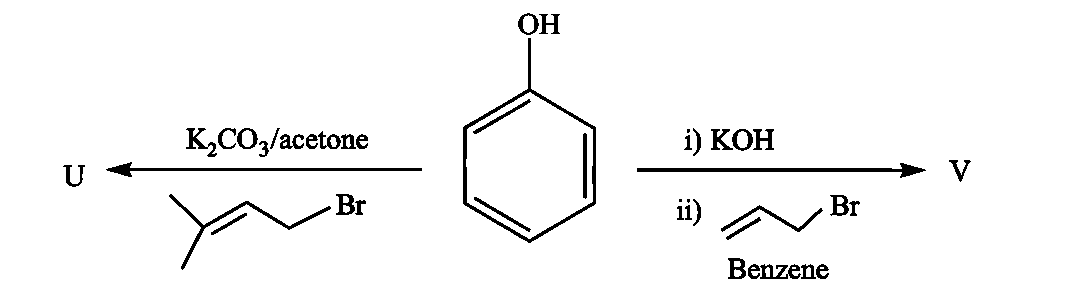
Options:
Answer:
Solution:
The given reactions involve the alkylation of phenol under different solvent conditions, which dictate whether O-alkylation or C-alkylation occurs.
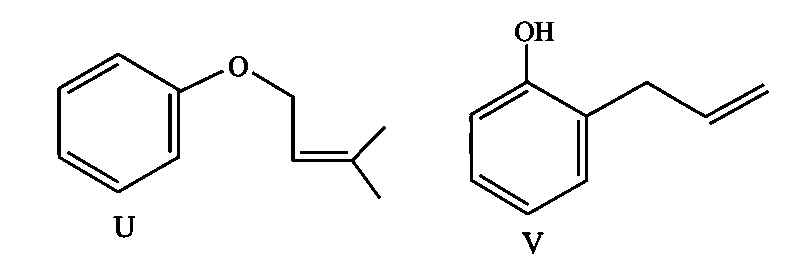
In the first reaction to form U, phenol reacts with 1-bromo-3-methylbut-2-ene in the presence of and acetone. acts as a base to form the phenoxide ion. Acetone is a polar aprotic solvent. In polar aprotic solvents, the phenoxide ion is weakly solvated and exists as a relatively free anion. Because oxygen is more electronegative and a harder nucleophilic center than carbon, it preferentially attacks the alkyl halide via an mechanism. This leads to O-alkylation, forming an ether. Therefore, U is phenyl 3-methylbut-2-enyl ether.
In the second reaction to form V, phenol first reacts with KOH to form potassium phenoxide. This salt is then reacted with allyl bromide in benzene. Benzene is a non-polar solvent. In non-polar solvents, the potassium phenoxide exists as a tight ion pair. The potassium cation coordinates strongly with the oxygen atom, sterically hindering it and reducing its nucleophilicity. Consequently, the electrophilic attack occurs preferentially at the less hindered ortho-carbon of the aromatic ring, leading to C-alkylation. Therefore, V is 2-allylphenol.
Comparing these products with the given options, Option (C) correctly shows U as the O-alkylated product and V as the C-alkylated product.
Answer: